
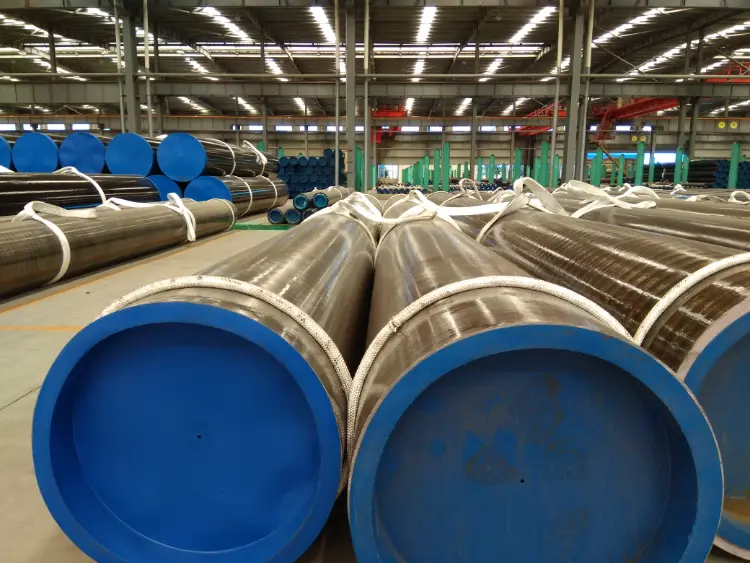
10# Carbon Steel Seamless Pipe (GB/T 8162)
10# Carbon Steel Seamless Pipe (GB/T 8162): Chemical, Mechanical & Equivalent Grades Guide
Complete technical data sheet for 10# carbon structural steel seamless pipe per GB/T 8162, including chemical composition, mechanical and thermal properties, international equivalents, and applications.
Hot rolling, cold drawing, heat treatment (normalizing, annealing), welding, bending, cutting, machining.
- Phone : +8618037372205
- Email : [email protected]
- WhatsApp: Contact via Whtsapp
- WeChat: +8618037372205
10# Carbon Steel Seamless Pipe Introduction
10# steel is a low-carbon structural steel grade specified in China's GB/T 8162 standard for seamless steel tubes used in general structures and automotive applications. It exhibits good plasticity, toughness, and weldability, making it suitable for cold forming and bending operations. With a carbon content of 0.07–0.13%, it offers a balance between strength and ductility. The tubes can be supplied in hot-rolled or cold-drawn conditions, often with heat treatment to meet specific mechanical requirements. Its excellent machinability and surface finish potential extend its use to furniture, bicycle frames, and hydraulic cylinders. International counterparts include AISI 1010, JIS S10C, and EN C10E (1.1121).
10# Carbon Steel Seamless Pipe Chemical Composition
Chemical composition according to GB/T 8162-2008 heat analysis for 10# steel seamless tubes. Elements are controlled to ensure good weldability, formability, and basic mechanical strength. Residual elements are minimized to avoid adverse effects on surface quality and performance.
| Chemical Element | Standard Value (wt%) | Remarks |
|---|---|---|
| Carbon (C) | 0.07–0.13 | Core strengthening element |
| Silicon (Si) | 0.17–0.37 | Deoxidizer; improves strength |
| Manganese (Mn) | 0.35–0.65 | Contributes to strength and hardenability |
| Phosphorus (P) | ≤0.035 | Impurity; kept low for ductility |
| Sulfur (S) | ≤0.035 | Impurity; kept low to avoid hot shortness |
| Chromium (Cr) | ≤0.15 | Residual element; not intentionally added |
| Nickel (Ni) | ≤0.30 | Residual element |
| Copper (Cu) | ≤0.20 | Residual element |
10# Carbon Steel Seamless Pipe Thermal and Electrical Physical Properties
The data below are typical for low-carbon steel (0.1% C) at room temperature unless otherwise noted. These values are not part of GB/T 8162 but are essential for design and thermal calculations. Density, elastic moduli, and expansion coefficients are consistent for 10# grade.
| Property Item | Standard Value | Unit | Test Condition |
|---|---|---|---|
| Density (ρ) | 7.85 | g/cm³ | 20 °C |
| Elastic modulus (E) | 206 | GPa | 20 °C |
| Shear modulus (G) | 79.3 | GPa | 20 °C |
| Poisson's ratio (ν) | 0.30 | - | 20 °C |
| Thermal expansion (α) | 10.6 × 10⁻⁶ | 1/°C | 20–100 °C |
| Thermal expansion (α) | 11.7 × 10⁻⁶ | 1/°C | 20–200 °C |
| Thermal expansion (α) | 12.8 × 10⁻⁶ | 1/°C | 20–400 °C |
| Thermal conductivity (λ) | 51.9 | W/(m·K) | 100 °C |
| Thermal conductivity (λ) | 48.6 | W/(m·K) | 200 °C |
| Specific heat capacity (c) | 486 | J/(kg·°C) | 100 °C |
| Electrical resistivity (ρ_e) | 0.15 | μΩ·m | 20 °C |
10# Carbon Steel Seamless Pipe Mechanical Properties
Mechanical properties for 10# seamless tubes according to GB/T 8162-2008 depend on wall thickness. Tensile and yield strengths decrease slightly with increasing wall thickness, while minimum elongation requirements remain high, reflecting the material's good ductility. Bending test is applicable for tubes of small outer diameter to verify formability without cracking. Impact values are not standardized but may be agreed upon.
| Property Item | Standard Requirement | Unit | Test Conditions |
|---|---|---|---|
| Tensile strength Rm | ≥335 | MPa | Wall thickness ≤16 mm |
| Yield strength ReL | ≥205 | MPa | Wall thickness ≤16 mm |
| Elongation A | ≥24 | % | Wall thickness ≤16 mm, l0=5.65√S0 |
| Tensile strength Rm | ≥315 | MPa | Wall thickness 16–40 mm |
| Yield strength ReL | ≥195 | MPa | Wall thickness 16–40 mm |
| Elongation A | ≥23 | % | Wall thickness 16–40 mm, l0=5.65√S0 |
| Tensile strength Rm | ≥295 | MPa | Wall thickness >40 mm |
| Yield strength ReL | ≥185 | MPa | Wall thickness >40 mm |
| Elongation A | ≥22 | % | Wall thickness >40 mm, l0=5.65√S0 |
| Bending test (180°) | Mandrel diameter = 0.5a, no cracks | - | OD ≤22 mm, a = wall thickness |
10# Carbon Steel Seamless Pipe Exact Equivalent Material Standards and Replaceable Grade Recommendations
| Country/Region | Standard | Grade | Remarks |
|---|---|---|---|
| China | GB/T 8162 | 10# | Original grade |
| International | ISO 683-2 | C10E (1.1121) | Chemical composition and mechanical properties closely match |
| Europe | EN 10297-1 | C10E (1.1121) | Seamless circular steel tubes for mechanical and general engineering purposes |
| USA | ASTM A513 / AISI | 1010 | Equivalent carbon content and mechanical property range |
| Japan | JIS G3445 | S10C | Carbon steel tubes for machine structural purposes |
| Germany (hist.) | DIN 2391 | C10 (1.0301) | Seamless precision steel tubes, similar but may have minor chemistry differences |
| UK (hist.) | BS 6323-4 | 040A10 | Seamless steel tubes for mechanical purposes |
10# Carbon Steel Seamless Pipe Application Introduction
10# seamless tubes are versatile for structural and automotive applications due to their excellent cold formability and weldability. They can be used in as-delivered condition or after heat treatment to suit specific needs. Typical uses include:
- Automotive: drive shafts, steering columns, bushings, spacers
- Mechanical engineering: rollers, hydraulic cylinder barrels, conveyor components
- Furniture & consumer goods: chair frames, table legs, bicycle frames
- Construction: scaffolding tubes, structural supports, handrails
Product Applications: Seamless steel tubes for structural and mechanical applications, Automotive drive shafts, Hydraulic cylinder tubes, Furniture frames, Bicycle frames, Rollers and conveyor systems
Processed into products: Shafts, Bushings, Spacers, Flanges (when welded), Tubular joints, Cold-formed parts, Precision turned parts
Application industries: Automotive, Mechanical Engineering, Construction, Furniture, Bicycle Manufacturing, General Engineering
10# Carbon Steel Seamless Pipe Similar or Proximate Substitute Material Recommendations
| Country/Region | Standard | Grade | Remarks and Analysis |
|---|---|---|---|
| China | GB/T 8162 | 20# | Higher carbon (0.17–0.23%) gives greater strength but lower ductility. Suitable when slightly higher strength is needed, but formability and weldability are reduced. |
| China | GB/T 8163 | 10# | For fluid transmission pipes; similar chemistry but different quality control. Can be a substitute if structural requirements are not critical. |
| China | GB/T 700 | Q235 | General structural steel, often used for welded tubes. Yield strength ~235 MPa. Higher impurities but widely available and cost-effective for non-critical structural parts. |
| International | ISO 3183 / EN 10208-1 | L245 / P235 | Pipeline steel, similar carbon content but with added micro-alloys for toughness; may be over-specified for simple structural applications. |
Notes:
Special Notes for Processing and Use:
- For applications requiring high surface quality, cold-drawn tubes with subsequent stress-relief annealing are recommended.
- Welding processes such as TIG and MIG are fully compatible; preheating is generally not required but may be beneficial for thick sections.
- The material is not intended for highly corrosive environments; protective coatings (paint, zinc plating, powder coating) are advised if moisture exposure is expected.
- When ordering, specify wall thickness tolerance, delivery condition, and any additional testing (e.g., eddy current, ultrasonic) as per GB/T 8162 options.
- Impact properties are not part of the original standard; if required for low-temperature service, agreement with the supplier is necessary.
- Share



