
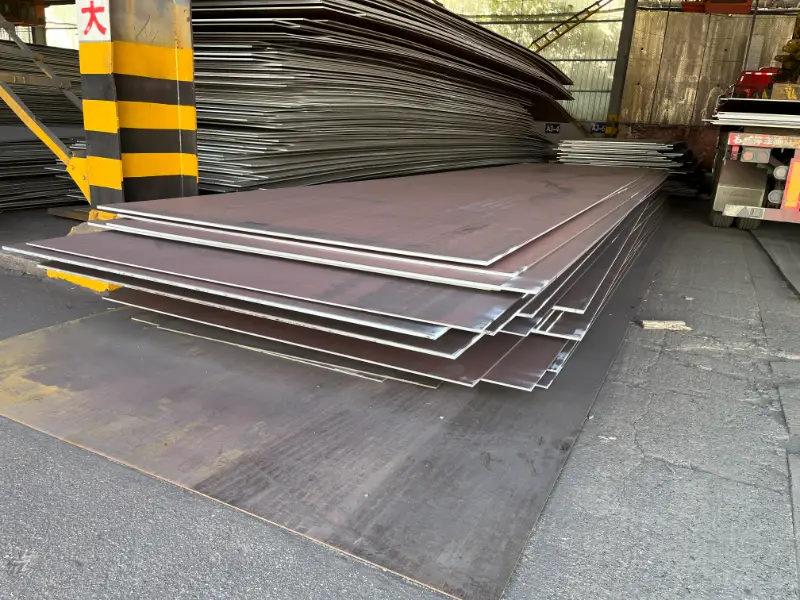
ASTM A203 Grade F (A203GRF) Nickel
ASTM A203 Grade F (A203GRF) Nickel-Alloy Steel Plate for Low-Temperature Pressure Vessels
Comprehensive material data sheet for ASTM A203 Grade F (A203GRF) steel plate, including chemical composition, mechanical and physical properties, equivalent grades, and application guidance.
Hot rolling, normalizing, quenching and tempering (optional), welding, cutting, forming
- Phone : +8618037372205
- Email : [email protected]
- WhatsApp: Contact via Whtsapp
- WeChat: +8618037372205
ASTM A203 Grade F Nickel Introduction
ASTM A203 Grade F is a nickel-alloy steel plate primarily designed for welded pressure vessels and boilers operating at low temperatures. It belongs to the ASTM A203/A203M standard, which covers several grades of nickel-alloy steel plates for low-temperature service. Grade F, containing approximately 3.50% nickel, offers an excellent combination of high notch toughness at temperatures down to -46°C (-50°F) and good weldability. Compared to lower nickel grades (A, B, D, E), Grade F provides superior resistance to brittle fracture in cryogenic conditions, making it suitable for demanding applications in the petrochemical, gas processing, and energy industries. The plates are typically supplied in the normalized or normalized and tempered condition, ensuring uniform mechanical properties and microstructure.
ASTM A203 Grade F Nickel Chemical Composition
The chemical composition of ASTM A203 Grade F is controlled to ensure the required low-temperature toughness. The nickel content is the primary alloying element for enhancing notch toughness at sub-zero temperatures. Maximum carbon limits vary with plate thickness to balance strength and weldability. Residual elements such as copper, chromium, and molybdenum are not specified but may be reported.
| Element | Standard Value | Notes |
|---|---|---|
| Carbon (C) | ≤0.20% (thickness ≤50 mm) ≤0.23% (thickness >50 mm) | Max |
| Manganese (Mn) | ≤0.70% (thickness ≤50 mm) ≤0.80% (thickness >50 mm) | Max |
| Phosphorus (P) | ≤0.025% | Max |
| Sulfur (S) | ≤0.025% | Max |
| Silicon (Si) | 0.13–0.45% (thickness ≤50 mm) 0.15–0.45% (thickness >50 mm) | Range |
| Nickel (Ni) | 3.25–3.75% | Nominal 3.50% |
| Copper (Cu) | ≤0.35% (if specified) | Max, optional |
| Chromium (Cr) | ≤0.25% (if specified) | Max, optional |
| Molybdenum (Mo) | ≤0.08% (if specified) | Max, optional |
ASTM A203 Grade F Nickel Thermal and Electrical Physical Properties
Physical properties are representative for nickel-alloy steel with ~3.5% Ni at room temperature unless otherwise noted. These values are useful for design and engineering calculations but are not part of the ASTM specification.
| Property | Typical Value | Unit | Test Condition |
|---|---|---|---|
| Density (ρ) | 7.85 | g/cm³ | 20°C |
| Elastic Modulus (E) | 200 | GPa | 20°C |
| Shear Modulus (G) | 80 | GPa | 20°C |
| Poisson's Ratio (ν) | 0.29 | – | 20°C |
| Thermal Expansion Coefficient (α) | 11.5 (20–100°C) 12.0 (20–200°C) | 10⁻⁶/K | Ambient to 200°C |
| Thermal Conductivity (λ) | 36 | W/m·K | 20°C |
| Specific Heat Capacity | 460 | J/kg·K | 20°C |
| Electrical Resistivity (ρ_e) | 0.25 | µΩ·m | 20°C |
ASTM A203 Grade F Nickel Mechanical Properties
Mechanical properties depend on plate thickness and heat treatment. Values below are per ASTM A203/A203M for normalized or normalized-and-tempered condition. Impact toughness is guaranteed for longitudinal specimens at agreed test temperatures, commonly -46°C for Grade F. Actual properties may be adjusted by supplementary requirements.
| Property | Standard Requirement | Unit | Test Condition |
|---|---|---|---|
| Yield Strength (ReH) | ≥275 | MPa | Thickness ≤50 mm |
| Yield Strength (ReH) | ≥265 | MPa | Thickness >50–75 mm |
| Tensile Strength (Rm) | 485–620 (70–90) | MPa (ksi) | Thickness ≤50 mm |
| Tensile Strength (Rm) | 485–620 (70–90) | MPa (ksi) | Thickness >50–75 mm |
| Elongation (A) | ≥21 | % | Gauge length 50 mm, thickness ≤50 mm |
| Elongation (A) | ≥21 | % | Gauge length 50 mm, thickness >50–75 mm |
| Charpy V-Notch (KV) | ≥27 (20) | J (ft·lbf) | Longitudinal, at -46°C (-50°F), typical; exact temperature by purchase order |
ASTM A203 Grade F Nickel Directly Equivalent Grades and Substitute Materials
| Region | Standard | Grade | Remarks |
|---|---|---|---|
| USA/International | ASME SA-203 | Grade F | Identical to ASTM A203 Grade F for pressure vessel construction |
| Europe | EN 10028-4 | 12Ni14 (1.5637) | Same nominal 3.5% Ni; slightly higher minimum strength; comparable low‑temperature toughness |
| Japan | JIS G3127 | SL3N255 | Nickel 3.25–3.75%; yield ≥255 MPa; used for low-temperature service down to -101°C |
ASTM A203 Grade F Nickel Application Introduction
ASTM A203 Grade F is widely used in the fabrication of pressure-retaining components that must maintain ductility and resistance to brittle fracture at sub-zero temperatures. Its excellent weldability and reliable notch toughness make it a preferred choice for critical equipment in cold climates and cryogenic processes.
Product Applications: Low-temperature pressure vessels, Liquefied petroleum gas (LPG) storage tanks, Ethylene and propylene storage spheres, Heat exchangers and condensers, Cold separators and knock-out drums, Low-pressure and medium-pressure boilers
Processed into products: Shell courses and heads (dished, hemispherical) of pressure vessels, Nozzle reinforcements and flanges, Baffle plates and tube sheets, Welded structural supports for low-temperature service, Skirt reinforcements and base rings for cold vessels, Process piping components (when fabricated from plate)
Application industries: Petrochemical and refining, Natural gas processing and liquefaction (LNG), Industrial gas storage and distribution, Chemical processing, Power generation (low-temperature boilers), Cryogenic engineering
ASTM A203 Grade F Nickel Similar or Technically Comparable Materials
| Region | Standard | Grade | Remarks |
|---|---|---|---|
| USA | ASTM A203 | Grade D / Grade E | 2.5% Ni grades; lower Ni content, less low‑temperature toughness; used at less severe conditions |
| USA | ASTM A353 / A553 Type I | 9% Ni | Significantly higher Ni content for cryogenic service down to -196°C; higher strength and cost |
| Europe | EN 10028-4 | 13MnNi6-3 (1.6217) | Lower Ni (0.30–0.80%); used for moderate low-temperature applications |
| China | GB 3531 | 15MnNiNbDR | Ni ~0.3–0.7% plus Nb; used for pressure vessels at low but not cryogenic temperatures |
Notes:
Additional considerations:
- Welding consumables should match the nickel content and toughness requirements; post-weld heat treatment (PWHT) may be applied per applicable codes such as ASME BPVC Section VIII.
- Impact testing temperature and acceptance criteria must be specified in the purchase order; typical impact test temperature for A203 Grade F is -46°C (-50°F).
- Plates are usually ultrasonically examined in accordance with ASTM A435 or A578 to ensure internal soundness.
- For enhanced toughness requirements, supplementary requirements (e.g., fine-grain practice, extra low sulfur) may be invoked.
- Share



