
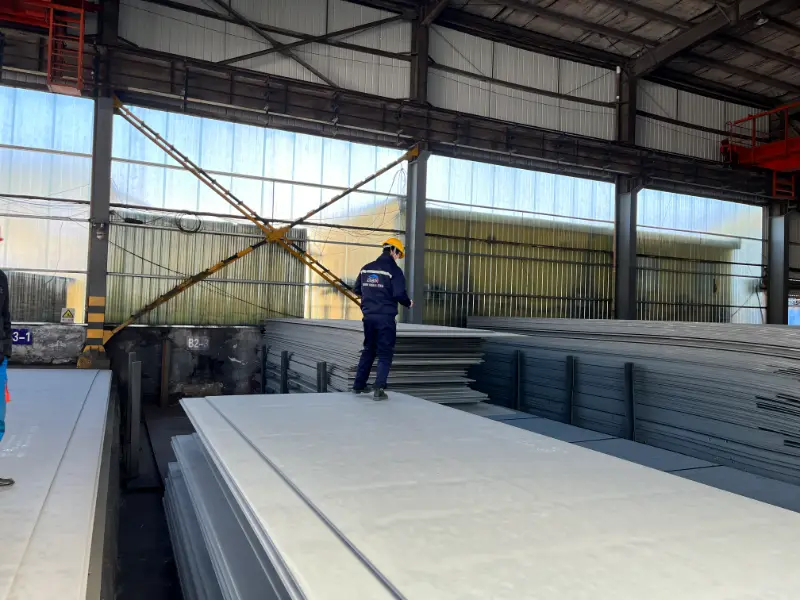
ASTM A202 Grade A (A202GRA) Boiler & Pressure Vessel Steel Plate
ASTM A202 Grade A (A202GRA) Boiler & Pressure Vessel Steel Plate
Complete technical data for ASTM A202 Grade A chromium-manganese-silicon alloy steel plate used in welded boilers and pressure vessels. Includes chemical composition, mechanical properties, physical properties, international equivalents, and application guidance.
Hot rolling, cold forming, welding, normalizing, stress relieving, cutting, bending
- Phone : +8618037372205
- Email : [email protected]
- WhatsApp: Contact via Whtsapp
- WeChat: +8618037372205
ASTM A202 Grade A Boiler & Pressure Vessel Steel Plate Introduction
ASTM A202 Grade A (A202GRA) is a chromium-manganese-silicon (Cr-Mn-Si) alloy steel plate intended primarily for welded boilers and pressure vessels in moderate-temperature service. This grade offers a balanced combination of strength and toughness, with specified minimum yield strength of 310 MPa (45 ksi) and tensile strength ranging from 515 to 655 MPa (75–95 ksi). The addition of chromium and silicon provides improved oxidation resistance and elevated-temperature strength compared to plain carbon steels.
- Controlled alloying elements ensure good weldability and formability under standard fabrication practices.
- Available in various thicknesses, it is typically supplied in the as-rolled, normalized, or stress-relieved condition depending on thickness and service requirements.
- Widely adopted in the oil & gas, chemical, and power generation industries for pressure-retaining components operating up to about 350°C (660°F).
ASTM A202 Grade A Boiler & Pressure Vessel Steel Plate Chemical Composition
The ladle analysis limits specified by ASTM A202 Grade A are listed below. Residual elements such as copper, nickel, and molybdenum are limited to ensure predictable weldability and high-temperature service performance. The steel is fully killed and made to fine grain practice.
| Element | Standard Value | Remarks |
|---|---|---|
| Carbon, C | 0.17 max | Ladle analysis |
| Manganese, Mn | 1.05 – 1.40 | Ladle analysis |
| Phosphorus, P | 0.035 max | Ladle analysis |
| Sulfur, S | 0.035 max | Ladle analysis |
| Silicon, Si | 0.60 – 0.90 | Ladle analysis |
| Chromium, Cr | 0.35 – 0.60 | Primary alloying for high-temp strength |
| Copper, Cu (residual) | 0.35 max | Residual element limit |
| Nickel, Ni (residual) | 0.35 max | Residual element limit |
| Molybdenum, Mo (residual) | 0.10 max | Residual element limit |
ASTM A202 Grade A Boiler & Pressure Vessel Steel Plate Thermal and Electrical Physical Properties
Physical property values are representative of low-alloy Cr-Mn-Si steel at room temperature unless otherwise noted. These values are not part of ASTM A202 but are useful for design calculations, heat transfer analysis, and electrical applications.
| Property | Standard Value | Unit | Test Condition |
|---|---|---|---|
| Density (ρ) | 7.85 | g/cm³ | Room temperature |
| Elastic Modulus (E) | 205 | GPa | Room temperature |
| Shear Modulus (G) | 80 | GPa | Room temperature |
| Poisson's Ratio (ν) | 0.30 | — | Room temperature |
| Thermal Expansion (α) | 11.7 | 10⁻⁶/K | 20–100 °C |
| Thermal Expansion (α) | 12.5 | 10⁻⁶/K | 20–300 °C |
| Thermal Conductivity (λ) | 42 | W/(m·K) | at 100 °C |
| Thermal Conductivity (λ) | 38 | W/(m·K) | at 200 °C |
| Specific Heat Capacity | 460 | J/(kg·K) | Room temperature |
| Electrical Resistivity (ρₑ) | 0.22 | 10⁻⁶ Ω·m | Room temperature |
ASTM A202 Grade A Boiler & Pressure Vessel Steel Plate Mechanical Properties
Mechanical properties are based on transverse test specimens from plates in the as-rolled or normalized condition. Tensile requirements apply for thicknesses up to 50 mm (2 in.). Bend test requirements demonstrate formability and soundness. All values are minimum unless a range is given.
| Property | Standard Value | Unit | Test Condition |
|---|---|---|---|
| Tensile Strength (Rm) | 515 – 655 | MPa | Transverse, thickness ≤ 50 mm |
| Tensile Strength (Rm) | 75 – 95 | ksi | Transverse, thickness ≤ 2 in. |
| Yield Strength (ReH) min | 310 | MPa | Transverse, thickness ≤ 50 mm |
| Yield Strength (ReH) min | 45 | ksi | Transverse, thickness ≤ 2 in. |
| Elongation (A) min | 22 | % | Gauge length 2 in. (50 mm), transverse; thickness ≤ 2 in. |
| Elongation (A) min | 18 | % | Gauge length 8 in. (200 mm), transverse; thickness ≤ 2 in. |
| Bend Test (180°) | d=2a | - | Transverse bend; thickness ≤ 25 mm; bend diameter = 2× thickness |
ASTM A202 Grade A Boiler & Pressure Vessel Steel Plate Direct Full Equivalent Grades and Replacement Options
| Country/Region | Standard | Grade | Notes |
|---|---|---|---|
| — | — | — | No direct full equivalent is defined by major standards (none share identical chemistry and mechanical requirements). |
ASTM A202 Grade A Boiler & Pressure Vessel Steel Plate Application Introduction
ASTM A202 Grade A is specifically designed for welded pressure‑containing equipment operating at moderate temperatures. Typical applications include:
- Steam drums and boiler shells in industrial boilers
- Pressure vessels and reactors in petroleum refining and chemical processing
- Heat exchanger shells and channel sections
- Thick‑walled piping headers and manifolds
Product Applications: Welded pressure vessels and storage tanks, Industrial boilers and steam drums, Shell‑and‑tube heat exchangers, High-pressure piping headers and manifolds, Autoclaves and reactors
Processed into products: Cylindrical shells and courses, Formed heads (ellipsoidal, torispherical, hemispherical), Nozzle reinforcements and flanges, Tube sheets and baffle plates, Support skirts and lugs, Compensating rings and stiffeners
Application industries: Oil & Gas Refining, Chemical & Petrochemical, Power Generation (fossil fuel and combined cycle), Pharmaceutical Processing, Water & Wastewater Treatment, Industrial Boiler Fabrication
ASTM A202 Grade A Boiler & Pressure Vessel Steel Plate Similar or Alternative Materials
| Country/Region | Standard | Grade | Notes |
|---|---|---|---|
| China | GB 713 | 15CrMoR | Similar C-Mo-Cr composition; slightly different Mn and Si limits. Requires design review for substitution. |
| European Union | EN 10028-2 | 13CrMo4-5 (1.7335) | Cr-Mo steel with comparable elevated‑temperature strength, but different Mn and Si content. Verify welding procedure. |
| Japan | JIS G3115 | SPV315 | Similar minimum yield strength (315 MPa) for pressure vessels; C-Mn-Si base with microalloying, not a Cr-matched grade. |
| International | ISO 9328-2:2018 | P355NH / P355NL1 | Normalized C-Mn fine‑grain steel with comparable strength; does not contain chromium or elevated Si. Suitable for pressure vessels if service temperature allows. |
Notes:
Welding: Preheat (typically 100–200°C depending on thickness) and low-hydrogen practices are recommended. Post-weld heat treatment (PWHT) may be specified per ASME Code requirements. Testing: Standard testing includes chemical analysis, tensile tests, and bend tests. Impact testing may be required when specified in the purchase order. Certification: Material can be supplied with EN 10204 3.1 or 3.2 certificates. Additional NDE (ultrasonic testing) is available upon agreement.
- Share



