
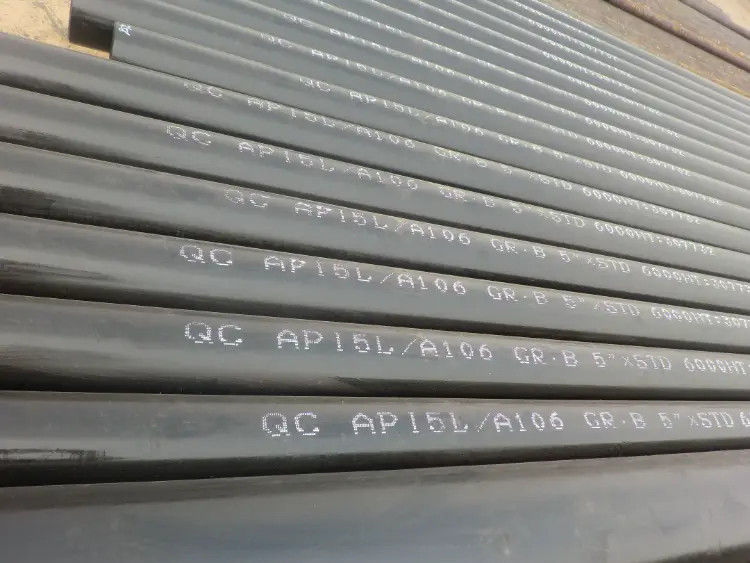
ASTM A106 Grade B Carbon Steel Pipe
ASTM A106 Grade B Carbon Steel Pipe: Composition, Properties & Equivalents
Complete technical data for ASTM A106 Grade B seamless carbon steel pipe including chemical composition, mechanical properties, international equivalents, and application guidance.
Hot-finished or cold-drawn seamless process, may be normalized
- Phone : +8618037372205
- Email : [email protected]
- WhatsApp: Contact via Whtsapp
- WeChat: +8618037372205
ASTM A106 Grade B Carbon Steel Pipe Introduction
ASTM A106 Grade B is a seamless carbon steel pipe specification designed for high-temperature service applications such as steam, water, gas and air lines in power plants, refineries and chemical plants. It belongs to the carbon steel seamless pipe category under ASTM A106/A106M. Key features:
- Minimum yield strength of 240 MPa and tensile strength of 415 MPa
- Good weldability and formability
- Can be supplied in sizes from NPS 1/8 to 48 with various wall thicknesses
- Capable of withstanding temperatures up to 400 °C under pressure
This material is widely used globally and has counterparts in other standards such as EN 10216-2 P265GH and GB 5310 20G. The standard covers both hot-finished and cold-drawn seamless pipe, typically delivered in the as-rolled or normalized condition.
ASTM A106 Grade B Carbon Steel Pipe Chemical Composition
The chemical composition of ASTM A106 Grade B is carefully controlled to ensure adequate strength, weldability, and high-temperature performance. Maximum limits are set for impurities such as phosphorus and sulfur, and a minimum silicon content is required for deoxidation. For each reduction of 0.01% carbon below 0.30%, an increase of 0.06% manganese above 1.06% is permitted, up to a maximum of 1.35% manganese. Residual elements like chromium, nickel, copper, molybdenum and vanadium are limited.
| Element | Standard Value (wt%) | Remarks |
|---|---|---|
| Carbon (C) | ≤ 0.30 | |
| Manganese (Mn) | 0.29 – 1.06 | May be increased to 1.35% when C is reduced, see standard |
| Phosphorus (P) | ≤ 0.035 | |
| Sulfur (S) | ≤ 0.035 | |
| Silicon (Si) | ≥ 0.10 | Minimum required for deoxidation |
| Chromium (Cr) | ≤ 0.40 | Residual element, not intentionally added |
| Copper (Cu) | ≤ 0.40 | Residual element, not intentionally added |
| Nickel (Ni) | ≤ 0.40 | Residual element, not intentionally added |
| Molybdenum (Mo) | ≤ 0.15 | Residual element, not intentionally added |
| Vanadium (V) | ≤ 0.08 | Residual element, not intentionally added |
ASTM A106 Grade B Carbon Steel Pipe Thermal and Electrical Physical Properties
The thermal and electrical properties are typical reference values for low-carbon steel and are not specified in ASTM A106. These values can be used for general engineering calculations. Actual properties may vary slightly depending on the exact composition and heat treatment.
| Property | Typical Value | Unit | Test Condition |
|---|---|---|---|
| Density (ρ) | 7.85 | g/cm³ | At 20°C |
| Modulus of Elasticity (E) | 205 | GPa | At 20°C |
| Shear Modulus (G) | 80 | GPa | At 20°C |
| Poisson's Ratio (ν) | 0.30 | — | At 20°C |
| Thermal Expansion Coefficient (α) | 12.2 | µm/m·°C | From 20 to 100°C |
| Thermal Conductivity (λ) | 51 | W/m·K | At 20°C |
| Specific Heat Capacity (c) | 460 | J/kg·K | At 20°C |
| Electrical Resistivity (ρ_e) | 0.14 | µΩ·m | At 20°C |
ASTM A106 Grade B Carbon Steel Pipe Mechanical Properties
Mechanical properties are determined on test specimens taken from the pipe. The yield strength may be determined by the 0.5% extension under load (EUL) method or the 0.2% offset method. Elongation requirements vary depending on specimen orientation (longitudinal or transverse) and wall thickness. These values are minimums as required by ASTM A106/A106M.
| Property | Standard Requirement | Unit | Test Condition |
|---|---|---|---|
| Tensile Strength (Rm) | ≥ 415 | MPa | Room temperature |
| Yield Strength (ReH / Rp0.2) | ≥ 240 | MPa | Room temperature, 0.5% EUL or 0.2% offset |
| Elongation (A), longitudinal strip | ≥ 21 | % | Wall thickness ≤ 7.9 mm (0.312 in) |
| Elongation (A), longitudinal strip | ≥ 22 | % | Wall thickness >7.9 mm to ≤11.1 mm (0.312–0.437 in) |
| Elongation (A), longitudinal strip | ≥ 23 | % | Wall thickness >11.1 mm to ≤15.9 mm (0.437–0.625 in) |
| Elongation (A), longitudinal strip | ≥ 24 | % | Wall thickness >15.9 mm to ≤19.0 mm (0.625–0.750 in) |
| Elongation (A), longitudinal strip | ≥ 21 | % | Wall thickness >19.0 mm (0.750 in) |
| Elongation (A), transverse strip | ≥ 12 | % | All wall thicknesses |
ASTM A106 Grade B Carbon Steel Pipe Exact Equivalent Material Standards and Substitutable Grades
| Country/Region | Standard | Grade | Remarks |
|---|---|---|---|
| Europe | EN 10216-2 | P265GH (1.0425) | Seamless steel tubes for pressure purposes; equivalent for high-temperature service |
| Germany (superseded) | DIN 17175 | St45.8 | Historically equivalent, now replaced by EN 10216-2 |
| Japan | JIS G3456 | STPT 410 | Carbon steel pipe for high-temperature service |
| China | GB 5310 | 20G | Seamless steel tubes and pipes for high-pressure boiler; close match in composition and properties |
| International | ISO 9329-2 | TS 410 | Seamless steel tubes for pressure purposes; part of ISO harmonized standard |
| USA | ASME SA106 | Grade B | Identical to ASTM A106 Grade B under ASME Boiler & Pressure Vessel Code |
ASTM A106 Grade B Carbon Steel Pipe Application Introduction
ASTM A106 Grade B is essential for high-temperature, high-pressure piping systems. Its balanced carbon content ensures good weldability and the ability to withstand elevated temperatures. Common uses span from utility piping in power stations to process piping in hydrocarbon industries. The material is widely available and easily fabricated into a variety of components.
Product Applications: High-temperature steam piping, Boiler tubes and headers, Superheater and reheater lines, Refinery process piping (e.g., fluid catalytic cracking, reforming), Hydrocarbon transfer lines, Heat exchanger shells and piping
Processed into products: Pipe spools and straight runs, Long-radius and short-radius elbows (90°, 45°), Tees (equal and reducing), Concentric and eccentric reducers, Weld-neck, slip-on, and threaded flanges, Bleed rings and olets, Pipe caps and stub ends, Valves (body and bonnet forged or machined from pipe)
Application industries: Oil & Gas (upstream, midstream, downstream), Power Generation (fossil and nuclear), Petrochemical Refining, Chemical Processing Plants, Boiler and Heat Exchanger Manufacturing, Shipbuilding and Marine Engineering
ASTM A106 Grade B Carbon Steel Pipe Similar / Alternative Materials
| Country/Region | Standard | Grade | Remarks |
|---|---|---|---|
| USA | ASTM A53 | Grade B (Type S seamless) | General purpose pipe; similar chemistry but intended for lower temperature/pressure applications, not rated for high-temperature service to the same extent. |
| USA | API 5L | Grade B (PSL1 or PSL2 seamless) | Line pipe for oil and gas transmission; comparable strength but focused on weldability and toughness over a wide temperature range. |
| USA | ASTM A105 / A105M | — | Forged carbon steel for piping components; matches A106 Gr.B chemistry, used for flanges, fittings, and valves. |
| Europe | EN 10216-2 | P235GH (1.0345) | Lower strength grade; similar base metal but with reduced C and Mn, select for lower stress applications. |
| China | GB/T 8163 | 20# | Seamless steel pipe for liquid service; close chemical equivalent but not specifically for high-temperature pressure systems. |
Notes:
Impact testing is not mandatory under ASTM A106 Grade B unless specified by the purchaser via supplementary requirement S3 or similar. Additional supplementary requirements (product analysis, hydrostatic test, nondestructive electric tests, etc.) may be ordered. The material can be supplied with specific heat treatment (e.g., normalizing). Weldability is generally good; preheating and post-weld heat treatment (PWHT) may be required for thick sections or when specified by relevant codes. For thicknesses above approximately 19 mm, PWHT according to ASME B31.3 or similar code is often applied.
- Share



