
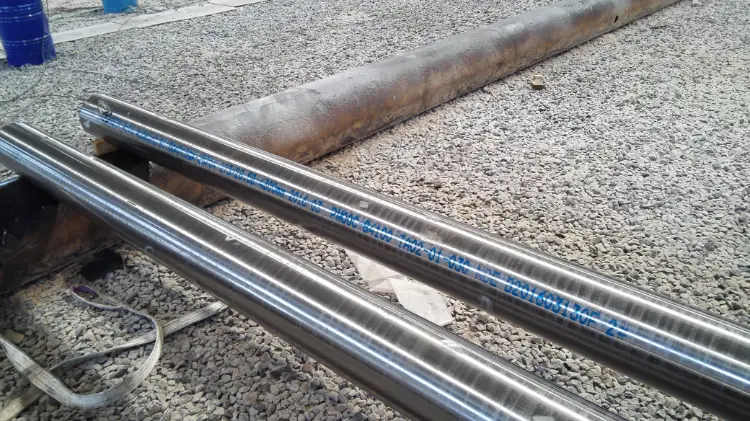
ASTM A106 Grade C Seamless Carbon Steel Pipe for High-Temperature Service
ASTM A106 Grade C Seamless Carbon Steel Pipe for High-Temperature Service | Composition, Properties & Equivalents
Comprehensive data sheet for ASTM A106 Grade C seamless carbon steel pipe used in high-temperature applications. Includes chemical composition, mechanical properties, physical properties, international equivalents, and application guidelines.
Hot finished (hot rolled or hot expanded); cold drawn may also be produced but typically hot finished
- Phone : +8618037372205
- Email : [email protected]
- WhatsApp: Contact via Whtsapp
- WeChat: +8618037372205
ASTM A106 Grade C Seamless Carbon Steel Pipe for High-Temperature Service Introduction
ASTM A106 Grade C is a carbon steel seamless pipe specification intended for high-temperature service. It is widely used in power plants, refineries, and chemical plants for conveying fluids at elevated temperatures and pressures. The material offers good tensile strength and ductility, with a minimum carbon content higher than Grades A and B, providing enhanced strength. A106 Gr.C is typically supplied in the hot-finished condition and can be used in the fabrication of pipework components. Its weldability requires careful control due to the carbon content, and post-weld heat treatment is often recommended to relieve stresses and reduce the risk of cracking.
ASTM A106 Grade C Seamless Carbon Steel Pipe for High-Temperature Service Chemical Composition
The chemical composition of ASTM A106 Grade C is governed by ASTM A106/A106M standard. The total content of the residual elements (Cr, Cu, Mo, Ni, V) shall not exceed 1.00%. The values shown are maximum limits unless a range is given. Silicon is only required for heat analysis; for product analysis its limit is 0.10% min.
| Chemical Element | Standard Value | Remarks |
|---|---|---|
| Carbon (C) | ≤ 0.35% | Max |
| Manganese (Mn) | 0.29 – 1.06% | Range |
| Phosphorus (P) | ≤ 0.035% | Max |
| Sulfur (S) | ≤ 0.035% | Max |
| Silicon (Si) | ≥ 0.10% (heat analysis) | Min for heat; product analysis ≥0.10% |
| Chromium (Cr) | ≤ 0.40% | Max, residual element |
| Copper (Cu) | ≤ 0.40% | Max, residual element |
| Molybdenum (Mo) | ≤ 0.15% | Max, residual element |
| Nickel (Ni) | ≤ 0.40% | Max, residual element |
| Vanadium (V) | ≤ 0.08% | Max, residual element |
| Cr+Cu+Mo+Ni+V | ≤ 1.00% | Sum of residual elements |
ASTM A106 Grade C Seamless Carbon Steel Pipe for High-Temperature Service Thermal and Electrical Physical Properties
The physical properties listed are typical values for carbon steels similar to ASTM A106 Grade C at room temperature unless noted. These are not specified by ASTM A106 standard but are provided for engineering calculations. Thermal properties vary with temperature; some representative temperature-dependent data are included.
| Property | Typical Value | Unit | Test Condition / Temperature |
|---|---|---|---|
| Density (ρ) | 7.85 | g/cm³ | 20 °C |
| Modulus of Elasticity (E) | 200 | GPa | 20 °C |
| Shear Modulus (G) | 77 | GPa | 20 °C |
| Poisson's Ratio (ν) | 0.3 | - | 20 °C |
| Thermal Expansion Coefficient (α) | 11.7 | 10⁻⁶/K | 20 – 100 °C |
| Thermal Expansion Coefficient (α) | 12.2 | 10⁻⁶/K | 20 – 200 °C |
| Thermal Expansion Coefficient (α) | 12.7 | 10⁻⁶/K | 20 – 300 °C |
| Thermal Expansion Coefficient (α) | 13.2 | 10⁻⁶/K | 20 – 400 °C |
| Thermal Expansion Coefficient (α) | 13.7 | 10⁻⁶/K | 20 – 500 °C |
| Thermal Conductivity (λ) | 50 | W/(m·K) | 20 °C |
| Specific Heat Capacity (cₚ) | 470 | J/(kg·K) | 20 °C |
| Electrical Resistivity (ρ_e) | 0.15 | µΩ·m | 20 °C |
ASTM A106 Grade C Seamless Carbon Steel Pipe for High-Temperature Service Mechanical Properties
Mechanical properties are determined on longitudinal test specimens. Tensile test is conducted at room temperature. The elongation minimum is determined by the formula e = 625,000 A^0.2 / U^0.9 for standard round specimens or e = 625,000 A^0.2 / U^0.9 for strip specimens; the values given are for standard 2 in. (50 mm) gage length round specimens. Bend test is required: cold bend 180° around a mandrel with diameter dependent on wall thickness.
| Property | Standard Required Value | Unit | Test Condition |
|---|---|---|---|
| Yield Strength (ReH, 0.2% offset) | ≥ 275 | MPa | Room temperature, longitudinal |
| Tensile Strength (Rm) | ≥ 485 | MPa | Room temperature, longitudinal |
| Elongation (A) | ≥ 30 | % | In 2 in. (50 mm) gage length, longitudinal, standard round specimen |
| Bend Test | 180° bend, no cracks | - | For wall thickness ≤0.75 in.: mandrel diameter = wall thickness; >0.75 in.: mandrel diam = wall thickness + 0.5 in. |
ASTM A106 Grade C Seamless Carbon Steel Pipe for High-Temperature Service Complete Equivalents and Substitute Grades
There is no single international standard with a completely identical grade to ASTM A106 Grade C. The following listed materials are often considered as functional substitutes, but they may differ in chemical composition range, mechanical properties, or test conditions. Direct substitution must be verified against the specific design code and service requirements.
| Country/Region | Standard | Grade | Remarks |
|---|---|---|---|
| Europe | EN 10216-2 | P265GH (1.0425) | Similar high-temperature seamless pipe, lower carbon (max 0.20%), higher Mn, minimum yield 265 MPa, tensile 410-570 MPa. Substitute with caution. |
| Japan | JIS G3456 | STPT410 | Carbon steel pipe for high-temperature service, min TS 410 MPa, YS 245 MPa, carbon max 0.30%, not full equivalent, but widely used. |
| China | GB/T 8163 | 20 | Seamless steel pipe for liquid service, TS 410-550 MPa, YS min 245 MPa, carbon 0.17-0.23%, not for high-temp design code but sometimes substituted for certain non-critical applications. |
| International | ISO 9329-2 | PH24 (TS 450) | Seamless steel tubes for pressure purposes, not fully equivalent; verify properties. |
ASTM A106 Grade C Seamless Carbon Steel Pipe for High-Temperature Service Application Introduction
ASTM A106 Grade C is a workhorse material for elevated-temperature piping. Its higher carbon content and strength make it suitable for main steam lines, boiler tubes, and services where temperatures exceed the capabilities of A106 Grade B. Design and fabrication must follow applicable codes (e.g., ASME B31.1 for power piping, ASME B31.3 for process piping). Welding procedures require preheating (typically 150–300 °C) due to the carbon content, and post-weld heat treatment (PWHT) is often mandatory to avoid cracking and to improve ductility.
Product Applications: High-temperature steam pipes, Superheater and reheater tubes, Boiler headers and main steam lines, Process piping for hot hydrocarbons, Pressure vessel connecting pipes
Processed into products: Seamless pipe sections (scheduled sizes), Butt-weld fittings (elbows, tees, reducers, caps), Flanges (when matched with A105 forging material or similar), Boiler tubes and heat exchanger tubes, Forged pipe fittings (e.g., sockets, couplings) produced from A106 Gr.C base material
Application industries: Power generation (fossil fuel, nuclear conventional island), Petroleum refining and petrochemical plants, Chemical processing, Oil and gas processing (onshore and offshore), Industrial boiler manufacturing
ASTM A106 Grade C Seamless Carbon Steel Pipe for High-Temperature Service Similar or Comparative Materials
This section lists grades that share some characteristics (such as being carbon steel pipes) but are intended for different service conditions or have different strength levels. They may be considered for alternative applications or comparison.
| Country/Region | Standard | Grade | Remarks |
|---|---|---|---|
| USA | ASTM A106/A106M | Grade B | Lower strength (YS min 240 MPa, TS min 415 MPa), lower carbon (max 0.30%). Commonly used for moderate temperature. |
| USA | ASTM A53/A53M | Grade B | General purpose pipe, YS min 240 MPa, TS min 415 MPa, not specifically for high-temperature; often used in structural and low-pressure fluid service. |
| USA | API 5L | X42 (PSL1) | Line pipe grade, YS min 290 MPa, TS min 415 MPa, for oil/gas transmission, not designed for high-temperature sustained operation. |
| Europe | EN 10216-2 | P235GH (1.0345) | Lower strength (YS min 235 MPa, TS 360-480 MPa), lower carbon (max 0.16%), for moderate temperature and pressure. |
Notes:
Welding: Preheating to 150–300 °C is typically recommended. Post-weld heat treatment at 600–650 °C is often mandatory per ASME B31.1/B31.3 to temper the heat-affected zone and reduce hardness.
Nondestructive testing: Usually supplied with hydrostatic test. Ultrasonic or eddy current testing may be specified by supplementary requirements.
Certification: ASTM A106 Grade C must be supplied with a test report certifying chemical analysis and mechanical properties. Marking includes manufacturer's name, specification, grade, and size.
Limitations: Not intended for low-temperature applications; for such service ASTM A333 grades should be considered.
- Share



