
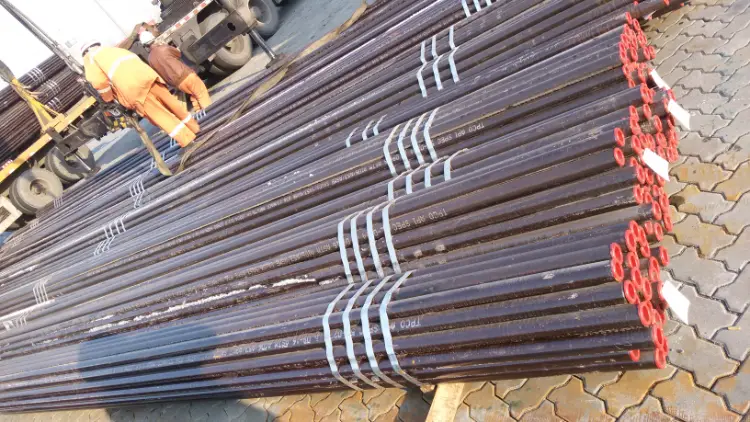
ASTM A106 Grade A Seamless Carbon Steel Pipe for High-Temperature Service
ASTM A106 Grade A Seamless Carbon Steel Pipe for High-Temperature Service - Properties & Equivalents
Comprehensive material data for ASTM A106 Grade A pipeline steel including chemical composition, mechanical and thermal properties, equivalents, and application guidance.
Hot finished or cold drawn, normalized or as-rolled, weldable, machinable, bendable
- Phone : +8618037372205
- Email : [email protected]
- WhatsApp: Contact via Whtsapp
- WeChat: +8618037372205
ASTM A106 Grade A Seamless Carbon Steel Pipe for High-Temperature Service Introduction
ASTM A106 Grade A is a seamless carbon steel pipe specifically designed for high-temperature service commonly used in power plants, refineries, and petrochemical facilities. Manufactured in accordance with ASTM A106/A106M, this grade offers reliable performance when conveying steam, water, gas, and air at elevated temperatures and moderate pressures. It is characterized by a minimum tensile strength of 48 ksi (330 MPa) and minimum yield strength of 30 ksi (205 MPa), providing adequate strength while maintaining good weldability and formability.
Key attributes include:
- Fully killed steel practice ensuring uniformity and soundness
- Controlled chemical composition with low phosphorus and sulfur for improved cleanliness
- Excellent resistance to graphitization at elevated temperatures
- Suitable for bending, flanging, and similar forming operations
- Available in a range of sizes from NPS 1/8 to 48 inches (DN 6 to 1200)
The Grade A variant is often selected when lower strength is acceptable and where cost efficiency is important, particularly for non-critical piping in utility and industrial systems.
ASTM A106 Grade A Seamless Carbon Steel Pipe for High-Temperature Service Chemical Composition
The chemical composition of ASTM A106 Grade A is strictly defined to ensure high-temperature integrity and weldability. Carbon and manganese are key strength contributors, while sulfur and phosphorus are kept low for cleanliness. Silicon is specified when fully killed steel is required. Residual elements (Cr, Cu, Mo, Ni, V) are limited to prevent adverse effects on high-temperature properties and corrosion resistance. All values apply to product analysis according to ASTM A106/A106M.
| Element | Standard Value (wt%) | Remarks |
|---|---|---|
| Carbon (C) | ≤0.25 | Max |
| Manganese (Mn) | 0.27 – 0.93 | Range |
| Phosphorus (P) | ≤0.035 | Max |
| Sulfur (S) | ≤0.035 | Max |
| Silicon (Si) | ≥0.10 | If required, for killed steel; typically 0.10–0.35 |
| Chromium (Cr) | ≤0.40 | Max (residual element) |
| Copper (Cu) | ≤0.40 | Max (residual element) |
| Molybdenum (Mo) | ≤0.15 | Max (residual element) |
| Nickel (Ni) | ≤0.40 | Max (residual element) |
| Vanadium (V) | ≤0.08 | Max (residual element) |
| Total Cr+Cu+Mo+Ni+V | ≤1.00 | Max for five residual elements combined |
ASTM A106 Grade A Seamless Carbon Steel Pipe for High-Temperature Service Thermal and Electrical Physical Properties
Typical physical properties of carbon steel matching ASTM A106 Grade A are provided below. These values are representative for normalized or as-rolled condition at various temperatures. Density, modulus, thermal expansion, conductivity, specific heat, and electrical resistivity are essential for pipe stress analysis, heat transfer calculations, and overall system design. Actual properties may slightly vary with specific heat treatment and manufacture.
| Property | Typical Value | Unit | Test Condition |
|---|---|---|---|
| Density (ρ) | 7.85 | g/cm³ | 20 °C |
| Elastic Modulus (E) | 200 | GPa | 20 °C |
| Shear Modulus (G) | 77 | GPa | 20 °C |
| Poissons Ratio (ν) | 0.29 | – | 20 °C |
| Thermal Expansion Coefficient (α) | 11.7 | 10⁻⁶/K | 20–100°C |
| Thermal Expansion Coefficient (α) | 12.2 | 10⁻⁶/K | 20–200°C |
| Thermal Expansion Coefficient (α) | 12.9 | 10⁻⁶/K | 20–400°C |
| Thermal Conductivity (λ) | 51.9 | W/(m·K) | 20 °C |
| Thermal Conductivity (λ) | 48.4 | W/(m·K) | 100 °C |
| Thermal Conductivity (λ) | 43.3 | W/(m·K) | 200 °C |
| Thermal Conductivity (λ) | 36.8 | W/(m·K) | 400 °C |
| Specific Heat Capacity | 486 | J/(kg·K) | 20 °C |
| Electrical Resistivity (ρ_e) | 0.142 | μΩ·m | 20 °C |
ASTM A106 Grade A Seamless Carbon Steel Pipe for High-Temperature Service Mechanical Properties
The following mechanical properties are specified at room temperature in accordance with ASTM A106/A106M. Tensile testing is performed on longitudinal strip or round specimens. Bend testing is mandatory to verify ductility and absence of cracks. Notch toughness (impact) testing is not a standard requirement but can be invoked through supplementary requirements S1 to S8 when the pipe is intended for low-temperature or critical service.
| Property | Specified Value | Unit | Test Condition |
|---|---|---|---|
| Tensile Strength (Rm) | ≥48 (330) | ksi (MPa) | Room temperature, longitudinal |
| Yield Strength (ReH, 0.2% offset) | ≥30 (205) | ksi (MPa) | Room temperature, longitudinal |
| Elongation (A) | ≥35 | % | Wall thickness ≤ 0.3125 in. (7.94 mm), 2 in. (50 mm) gauge length |
| Elongation (A) | ≥30 | % | Wall thickness > 0.3125 in. (7.94 mm), 2 in. (50 mm) gauge length |
| Bend Test (Bend diameter) | 2t | – | Wall thickness ≤ 0.75 in. (19.1 mm), 180° bend, t = specimen thickness |
| Bend Test (Bend diameter) | 3t | – | Wall thickness > 0.75 in. (19.1 mm), 180° bend, t = specimen thickness |
ASTM A106 Grade A Seamless Carbon Steel Pipe for High-Temperature Service Exact Equivalent Material Standards and Alternative Grades
| Country/Region | Standard | Grade | Remarks |
|---|---|---|---|
| USA | API 5L | Grade A (PSL 1 seamless) | Identical minimum tensile/yield (48 ksi/30 ksi) and very similar chemistry; widely used in pipelines. |
| USA | ASTM A53 | Grade A Type S (seamless) | Same tensile requirements; C and Mn limits slightly differ, but functionally equivalent for many high-temperature services. |
| China | GB/T 8163 | 10 | Seamless steel pipe for fluid transport; min. tensile 335 MPa, min. yield 205 MPa, closely matching A106 Gr.A. |
| Japan | JIS G3454 | STPG370 | Carbon steel pressure pipes; min. tensile 370 MPa, min. yield 215 MPa, can serve as direct replacement. |
| Europe | EN 10216-1 | P235TR1 | Seamless tube for pressure purposes; slightly higher strength (360–500 MPa tensile, 235 MPa yield), but may be used with design verification. |
ASTM A106 Grade A Seamless Carbon Steel Pipe for High-Temperature Service Application Introduction
ASTM A106 Grade A finds extensive use throughout process and power industries where reliable high-temperature fluid transport is critical. Its excellent weldability and bendability make it a preferred choice for fabricated piping assemblies. Typical installations include steam systems, boiler connections, and hydrocarbon process piping in refineries and chemical plants. The material can be easily cut, threaded, flanged, and welded using conventional methods, offering versatile fabrication options.
- Steam and condensate lines up to 900°F (482°C) intermittent
- Boiler tubes, economizers, superheaters
- Heat exchange equipment
- Petroleum refining process piping
- Compressed air and gas distribution
Product Applications: High-temperature piping systems, Steam pipelines, Boiler tubes and superheater tubes, Heat exchanger tubes, Process piping, Pressure vessel connections
Processed into products: Pipe spools, Elbows and bends, Tees and reducers, Flanges and fittings, Expansion joints, Manifolds, Headers
Application industries: Oil & Gas, Petrochemical, Power Generation (Boilers, Steam Lines), Chemical Processing, Refineries, Shipbuilding, General Engineering
ASTM A106 Grade A Seamless Carbon Steel Pipe for High-Temperature Service Similar or Alternative Material Recommendations
| Country/Region | Standard | Grade | Remarks |
|---|---|---|---|
| USA | ASTM A106 | Grade B | Higher strength (60 ksi tensile, 35 ksi yield), commonly used for elevated temperature lines; can replace Grade A if increased load capacity is needed. |
| USA | ASTM A53 | Grade B Type S | Seamless pipe with higher strength, suitable for similar high-temperature applications where design permits. |
| USA | API 5L | Grade B (PSL 1 seamless) | Line pipe grade with higher strength; interchangeable where pressure/temperature ratings are re-evaluated. |
| USA | ASTM A192 | – | Seamless carbon steel boiler tubes with strength comparable to A106 Gr.A; ideal for boiler and superheater applications. |
| Europe | EN 10216-2 | P265GH | Elevated temperature seamless tube; higher strength, excellent for European pressure equipment, may replace A106 Gr.A with updated design calculations. |
Notes:
Supplementary requirements S1 to S8 of ASTM A106/A106M may be specified for impact testing, special heat treatment, non-destructive examination, or tighter chemistry. Consult the current standard for full details. All data provided is for general reference; actual procurement should be based on the latest edition of ASTM A106/A106M. Properties stated are typical; variations can occur depending on production process and product dimensions.
- Share



