
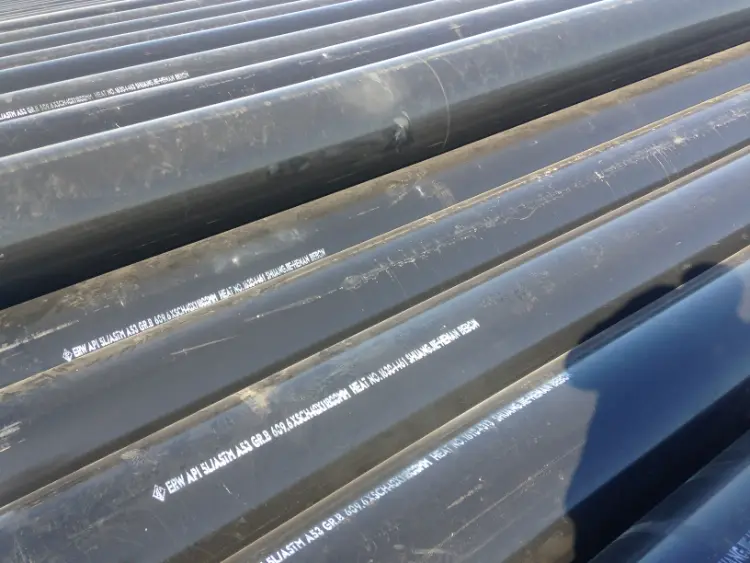
ASTM A53 Grade B Pipeline Steel
ASTM A53 Grade B Pipeline Steel: Complete Technical Data & International Equivalents
Comprehensive data for ASTM A53 Gr. B pipeline steel: chemical composition, mechanical and physical properties, thermal and electrical data, international equivalent grades, application guide and typical components.
Hot‑rolled, cold‑drawn, or electric‑resistance welded (ERW); may be normalized or stress‑relieved as required
- Phone : +8618037372205
- Email : [email protected]
- WhatsApp: Contact via Whtsapp
- WeChat: +8618037372205
ASTM A53 Grade B Pipeline Steel Introduction
ASTM A53 Grade B is a widely used carbon steel pipe specification covering seamless and welded black and hot-dipped galvanized pipe in sizes NPS 1/8 to NPS 26. Key features:
- Minimum tensile strength 415 MPa (60 ksi) and yield strength 240 MPa (35 ksi)
- Good weldability and formability for structural and pressure applications
- Available in black or galvanized finishes
- Suitable for steam, water, gas and air lines up to moderate temperatures
- Commonly used in construction, mechanical systems and low‑pressure fluid transport
Grade B is the standard choice for general‑purpose piping due to its balanced strength and ductility.
ASTM A53 Grade B Pipeline Steel Chemical Composition
Chemical requirements per ASTM A53 Grade B, Table 1. Maximum limits are given for seamless and welded pipe. The sum of copper, nickel, chromium, molybdenum and vanadium shall not exceed 1.00 %. Silicon and aluminium are not specified but may be present as deoxidizers. For product analysis, slightly higher limits apply as per standard.
| Chemical Element | Standard Value (max, %) | Remarks |
|---|---|---|
| Carbon (C) | 0.30 | For content >0.25, lower strength may be permitted for small sizes |
| Manganese (Mn) | 1.20 | Manganese contributes to strength and toughness |
| Phosphorus (P) | 0.05 | Maximum permissible for all grades |
| Sulfur (S) | 0.045 | Maximum permissible for all grades |
| Copper (Cu) | 0.40 | Residual element; higher when intentionally added for atmospheric corrosion resistance |
| Nickel (Ni) | 0.40 | Residual element |
| Chromium (Cr) | 0.40 | Residual element |
| Molybdenum (Mo) | 0.15 | Residual element |
| Vanadium (V) | 0.08 | Residual element |
| Cu + Ni + Cr + Mo + V | 1.00 | Sum of residual elements shall not exceed this value |
ASTM A53 Grade B Pipeline Steel Thermal and Electrical Physical Properties
The following values are typical for carbon‑steel pipes similar to ASTM A53 Grade B. They are not specified in the standard but are based on extensive technical literature for low‑carbon steel at conventional ambient conditions. Thermal expansion, conductivity and specific heat are given for the temperature range 20–100 °C unless noted otherwise. Actual properties may vary slightly with exact composition and heat treatment.
| Property | Typical Reference Value | Unit | Test Condition |
|---|---|---|---|
| Density (ρ) | 7.85 | g/cm³ (kg/m³ = 7850) | At 20 °C |
| Modulus of Elasticity (E) | 205 | GPa | At 20 °C |
| Shear Modulus (G) | 80 | GPa | Calculated from E and ν |
| Poisson's Ratio (ν) | 0.29 | — | In the elastic range |
| Thermal Expansion Coefficient (α) | 11.7 × 10⁻⁶ | /°C | 20–100 °C |
| Thermal Conductivity (λ) | 52 | W/(m·K) | At 20 °C |
| Specific Heat Capacity (cₚ) | 486 | J/(kg·K) | At 20 °C |
| Electrical Resistivity (ρₑ) | 0.15 | μΩ·m | At 20 °C |
ASTM A53 Grade B Pipeline Steel Mechanical Properties
Mechanical properties are determined on test specimens taken from the pipe wall. Tensile test is mandatory; values apply to both seamless and welded pipe. Bend test is required for pipe NPS 2 and smaller. Elongation varies with specimen dimensions; values below represent typical minimums for longitudinal strip tests with 50 mm (2 in.) gauge length. For pipe over NPS 12, elongation values are determined by agreement.
| Performance Property | Standard Required Value | Unit | Test Condition |
|---|---|---|---|
| Yield Strength (ReH) | ≥ 240 | MPa | Room temperature, 0.2% offset or 0.5% extension under load (EUL) |
| Tensile Strength (Rm) | ≥ 415 | MPa | Room temperature |
| Elongation (A) | ≥ 30* | % | In 50 mm (2 in.) gauge length, for wall thickness ≤ 7.9 mm (0.312 in.), typical; actual values per ASTM A53 formula |
| Bend Test | No cracks or failures | — | Cold bend around mandrel diameter = 3× specimen thickness (180°) for pipe ≤ NPS 2 |
ASTM A53 Grade B Pipeline Steel Fully Equivalent Material Standards and Replaceable Grades
| Country/Region | Standard | Grade/Designation | Remarks |
|---|---|---|---|
| United States | ASTM A53/A53M | Grade B | Original standard; seamless and welded pipe for pressure and structural use |
| United States | API 5L | Grade B (PSL1/PSL2) | Line pipe for petroleum and gas; comparable strength and carbon content, often considered interchangeable in general piping |
| Canada | CSA Z245.1 | Grade 290 (Cat I) | Steel pipe for gas and liquid transmission; chemical and tensile requirements align closely with ASTM A53 Gr.B |
| International | ISO 3183 | L245 | Petroleum and natural gas industries – line pipe; L245 corresponds to minimum yield 245 MPa, similar to A53 Gr.B |
| European Union | EN 10217-1 | P235TR2 | Welded steel tubes for pressure purposes; yield 235 MPa, tensile 360–500 MPa, chemistry and usage overlap with A53 Gr.B |
| European Union | EN 10216-1 | P235TR2 | Seamless steel tubes for pressure purposes; equivalent to welded version with comparable performance |
| Japan | JIS G3454 | STPG 410 | Carbon steel pipes for pressure service; tensile strength ≥410 MPa, yield ≥245 MPa, widely used in Japanese engineering |
| China | GB/T 8163 | 20 | Seamless steel tubes for liquid service; typical tensile 410–550 MPa, yield ≥245 MPa, used as a direct substitution in many projects |
ASTM A53 Grade B Pipeline Steel Application Introduction
ASTM A53 Grade B pipe is a versatile carbon steel product employed across a wide range of industries. Its combination of moderate strength, good weldability and availability in both seamless and welded forms makes it a cost‑effective choice for general piping and structural uses. Typical application fields include:
Product Applications: Transmission pipelines for natural gas, crude oil and refined products, Fabricated steel structures (handrails, ladders, guardrails), Ductile‑iron replacement in water distribution networks, Process piping in chemical plants and refineries, Fire sprinkler and standpipe systems, HVAC heating and chilled‑water circuits, Steel piling and caissons, Conduit for electrical and communication cables
Processed into products: Straight pipe spools and coils, Butt‑weld fittings (elbows, tees, reducers), Threaded fittings and unions, Flanges (slip‑on, weld‑neck, blind), Valve bodies and bonnets, Pipe supports, clamps and anchors, Corrosion‑resistant linings (when coated or galvanized), Custom fabricated pressure vessels (with additional design verification)
Application industries: Oil and gas extraction and transportation, Petrochemical processing plants, Water and wastewater treatment facilities, Building and civil infrastructure (structural columns, bollards, sign posts), Power generation (cooling water, steam condensate lines), Fire protection systems (sprinkler mains and branch lines), Machinery manufacturing (fluid power, pneumatic lines), Mining and slurry handling
ASTM A53 Grade B Pipeline Steel Similar or Closely Related Substitute Materials
| Country/Region | Standard | Grade/Designation | Remarks |
|---|---|---|---|
| United States | ASTM A106/A106M | Grade B | Seamless carbon steel pipe for high‑temperature service; slightly higher carbon (max 0.30) and manganese (max 1.06), but similar tensile properties; often used when elevated temperature rating is needed |
| United States | ASTM A134 | All grades | Electric‑fusion (arc)‑welded steel pipe; may use A53 plates, so final properties can mirror Grade B, but standard covers larger sizes |
| United States | ASTM A135 | Grade A/B | Electric‑resistance‑welded steel pipe; Grade B meets same tensile requirements as A53 Gr.B but limited to NPS 30 and thinner walls |
| United States | ASTM A795 | Type S, Grade 30 | Steel pipe for fire protection use; similar chemistry and strength, but specifically for sprinkler systems; hot‑dipped or black |
| United States | ASTM A53 | Grade A | Lower strength variant (yield 205 MPa, tensile 330 MPa); suitable where less demanding mechanical properties are acceptable, can replace Gr.B in non‑critical applications |
Notes:
Additional remarks:
- ASTM A53 pipe may be supplied plain‑end, threaded, or threaded and coupled.
- Galvanized pipe must comply with ASTM A53 hot‑dip coating requirements (average zinc mass ≥ 550 g/m² or 1.8 oz/ft²).
- Hydrostatic test is mandatory for each length; the test pressure is determined by the formula P = 2St/D, where S = 60% of minimum yield strength, typically resulting in pressures near 10 MPa for standard wall thicknesses.
- Non‑destructive electric testing is allowed as an alternative to hydrostatic testing for certain sizes.
- Welding processes should follow AWS or ASME guidelines; typical preheat is not required for thicknesses below 25 mm, but post‑weld heat treatment may be advisable for heavy sections to relieve residual stresses.
- The pipe may be supplied in double‑random lengths (approx. 10–12 m) or as agreed.
- For corrosive environments, additional coatings (fusion‑bonded epoxy, 3‑layer PE) or cathodic protection are recommended.
- Share



