
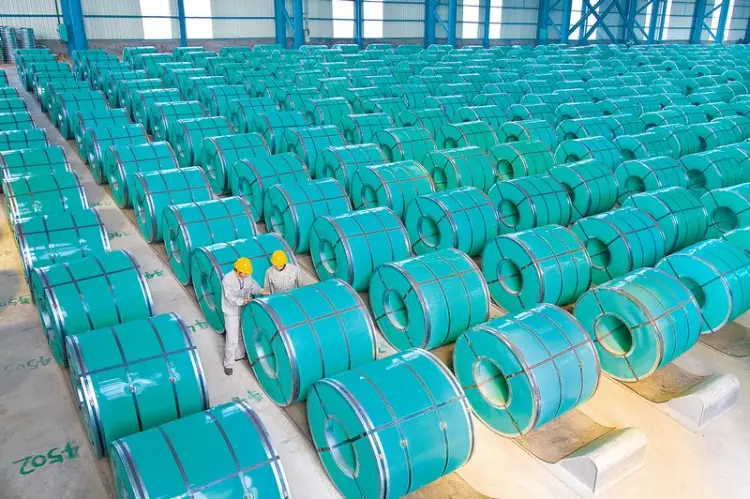
ASME SA572/SA572M Grade 60 High-Strength Low-Alloy Steel Coil
ASME SA572/SA572M Grade 60 High-Strength Low-Alloy Steel Coil | Advanced Structural Material
Comprehensive data for ASME SA572/SA572M Grade 60 carbon and low-alloy high-strength steel coil, including chemical composition, mechanical properties, thermal and electrical properties, and international equivalents.
Hot rolling, controlled rolling, normalizing (if specified); suitable for cold forming, machining, welding, and punching
- Phone : +8618037372205
- Email : [email protected]
- WhatsApp: Contact via Whtsapp
- WeChat: +8618037372205
ASME SA572/SA572M Grade 60 High-Strength Low-Alloy Steel Coil Introduction
ASME SA572/SA572M Grade 60 is a high-strength low-alloy (HSLA) structural steel primarily supplied in coil form. It is a columbium-vanadium (niobium-vanadium) strengthened steel offering a minimum yield strength of 60 ksi (415 MPa) and tensile strength between 75–100 ksi (520–690 MPa). This grade is widely utilized for welded structures, bridges, buildings, and heavy machinery where weight reduction through higher strength is essential. It provides excellent notch toughness, good weldability, and formability under controlled conditions. The microalloying elements (Cb and V) ensure fine grain size and precipitation hardening, which enhance mechanical properties without requiring quenching and tempering. The grade is produced to the ASME SA572/SA572M specification, which is identical to ASTM A572/A572M in technical requirements.
ASME SA572/SA572M Grade 60 High-Strength Low-Alloy Steel Coil Chemical Composition
The chemical composition complies with ASME SA572/SA572M Grade 60. Columbium (niobium) and vanadium are the primary microalloying elements, present either individually or in combination, to achieve the required strength and grain refinement. Maximum limits on carbon, manganese, phosphorus, sulfur, and silicon ensure good weldability and toughness.
| Element | Standard Value (%) | Remarks |
|---|---|---|
| Carbon (C) | ≤ 0.26 | Heat analysis |
| Manganese (Mn) | ≤ 1.35 | Heat analysis |
| Phosphorus (P) | ≤ 0.04 | Heat analysis |
| Sulfur (S) | ≤ 0.05 | Heat analysis |
| Silicon (Si) | ≤ 0.40 | For killed steel; may be specified up to 0.40 max |
| Columbium (Nb) | 0.005–0.05* | Also known as niobium; present if Cb is used |
| Vanadium (V) | 0.01–0.15* | Present if V is used |
| Nitrogen (N) | ≤ 0.015 (if Cb is used) | Applicable when columbium is added; otherwise not required |
| Copper (Cu) | ≤ 0.40 (if specified) | Optional; not mandatory for standard Grade 60 |
ASME SA572/SA572M Grade 60 High-Strength Low-Alloy Steel Coil Thermal and Electrical Physical Properties
The following physical properties are typical for ASME SA572 Grade 60 steel at room temperature and are intended for design and modeling. Actual values may vary based on manufacturing conditions and composition within the specification range. Thermal expansion is comparable to other carbon-manganese steels.
| Property | Typical Value | Unit | Condition / Temperature |
|---|---|---|---|
| Density (ρ) | 7.85 | g/cm³ | At 20 °C |
| Modulus of Elasticity (E) | 200 | GPa | At 20 °C |
| Shear Modulus (G) | 77 | GPa | At 20 °C |
| Poisson's Ratio (ν) | 0.3 | - | At 20 °C |
| Thermal Expansion Coefficient (α) | 12.0 × 10⁻⁶ | 1/°C | 20–100 °C |
| Thermal Expansion Coefficient (α) | 12.5 × 10⁻⁶ | 1/°C | 20–200 °C |
| Thermal Expansion Coefficient (α) | 13.2 × 10⁻⁶ | 1/°C | 20–400 °C |
| Thermal Conductivity (λ) | 52 | W/(m·K) | At 20 °C |
| Specific Heat Capacity (cp) | 470 | J/(kg·K) | At 20 °C |
| Electrical Resistivity (ρe) | 0.16 × 10⁻⁶ | Ω·m | At 20 °C |
ASME SA572/SA572M Grade 60 High-Strength Low-Alloy Steel Coil Mechanical Properties
Mechanical properties are based on ASME SA572/SA572M Grade 60 for plates, coils, and bars in thicknesses up to 100 mm (4 in.). Values may vary with product thickness and orientation. Elongation depends on gauge length: 200 mm (8 in.) or 50 mm (2 in.). Charpy V-notch impact tests are supplementary and not mandatory unless specified.
| Property | Standard Required Value | Unit | Test Condition / Thickness |
|---|---|---|---|
| Yield Strength (ReH) | ≥ 415 | MPa | All thicknesses (≤ 100 mm) |
| Yield Strength (ReH) | ≥ 60 | ksi | All thicknesses (≤ 4 in.) |
| Tensile Strength (Rm) | 520 – 690 | MPa | All thicknesses |
| Tensile Strength (Rm) | 75 – 100 | ksi | All thicknesses |
| Elongation (A) in 200 mm | ≥ 18 | % | Plates, coils, bars ≤ 100 mm thick |
| Elongation (A) in 50 mm | ≥ 21 | % | Plates, coils, bars ≤ 100 mm thick |
| Bend Test (Dia = bend diameter, a = sample thickness) | Dia = 2.5a (for thickness ≤ 20 mm); Dia = 3a (for thickness > 20 mm) | - | 180° bend; no cracks on outside of bent portion |
| Charpy V-notch Impact (KV₂) | Not required unless specified | J | Supplementary requirement |
ASME SA572/SA572M Grade 60 High-Strength Low-Alloy Steel Coil Identical Material Standards and Grade Replacements
| Country / Region | Standard | Grade | Remarks |
|---|---|---|---|
| USA / International | ASTM A572/A572M | Grade 60 [415] | Identical technical requirements, dual certified with ASME SA572 |
| USA / International | ASME SA572/SA572M | Grade 60 [415] | Original specification; identical to ASTM A572 Grade 60 |
| Canada | CSA G40.21 | 50A / 350A | Not identical but sometimes accepted for certain structural needs; verify chemistry and mechanicals |
ASME SA572/SA572M Grade 60 High-Strength Low-Alloy Steel Coil Application Introduction
ASME SA572 Grade 60 steel coil is engineered for structural applications demanding high strength-to-weight ratios. It is suitable for welded, bolted, and riveted structures in heavy engineering. Its controlled grain size and low carbon equivalent improve weldability and low-temperature toughness. Typical processing includes cutting, cold forming, hot forming, and welding with low-hydrogen practices. Preheating is generally not required for moderate thicknesses, but may be recommended based on carbon equivalent and joint restraint.
Product Applications: Welded plate girders, Structural columns and beams, Boom and arm sections for excavators, Chassis and frame rails for heavy trucks, Offshore platform decks and modules, Wind turbine tower sections, Bridge bearing assemblies
Processed into products: Flanges and webs for built-up sections, Stiffeners and gusset plates, Lifting lugs and pad eyes, Base plates and splice plates, Crane rail beams, Excavator bucket shells, Trailer frame cross members
Application industries: Bridge construction, Building and high-rise structures, Heavy machinery and earthmoving equipment, Shipbuilding and offshore structures, Railway cars and wagon frame manufacturing, Transmission towers and telecom structures, Pressure vessel and storage tank manufacturing (non-ASME Section VIII applications), Mining and aggregate handling equipment
ASME SA572/SA572M Grade 60 High-Strength Low-Alloy Steel Coil Similar or Closely Related Alternative Materials
| Country / Region | Standard | Grade | Remarks |
|---|---|---|---|
| European Union | EN 10025-4 | S460M | Thermomechanical rolled; similar strength but different toughness and production route |
| European Union | EN 10025-3 | S460N / S460NL | Normalized high-strength steel; close in strength, may require qualification of weldability |
| Japan | JIS G3106 | SM570 | Similar tensile strength range, but carbon equivalent and impact test requirements differ |
| China | GB/T 1591 | Q460C / Q460D / Q460E | Comparable minimum yield strength; need to compare impact toughness levels |
| International | ISO 4951-1 | S460M | Similar mechanical properties, but slight differences in chemistry and delivery condition |
Notes:
- ASME SA572/SA572M Grade 60 is often supplied with additional requirements for fine-grain practice and/or supplementary Charpy impact testing (e.g., at -20°C or -40°C) when toughness is critical.
- The material can be provided with ultrasonic testing in accordance with ASTM A578/A578M or equivalent.
- When used in pressure vessel construction, design must be in accordance with ASME BPVC Section VIII, Division 1 or 2, where applicable, but Grade 60 may not be listed in all sections – check allowable stress tables.
- For welding, low-hydrogen electrodes (AWS E7018) or equivalent filler metals are recommended; preheat and interpass temperatures should follow established guidelines based on carbon equivalent and thickness.
- Typical coil width ranges from 1000 mm to 2000 mm, with thickness from 2.0 mm up to 12.7 mm in coil form; heavier gauges are available as plate.
- Share



