
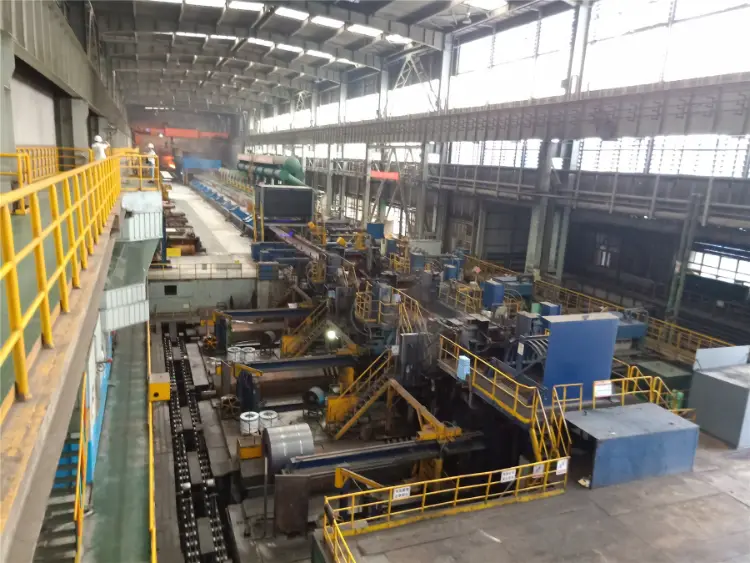
ASME SA572/SA572M Grade 55 Low-Alloy High-Strength Steel Coil
ASME SA572/SA572M Grade 55 Low-Alloy High-Strength Steel Coil - Properties & Equivalents
Technical data sheet for ASME SA572/SA572M Grade 55 steel coil: chemical composition, mechanical properties, physical characteristics, international equivalents, and application guidance for structural engineering.
Welding, hot-rolling, cold-forming, machining, punching, shearing
- Phone : +8618037372205
- Email : [email protected]
- WhatsApp: Contact via Whtsapp
- WeChat: +8618037372205
ASME SA572/SA572M Grade 55 Low-Alloy High-Strength Steel Coil Introduction
ASME SA572/SA572M Grade 55 is a carbon and low-alloy high-strength structural steel supplied in coil form, also available as plate, strip, or sheet. It offers a minimum yield strength of 55 ksi (380 MPa) and tensile strength of 70 ksi (485 MPa). The steel provides excellent weldability, formability, and notch toughness, making it suitable for riveted, bolted, or welded construction in bridges, buildings, and heavy machinery. It is produced to the chemical and mechanical requirements of ASME SA572/SA572M, which is identical to ASTM A572/A572M. Typical delivery conditions include as-rolled, normalized, or stress-relieved, with optional impact testing.
ASME SA572/SA572M Grade 55 Low-Alloy High-Strength Steel Coil Chemical Composition
The heat analysis shall conform to the requirements of ASTM A572/A572M. For Grade 55, maximum limits apply; grain refining elements such as niobium, vanadium, or titanium may be added at the manufacturer's discretion to achieve the required mechanical properties. Typical silicon content is reported when it is specified.
| Element | Standard Value (max, unless range) | Remarks |
|---|---|---|
| Carbon (C) | 0.25% | For thickness ≤ 4 in. (100 mm) |
| Manganese (Mn) | 1.35% | May be adjusted for thickness |
| Phosphorus (P) | 0.030% | Stricter limits may apply by agreement |
| Sulfur (S) | 0.030% | |
| Silicon (Si) | 0.15–0.40% (if specified) | When silicon is required, maximum 0.40% |
| Columbium (Nb) | 0.005–0.05% | Optional grain refiner |
| Vanadium (V) | 0.01–0.15% | Optional grain refiner |
| Titanium (Ti) | 0.006–0.04% | Optional grain refiner |
| Nitrogen (N) | 0.015% max | When applicable |
| Other elements | As agreed | Residuals shall not exceed standard limits |
ASME SA572/SA572M Grade 55 Low-Alloy High-Strength Steel Coil Thermal and Electrical Physical Properties
The physical constants below are representative for low-alloy carbon steel and are not part of the material standard. They are provided for engineering calculations and design. Values are measured at room temperature unless otherwise specified.
| Property | Typical Value | Unit | Test Condition / Remarks |
|---|---|---|---|
| Density (ρ) | 7.85 | g/cm³ | At 20°C |
| Modulus of Elasticity (E) | 200 | GPa | Tension, room temperature |
| Shear Modulus (G) | 80 | GPa | Calculated |
| Poisson's Ratio (ν) | 0.30 | – | Elastic range |
| Thermal Expansion Coefficient (α) | 11.7 | 10⁻⁶/K | 20–100°C |
| Thermal Expansion Coefficient (α) | 12.4 | 10⁻⁶/K | 20–200°C |
| Thermal Conductivity (λ) | 51.9 | W/(m·K) | At 20°C |
| Specific Heat Capacity (c) | 460 | J/(kg·K) | Ambient temperature |
| Electrical Resistivity (ρ₃) | 0.15 | μΩ·m | At 20°C |
ASME SA572/SA572M Grade 55 Low-Alloy High-Strength Steel Coil Mechanical Properties
The mechanical properties are determined according to ASTM A6/A6M. Tensile tests are conducted in the longitudinal direction for coil products. Yield and tensile strengths remain consistent for thicknesses up to 4 in. (100 mm). Elongation requirements vary with thickness, and bend tests must show no cracks on the outside of the bent portion. Impact toughness (KV) is not mandatory but can be ordered for specific conditions.
| Property | Standard Requirement | Unit | Test Condition / Remarks |
|---|---|---|---|
| Yield Strength (ReH) | ≥ 55 | ksi [380 MPa] | Thickness ≤ 4 in. (100 mm); for thinner material (≤ 0.75 in.) the same minimum applies |
| Tensile Strength (Rm) | ≥ 70 | ksi [485 MPa] | Thickness ≤ 4 in. (100 mm) |
| Elongation (A) in 8 in. [200 mm] | ≥ 18% | % | Thickness ≤ 0.75 in. (20 mm), longitudinal |
| Elongation (A) in 8 in. [200 mm] | ≥ 17% | % | Thickness 0.75–1.25 in. (20–30 mm) |
| Elongation (A) in 8 in. [200 mm] | ≥ 16% | % | Thickness 1.25–2 in. (30–50 mm) |
| Elongation (A) in 8 in. [200 mm] | ≥ 15% | % | Thickness 2–4 in. (50–100 mm) |
| Elongation (A) in 2 in. [50 mm] | ≥ 23% | % | Thickness ≤ 0.75 in. (for info; specimen type per A6) |
| Bend Test (180°) – bend diameter / thickness ratio | 2.0 T | – | Thickness ≤ 0.75 in. (19 mm) |
| Bend Test (180°) – bend diameter / thickness ratio | 2.5 T | – | Thickness 0.75–1.25 in. (19–32 mm) |
| Bend Test (180°) – bend diameter / thickness ratio | 3.0 T | – | Thickness > 1.25 in. (32 mm) |
| Impact Toughness (KV) | Not specified; available by agreement | ft·lbf [J] | Typically 20 ft·lbf @ -20°F or other temperature on request |
ASME SA572/SA572M Grade 55 Low-Alloy High-Strength Steel Coil Exact Equivalent Standards and Replaceable Grades
| Country / Region | Standard | Grade / Designation | Remarks |
|---|---|---|---|
| USA | ASTM A572/A572M | Grade 55 [380] | Identical chemical and mechanical requirements; ASTM and ASME grades are interchangeable. |
| USA | ASME SA572/SA572M | Grade 55 [380] | Original specification; SA572 is adopted from ASTM A572 for boiler and pressure vessel code applications. |
ASME SA572/SA572M Grade 55 Low-Alloy High-Strength Steel Coil Application Introduction
ASME SA572/SA572M Grade 55 steel coil finds extensive use in structural and heavy engineering applications where high strength-to-weight ratio and dependable weldability are required. Its formability allows efficient production of cold-formed sections and welded built-up members. Typical end uses span across multiple industries:
Product Applications: Welded bridge girders and box sections, High-strength building columns and trusses, Crane booms, jibs, and outriggers, Heavy-duty truck chassis and trailer frames, Railcar underframes and couplers, Transmission line poles and lattice towers, Offshore platform structural members, Steel silos, hoppers, and industrial ducting
Processed into products: Flanges and webs of fabricated beams, Cold-formed purlins and side rails, Stiffened panels for ship decks, Brackets, gusset plates, and connection plates, Hydraulic cylinder bodies and rods, Excavator booms and dipper arms, Pressure vessel skirts and supports, Machinery frames and base plates
Application industries: Civil and structural engineering, Bridge construction and repair, Heavy equipment and machinery manufacturing, Shipbuilding and offshore structures, Railcar and automotive transportation, Wind energy towers and foundations, Storage tanks and pressure vessels (non-code primary structure), Mining and earth-moving equipment
ASME SA572/SA572M Grade 55 Low-Alloy High-Strength Steel Coil Similar / Alternative Materials with Comparable Performance
| Country / Region | Standard | Grade | Remarks |
|---|---|---|---|
| European Union | EN 10025-2 | S355J2 (+N) | Minimum yield 355 MPa, tensile 470–630 MPa; slightly lower yield but improved toughness. Suitable for structural use with comparable weldability. |
| China | GB/T 1591 | Q355B / Q355C / Q355D | Yield 355 MPa, similar carbon equivalent; often used as interchangeable in general construction. |
| Japan | JIS G3106 | SM490A / B / C | Yield ≥ 325–365 MPa depending on thickness; tensile 490–610 MPa. Suitable for welded structures. |
| Germany (historical) | DIN 17100 | St52-3 | Obsolete but shows similar strength range; replaced by S355J2. |
| India | IS 2062 | E350 BR / C | Yield 350 MPa min; close in strength and chemistry for moderate conditions. |
| International | ISO 630-2 | S355K2 | Structural steel with 355 MPa yield; correlates with Grade 55 when slightly lower yield is acceptable. |
Notes:
Ordering Information: Coil thicknesses typically range from 1.5 mm to 20 mm, with widths up to 2000 mm, depending on the mill. Welding consumables should match the strength level (e.g., E70XX electrodes). Corrosion protection by painting or galvanizing is common for outdoor exposure. Testing and certification per EN 10204 3.1 or ASTM A6/A6M are available. For low-temperature applications, specify supplementary Charpy V-notch requirements. The data provided herein is for general reference; always consult the latest ASME SA572/SA572M standard for project-specific acceptance criteria.
- Share



