
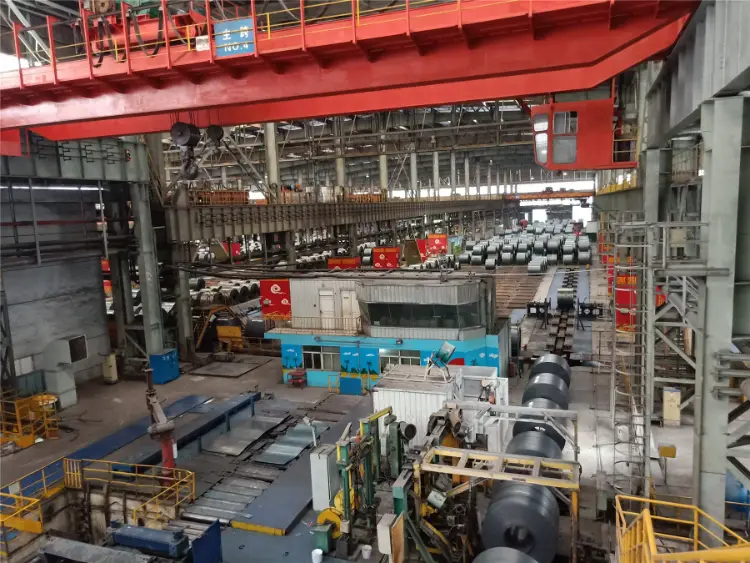
ASME SA572/SA572M Grade 65 Carbon & Low-Alloy High-Strength Steel Coil
ASME SA572/SA572M Grade 65 Carbon & Low-Alloy High-Strength Steel Coil - Expert Data Hub
In-depth technical profile of ASME SA572/SA572M Grade 65 carbon and low-alloy high-strength steel coil, including chemical composition, mechanical and physical properties, international equivalents, and application guidance.
Welding, bolting, riveting, cold forming, bending, stamping, machining, sawing, drilling, oxy-fuel and plasma cutting
- Phone : +8618037372205
- Email : [email protected]
- WhatsApp: Contact via Whtsapp
- WeChat: +8618037372205
ASME SA572/SA572M Grade 65 Carbon & Low-Alloy High-Strength Steel Coil Introduction
ASME SA572/SA572M Grade 65 is a high-strength low-alloy (HSLA) structural steel specified primarily for bolted, riveted, or welded construction. It is produced in coil form and classified as a niobium-vanadium columbium-bearing steel, designed to deliver a minimum yield strength of 450 MPa (65 ksi) in thicknesses up to 32 mm (1.25 in.).
Key features:
- Excellent strength-to-weight ratio, enabling lighter structural designs.
- Good weldability with standard shop practices when low-hydrogen procedures are followed.
- Ductility sufficient for cold forming and bending operations.
- Notch toughness suitable for moderate service temperatures when killed fine-grain practice is applied.
- Widely adopted in bridge, building, and heavy equipment construction.
The material is typically supplied in as-rolled or normalized condition, and can undergo further processing such as pickling and oiling for coil products.
ASME SA572/SA572M Grade 65 Carbon & Low-Alloy High-Strength Steel Coil Chemical Composition
Chemical requirements per ASME SA572/SA572M Grade 65. The steel is typically microalloyed with niobium (columbium), vanadium, or a combination thereof to achieve strength. Silicon content is reported when specifically requested. In practice, producers balance carbon and manganese with grain refiners to meet mechanical properties while maintaining good weldability. Limits shown are maxima unless a range is given.
Note: The standard does not mandate exact amounts of Nb or V; they are used at the manufacturer's discretion to satisfy property requirements.
| Element | Value (max, unless range) | Remarks |
|---|---|---|
| Carbon (C) | 0.26 | For thickness ≤ 19 mm (0.75 in.); varies slightly by product form |
| Manganese (Mn) | 1.35 | May be reduced when adequate strength is achieved via other alloying |
| Phosphorus (P) | 0.04 | Strictly controlled for weldability and toughness |
| Sulfur (S) | 0.05 | Can be lower for improved formability |
| Silicon (Si) | 0.15 – 0.40 | Typically specified only upon request; aids deoxidation |
| Niobium (Nb) / Columbium (Cb) | 0.005 – 0.05* | Grain refiner, added as necessary (*range typical, not mandatory limit) |
| Vanadium (V) | 0.01 – 0.15* | Often used alone or with Nb; actual addition varies |
| Copper (Cu) | 0.20 min (when specified) | To improve atmospheric corrosion resistance (optional) |
ASME SA572/SA572M Grade 65 Carbon & Low-Alloy High-Strength Steel Coil Thermal and Electrical Physical Properties
Physical properties for low-alloy carbon-manganese steels are relatively insensitive to minor alloying variations. The values below are representative for ASME SA572 Gr. 65 at room temperature unless noted otherwise. These are provided for engineering calculations and are not part of the procurement specification.
Coefficient of thermal expansion (CTE) can vary with temperature; the 20-100°C range is the most commonly used for structural analysis.
| Property | Value (Typical) | Unit | Test Condition / Notes |
|---|---|---|---|
| Density (ρ) | 7.85 | g/cm³ | Room temperature |
| Modulus of Elasticity (E) | 200 | GPa | Tension, ambient temperature |
| Shear Modulus (G) | 80 | GPa | Calculated from E and ν |
| Poisson's Ratio (ν) | 0.3 | dimensionless | Elastic range |
| Thermal Expansion Coeff. (α) | 11.7 | 10⁻⁶/°C | 20 – 100 °C |
| Thermal Expansion Coeff. (α) | 12.5 | 10⁻⁶/°C | 20 – 200 °C |
| Thermal Conductivity (λ) | 50 | W/(m·K) | At 20°C |
| Specific Heat Capacity (cp) | 460 – 480 | J/(kg·K) | 20°C – 100°C |
| Electrical Resistivity (ρ_e) | 0.18 – 0.22 | μΩ·m | 20°C |
ASME SA572/SA572M Grade 65 Carbon & Low-Alloy High-Strength Steel Coil Mechanical Properties
Mechanical properties for ASME SA572/SA572M Grade 65 coil/plate in as-rolled condition. Values depend on specimen orientation and product thickness. The standard guarantees minimum yield and tensile strengths along with minimum elongation. Bending test parameters are included for shop verification. Absorbed energy values (Charpy V-notch) are not mandatory unless supplementary requirements are invoked.
Typical conditions: Longitudinal test, room temperature.
| Property | Value | Unit | Test Condition / Remarks |
|---|---|---|---|
| Yield Strength (ReH / Rp0.2) | 450 min | MPa (65 ksi min) | 0.2% offset; for thicknesses ≤ 32 mm (1.25 in.) |
| Yield Strength (ReH) | 415 min (60 ksi) | MPa | Thickness > 32 mm to 100 mm (source: supplementary limits) |
| Tensile Strength (Rm) | 550 – 700 | MPa (80 – 100 ksi) | Typical range; standard minimum is 550 MPa (80 ksi) for thin products |
| Tensile Strength (Rm) min | 550 (80 ksi) | MPa | Thickness ≤ 20 mm (0.75 in.) |
| Tensile Strength (Rm) min | 515 (75 ksi) | MPa | Thickness > 20 mm to 40 mm (1.5 in.) |
| Elongation (A) in 200 mm | 15 – 18 min | % | 200 mm gauge (8 in.); 15% min typical for plate; 18% for coils/ sheets |
| Elongation (A) in 50 mm | 19 – 22 min | % | 50 mm gauge (2 in.); applicable for thinner products |
| Bend Test (dia. × thick.) | 2.0 t (180°) | - | t = specimen thickness; no cracks on outside of bent portion |
| Charpy Impact (KV₂) | 27 at -20°C (optional) | Joules | When supplementary requirement S5 or S8 is specified (transverse) |
ASME SA572/SA572M Grade 65 Carbon & Low-Alloy High-Strength Steel Coil Direct Equivalent Standards and Replaceable Grades
| Country/Region | Standard | Grade | Remarks |
|---|---|---|---|
| USA | ASTM A572/A572M | Grade 65 [450] | Identical to ASME SA572 Grade 65; specifications are technically equivalent. |
| Europe | EN 10025-3 / EN 10025-4 | S460N / S460M | S460N (normalized) and S460M (TMCP) closely match strength level; welding and toughness differ slightly. |
| Japan | JIS G3106 | SM570 | Min. yield 460 MPa; often used for welded structures; chemical composition is harmonized. |
| China | GB/T 1591 | Q460D / Q460E | Minimum yield 460 MPa; D/E variants cover impact requirements. |
| International | ISO 4950-2 | E460 | Yield strength 460 MPa class; suitable for structural use. |
ASME SA572/SA572M Grade 65 Carbon & Low-Alloy High-Strength Steel Coil Application Introduction
ASME SA572 Grade 65 is engineered for structural applications demanding high strength and moderate toughness. Its balanced chemistry and controlled rolling practice make it suitable for welding-intensive assemblies in heavy industries. The material is frequently adopted for main load-carrying components in bridges, building frames, mobile cranes, and heavy-duty machinery. When higher atmospheric corrosion resistance is desired, a copper-bearing variant (Type 2) can be specified.
Product Applications: Steel girder bridges and pedestrian overpasses, High-rise building columns and trusses, Mobile crane and excavator booms, Rail car underframes and container chassis, Offshore platform decks and tubular joints, Transmission tower legs and anchor plates, Heavy-duty trailer frames
Processed into products: Structural beams (I-beams, H-piles) and columns, Welded box sections and lifting lugs, Cut-to-size gusset plates and stiffeners, Bent plates for crane jibs and boom sections, Machined connecting links and pivot pins, Drilled and bolted splice plates, Cold-formed channels and angle brackets
Application industries: Civil Engineering and Construction, Bridge and Highway Infrastructure, Heavy Machinery and Mining Equipment, Railway Rolling Stock, Shipbuilding and Offshore Structures, Wind Energy (tower and foundation structures), Automotive (commercial vehicle frames)
ASME SA572/SA572M Grade 65 Carbon & Low-Alloy High-Strength Steel Coil Similar / Alternative HSLA Materials
| Country/Region | Standard | Grade | Remarks |
|---|---|---|---|
| USA | ASTM A572 | Grade 60 [415] | One step lower strength grade; higher elongation; often substituted when 65 ksi is not required. |
| USA | ASTM A572 | Grade 70 [485] | Higher strength option but slightly reduced ductility; available in similar thicknesses. |
| Europe | EN 10025-2 | S355J2+N | Lower strength; widely used structural steel; easier to weld and form. |
| Europe | EN 10025-6 | S690QL | Very high strength quenched and tempered steel; requires special welding procedures. |
| Germany | DIN 17100 | St52-3 (historic) | Obsolete but historically similar to S355; not a strength match. |
| China | GB/T 1591 | Q345D | Lower strength HSLA; often used where toughness and weldability are key. |
Notes:
Supplementary requirements may be specified for Charpy impact testing (e.g., S5 or S8), fine grain practice, and through-thickness (Z-direction) properties when ordered under ASME SA572 Supplementary Requirement S17.
Welding: Preheat and interpass temperature should be controlled based on thickness and heat input to avoid hydrogen cracking; the carbon equivalent (CE) typically ranges between 0.38 and 0.43, suggesting low-hydrogen electrodes and procedures.
Forming: Minimum bend radii for cold forming should comply with the recommended 2t–3t rule; hot forming above 650°C may alter mechanical properties.
Corrosion: For unprotected outdoor applications, standard weathering grades (ASME SA588 or SA572 Type 2) are preferred; otherwise, protective coating systems are required.
- Share



