
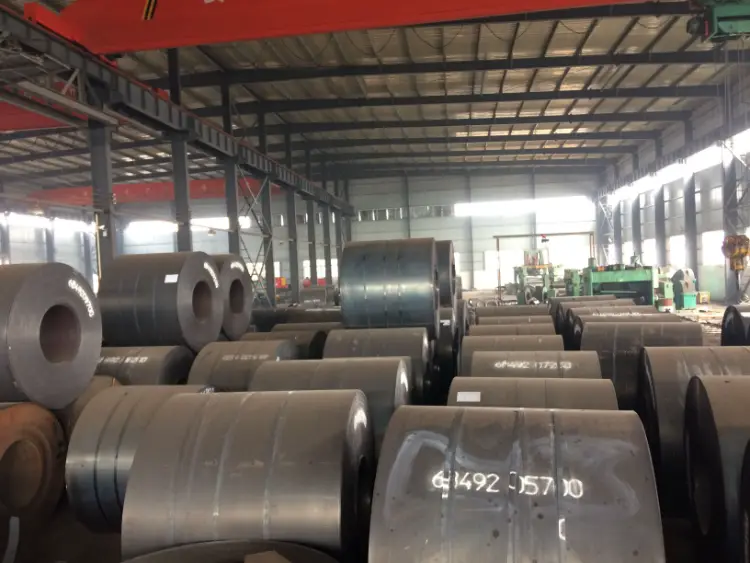
ASME SA514 Grade Q High-Strength Quenched & Tempered Steel Coil
ASME SA514 Grade Q High-Strength Quenched & Tempered Steel Coil | 620 MPa Yield
Explore ASME SA514/SA514M Grade Q carbon and low-alloy high-strength steel coil. Chemical composition, mechanical properties under quenching and tempering, thermal and electrical data, equivalent grades, and typical applications in pressure vessels and structural engineering.
Hot rolling, quenching, tempering, cutting, welding, cold forming (with caution)
- Phone : +8618037372205
- Email : [email protected]
- WhatsApp: Contact via Whtsapp
- WeChat: +8618037372205
ASME SA514 Grade Q High-Strength Quenched & Tempered Steel Coil Introduction
ASME SA514/SA514M Grade Q is a quenched and tempered, carbon and low-alloy high-strength structural steel plate/coil intended primarily for welded pressure vessels. It delivers a minimum yield strength of 620 MPa (90 ksi) and an ultimate tensile strength of 760–895 MPa (110–130 ksi), while maintaining good notch toughness. Grade Q exhibits a fine bainitic/martensitic microstructure that provides an excellent combination of strength, weldability and resistance to brittle fracture. The steel is typically supplied in the quenched and tempered condition and meets the stringent requirements of the ASME Boiler and Pressure Vessel Code.
- Guaranteed high yield and tensile strength for weight-optimized designs.
- Suitable for moderate ambient and low-temperature service when ordered with supplementary toughness requirements.
- Excellent through-thickness homogeneity and flatness after tempering.
ASME SA514 Grade Q High-Strength Quenched & Tempered Steel Coil Chemical Composition as per ASME SA514/SA514M Grade Q
The ladle analysis limits for Grade Q are given below. The steel is fine-grained and microalloyed with vanadium and controlled titanium additions to maintain strength and weldability. Residual elements such as copper and nickel are restricted to safeguard hot ductility and toughness.
- All values are maximum unless a range is shown.
- Boron is not intentionally added in this grade.
| Element | Standard Value (%) | Remarks |
|---|---|---|
| Carbon (C) | 0.12 – 0.21 | For strength and hardenability |
| Manganese (Mn) | 0.70 – 1.00 | Deoxidizer and strength agent |
| Phosphorus (P) | ≤ 0.025 | Controlled for toughness |
| Sulfur (S) | ≤ 0.025 | Controlled for cleanliness |
| Silicon (Si) | 0.15 – 0.35 | Deoxidation and strength |
| Chromium (Cr) | 0.85 – 1.25 | Hardenability and corrosion resistance |
| Molybdenum (Mo) | 0.15 – 0.25 | Hardenability and creep resistance |
| Vanadium (V) | 0.03 – 0.08 | Grain refinement and precipitation strengthening |
| Titanium (Ti) | ≤ 0.02 | Grain refinement and nitrogen fixation |
| Copper (Cu) | ≤ 0.40 | Residual element |
| Nickel (Ni) | ≤ 0.90 | Residual element, may be higher for specific thickness agreements |
| Boron (B) | – | Not intentionally added |
ASME SA514 Grade Q High-Strength Quenched & Tempered Steel Coil Physical Properties
The following physical constants are representative for quenched and tempered low-alloy steels with similar chemical composition. Actual values may vary slightly depending on heat treatment and exact chemistry. These data assist in design calculations for thermal expansion, heat transfer, and electrical resistivity.
- Density measured at 20°C.
- Thermal conductivity at 100°C.
- Electrical resistivity at room temperature.
| Property | Typical Value | Unit | Test Condition / Remarks |
|---|---|---|---|
| Density (ρ) | 7.85 | g/cm³ | At 20°C |
| Modulus of Elasticity (E) | 205 | GPa | Tension, at room temperature |
| Shear Modulus (G) | 80 | GPa | Calculated from E and ν |
| Poisson's Ratio (ν) | 0.30 | – | Typical for ferritic steel |
| Thermal Expansion Coefficient (α) | 11.7 × 10⁻⁶ | m/(m·K) | Mean value 20–100°C |
| Thermal Expansion Coefficient (α) | 12.5 × 10⁻⁶ | m/(m·K) | Mean value 20–200°C |
| Thermal Conductivity (λ) | 45 | W/(m·K) | At 100°C |
| Specific Heat Capacity (c) | 480 | J/(kg·K) | At room temperature |
| Electrical Resistivity (ρ_e) | 0.22 × 10⁻⁶ | Ω·m | At 20°C |
ASME SA514 Grade Q High-Strength Quenched & Tempered Steel Coil Mechanical Properties
Mechanical properties are verified after quenching and tempering in accordance with the standard. Transverse test specimens are taken from the plate/coil. Elongation values depend on specimen gauge length and product thickness. Bending tests are conducted at 180° with the specified mandrel diameter ratio. Impact toughness is an optional supplementary requirement (S5), often specified at temperatures down to -40°C.
- Yield strength (ReH) – 0.2% offset method.
- Tensile test specimens: rectangular or round as per ASME SA370.
| Property | Required Value | Unit | Test Condition |
|---|---|---|---|
| Yield Strength (ReH) | ≥ 620 | MPa | At room temperature, transverse specimen |
| Tensile Strength (Rm) | 760 – 895 | MPa | At room temperature, transverse specimen |
| Elongation (A) | ≥ 18 | % | Gauge length 2 in (50 mm), thickness ≤ ¾ in (19 mm) |
| Elongation (A) | ≥ 16 | % | Gauge length 8 in (200 mm), thickness > ¾ in to 2.5 in (19–65 mm) |
| Bend Test | No cracks | – | 180° bend, mandrel diameter = 3t (t = specimen thickness), any direction |
| Charpy V-Notch Impact (KV) | ≥ 27 (typical) | J | Transverse specimen at -40°C (optional S5 supplementary requirement) |
| Hardness | Approx. 235–293 HBW | HBW | For information only, not a standard requirement |
ASME SA514 Grade Q High-Strength Quenched & Tempered Steel Coil Identical or Fully Equivalent Standards and Alternative Designations
| Country/Region | Standard | Grade/Designation | Remarks |
|---|---|---|---|
| USA | ASTM A514/A514M | Grade Q | Chemically and mechanically identical; ASME SA514 is the Boiler & Pressure Vessel Code adoption of ASTM A514. |
| USA | ASTM A517/A517M | Grade Q | Identical chemistry but intended for pressure vessel shell courses where moderate strength and high toughness are required; tensile requirements match SA514 Grade Q. |
ASME SA514 Grade Q High-Strength Quenched & Tempered Steel Coil Application Introduction
ASME SA514 Grade Q is tailored for heavy welded fabrications where high strength-to-weight ratio and reliable toughness are essential. The quenched and tempered condition ensures uniformity and enables the steel to be processed into a wide variety of end-use components.
- Preferred for applications requiring a minimum yield strength of 620 MPa in thicknesses up to 65 mm.
- Commonly chosen for pressure vessel shells, bridges, and mobile equipment where transport weight is critical.
Product Applications: Welded pressure vessels and heat exchangers (ASME Section VIII Div.1 & 2), Mining truck beds and buckets, Bridge structural elements, Mobile crane boom sections, Hydraulic cylinder bodies and rods (thick wall), Offshore platform nodes and legs, Roll-over protective structures (ROPS) for heavy machinery
Processed into products: Pressure vessel shells, heads, and flanges, Bullet and spherical storage tanks, Gear rings and slewing rings, Heavy-duty shafting and axles, Wear plates and impact-resistant liners, Welded structural channels and built-up sections, Crane outrigger beams and counterweight brackets
Application industries: Oil & Gas (pressure vessels, separators, storage tanks), Power Generation (penstocks, turbine scroll casings), Mining & Heavy Earthmoving (dump truck bodies, excavator booms, loader arms), Shipbuilding & Offshore (jack-up rig legs, crane pedestals), Industrial Machinery (press frames, crusher jaws), Bridge Construction (girders, orthotropic decks), Transportation (heavy haulage trailers, mobile crane telescopic booms)
ASME SA514 Grade Q High-Strength Quenched & Tempered Steel Coil Similar or Closely Matching High-Strength QT Steels
| Country/Region | Standard | Grade/Designation | Remarks |
|---|---|---|---|
| Europe | EN 10025-6 | S690Q / S690QL / S690QL1 | Yield ≥690 MPa, tensile 770–940 MPa; higher strength than SA514 Grade Q but often used as an alternative after engineering assessment. |
| Europe | EN 10028-6 | P690Q / P690QL1 / P690QL2 | Pressure vessel steel with enhanced through-thickness properties, suitable for low temperatures. Strength level similar to Grade Q. |
| Japan | JIS G 3128 | SHY685 / SHY685N / SHY685NS | High yield strength (≥685 MPa) steel for welded structures; comparable to SA514 Grade Q in strength and weldability. |
| China | GB/T 16270 | Q620D / Q690D | Quenched and tempered high-strength structural steel; Q620D has similar minimum yield, Q690D slightly higher. Can replace Grade Q with appropriate design adjustments. |
| International | ISO 4950-2/3 | S620Q / S690Q | ISO standard high yield strength flat products; S620Q matches the 620 MPa yield level of Grade Q. |
Notes:
Welding: Preheating (typically 100–200°C) and low-hydrogen practices are recommended. Post-weld heat treatment is not normally required but may be applied for stress relief; users must verify that tempering temperature is not exceeded to avoid loss of strength. Forming: Cold forming should be done with generous radius; hot forming must be followed by re-quenching and tempering. Availability: Supplied as coils or cut-to-length plates. Thickness range usually up to 2.5 in (65 mm). For thicknesses above 65 mm or for the highest toughness levels, consider upgraded grades (e.g., S690QL1) or alternative standards.
- Share



