
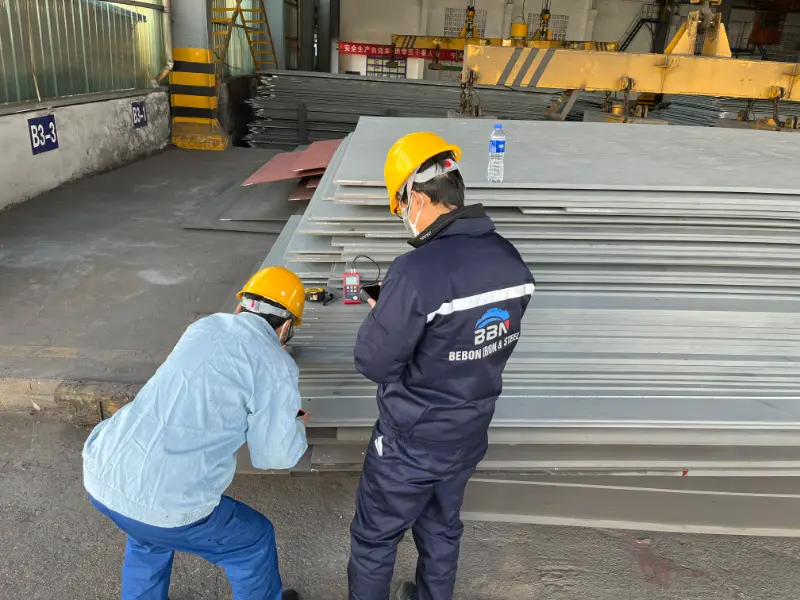
Q355NH Weathering Steel per GB/T 4171
Q355NH Weathering Steel per GB/T 4171 - Full Material Data & Equivalents
Comprehensive material data for Q355NH weathering steel according to Chinese standard GB/T 4171, including chemistry, mechanical & physical properties, precise international equivalents, and application guidance.
Hot rolling, normalizing, controlled rolling, cold forming, welding, machining
- Phone : +8618037372205
- Email : [email protected]
- WhatsApp: Contact via Whtsapp
- WeChat: +8618037372205
Q355NH Weathering Steel per GB/T 4171 Introduction
Q355NH is a high-strength low-alloy structural steel governed by GB/T 4171 (Atmospheric corrosion resisting structural steel). It is specifically designed for outdoor applications without protective coatings, developing a dense, adherent oxide patina that retards further corrosion. With a minimum yield strength of 355 MPa and good weldability, it is widely used in bridges, containers, and building structures.
Key features:
- Enhanced atmospheric resistance via additions of Cu, Cr, and Ni.
- Excellent combination of strength and ductility, with elongation ≥22%.
- Available in multiple thickness ranges with reliable mechanical properties.
- Can be supplied to various impact test temperatures (+20°C, 0°C, -20°C).
- Cost-effective alternative to coated or stainless steels in non-marine environments.
Q355NH Weathering Steel per GB/T 4171 Chemical composition
The chemistry of Q355NH is formulated to provide a protective rust layer. Copper, chromium, and nickel are intentionally added to improve atmospheric corrosion resistance. Phosphorus and sulfur are kept low to ensure weldability and toughness. Grain-refining elements such as Nb, V, or Ti may be used optionally.
| Chemical element | Standard value | Remarks |
|---|---|---|
| C | ≤0.16 | |
| Si | ≤0.50 | |
| Mn | 0.50 – 1.50 | |
| P | ≤0.030 | |
| S | ≤0.030 | |
| Cu | 0.20 – 0.55 | |
| Cr | 0.40 – 0.80 | |
| Ni | ≤0.65 | |
| Grain refining elements (Nb+V+Ti) | ≤0.22 | Optional; applied when finer grain is required |
Q355NH Weathering Steel per GB/T 4171 Thermal and electrical physical properties
The following values are representative for Q355NH and similar low-alloy weathering steels at room temperature. They may vary slightly with actual composition and heat treatment.
| Property | Typical value | Unit | Condition |
|---|---|---|---|
| Density (ρ) | 7.85 | g/cm³ | 20°C |
| Elastic modulus (E) | 206 | GPa | 20°C |
| Shear modulus (G) | 79.3 | GPa | 20°C |
| Poisson's ratio (ν) | 0.3 | - | 20°C |
| Thermal expansion coefficient (α) | 12.0 | ×10⁻⁶/K | 20–100°C |
| Thermal expansion coefficient (α) | 12.5 | ×10⁻⁶/K | 20–200°C |
| Thermal expansion coefficient (α) | 13.0 | ×10⁻⁶/K | 20–300°C |
| Thermal conductivity (λ) | 42 | W/(m·K) | 20°C |
| Specific heat capacity (cₚ) | 460 | J/(kg·K) | 20°C |
| Electrical resistivity (ρₑ) | 0.15 | μΩ·m | 20°C |
Q355NH Weathering Steel per GB/T 4171 Mechanical properties
Tensile and bending properties are thickness-dependent. Impact toughness values are given for the usual test temperatures; the exact temperature is agreed at the time of order. All test pieces are taken in the longitudinal direction unless otherwise stated.
| Property | Requirement | Unit | Test condition / remarks |
|---|---|---|---|
| Yield strength (ReH) | ≥355 | MPa | Thickness ≤16 mm |
| Yield strength (ReH) | ≥345 | MPa | Thickness 16 < t ≤ 40 mm |
| Yield strength (ReH) | ≥335 | MPa | Thickness 40 < t ≤ 63 mm |
| Yield strength (ReH) | ≥325 | MPa | Thickness 63 < t ≤ 80 mm |
| Yield strength (ReH) | ≥315 | MPa | Thickness 80 < t ≤ 100 mm |
| Tensile strength (Rm) | 490 – 630 | MPa | Thickness ≤100 mm |
| Elongation after fracture (A) | ≥22 | % | L₀ = 5.65√S₀; thickness ≤100 mm |
| Bending test (180° bend) | d = 3a | - | Thickness ≤16 mm |
| Bending test (180° bend) | d = 4a | - | Thickness 16 < t ≤ 100 mm |
| Charpy V‑notch impact energy (KV₂) | ≥47 | J | Test temperature +20°C, longitudinal |
| Charpy V‑notch impact energy (KV₂) | ≥34 | J | Test temperature 0°C, longitudinal |
| Charpy V‑notch impact energy (KV₂) | ≥27 | J | Test temperature -20°C, longitudinal |
Q355NH Weathering Steel per GB/T 4171 Fully equivalent international standards and substitute grades
| Country / Region | Standard | Grade | Remarks |
|---|---|---|---|
| International (ISO) | ISO 4952 | S355W | Same nominal yield 355 MPa, atmospheric corrosion resistant |
| Europe | EN 10025-5 | S355J2W | Impact tested at -20°C (KV₂ ≥27 J), fully equivalent |
| Japan | JIS G 3125 | SPA-H | High-strength weathering steel, 355 MPa class, equivalent performance |
Q355NH Weathering Steel per GB/T 4171 Application Introduction
Q355NH is a cost‑effective choice for load‑bearing structures exposed to the weather. It is widely used in unpainted condition, as the stable rust layer provides long‑term protection. Typical applications include bridges, containers, railway vehicles, building frames, and transmission towers. The steel is suitable for welded, bolted, and riveted connections, and can be supplied as pipes, plates, and profiles.
Product Applications: Weather‑resistant steel pipes (structural tubes, hollow sections), Hot‑rolled plates and coils, Structural sections (H‑beams, channels, angles), Cold‑formed profiles and corrugated sheets
Processed into products: Bridge girders, trusses, and deck plates, Container corner posts, rails, and panels, Railcar underframes, side stakes, and end walls, Building columns, beams, and bracing members, Transmission tower legs and lattice arms, Exhaust stacks, silencers, and breeching ducts, Offshore structural walkways and handrails (non‑splash zone)
Application industries: Bridge engineering, Container and intermodal transport, Railway rolling stock (wagons, coaches), Building and civil engineering (exposed steelwork), Power transmission and telecommunication towers, Industrial flues, chimneys, and ductwork, Coastal infrastructure (atmospheric zone, not submerged)
Q355NH Weathering Steel per GB/T 4171 Similar / comparable alternative grades
| Country / Region | Standard | Grade | Remarks |
|---|---|---|---|
| USA | ASTM A588/A588M | Grade A | Yield 345 MPa min (slightly lower), similar corrosion resistance |
| USA | ASTM A588/A588M | Grade B | Yield 345 MPa min, similar weathering characteristics |
| USA | ASTM A709/A709M | Grade 50W | Yield 345 MPa, used in bridges, similar patina behaviour |
| Europe | EN 10025-5 | S355J0W | Yield 355 MPa, impact at 0°C (27 J), close match |
| China | GB/T 4171 | Q345NH | Yield 345 MPa, same corrosion class, slightly lower strength |
Notes:
Q355NH can be ordered with different impact test temperatures (+20°C, 0°C, -20°C) as per agreement. When welding, low‑hydrogen consumables and procedures are recommended to avoid cold cracking; preheating is generally not required for thicknesses up to 25 mm. The protective patina develops more rapidly under alternating wet‑dry cycles; initial rust run‑off may stain adjacent surfaces, so design should minimise crevices and water traps. For extremely aggressive environments (e.g., marine splash zones), a coating system is still advisable.
- Share



