
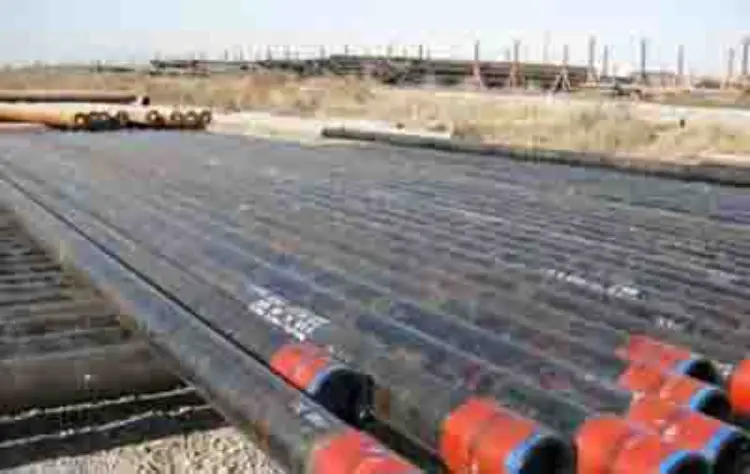
Q415NH Weathering Steel Pipe: Composition, Mechanical Properties and Equivalent Grades
GB/T 4171 Q415NH Weathering Steel Pipe: Chemical, Mechanical & Physical Data
Comprehensive material data for Q415NH weathering steel pipe according to GB/T 4171, including chemical composition, mechanical properties, thermal and electrical properties, equivalent grades, and application guidance.
Hot rolling, controlled rolling, normalizing, cold forming, welding, cutting, and machining
- Phone : +8618037372205
- Email : [email protected]
- WhatsApp: Contact via Whtsapp
- WeChat: +8618037372205
Q415NH Weathering Steel Pipe: Composition, Mechanical Properties and Equivalent Grades Introduction
Q415NH is a high-strength low-alloy structural steel with improved atmospheric corrosion resistance, classified under Chinese standard GB/T 4171 (Weathering structural steel). The designation "Q" indicates yield point, "415" the minimum yield strength of 415 MPa for thickness ≤16 mm, and "NH" signifies atmospheric corrosion resistance. The steel achieves its weathering properties through a carefully balanced addition of copper, chromium, nickel, and other alloying elements, which promote the formation of a dense protective patina when exposed to the atmosphere. This self-protecting oxide layer significantly reduces corrosion rate compared to plain carbon steels, allowing unpainted use in many environments. Q415NH steel pipes are typically supplied in hot-rolled or normalized condition and offer a good combination of strength, toughness, and weather resistance, making them suitable for welded structures and load-bearing components in civil engineering, transportation, and industrial applications.
Q415NH Weathering Steel Pipe: Composition, Mechanical Properties and Equivalent Grades Chemical Composition
The chemical composition limits for Q415NH are specified in GB/T 4171. The alloying elements such as Cu, Cr, and Ni are critical for developing the self-protective rust layer that enhances atmospheric corrosion resistance. All values are maximum unless a range is given.
| Element | Specified Value | Remarks |
|---|---|---|
| Carbon (C) | ≤0.12 | Max 0.12% |
| Silicon (Si) | 0.25 – 0.75 | Range |
| Manganese (Mn) | ≤1.00 | Max 1.00% |
| Phosphorus (P) | ≤0.025 | Max 0.025% |
| Sulfur (S) | ≤0.020 | Max 0.020% |
| Copper (Cu) | 0.20 – 0.55 | Required for weather resistance |
| Chromium (Cr) | 0.30 – 1.25 | Enhances patina formation |
| Nickel (Ni) | ≤0.65 | Max 0.65% |
| Other elements | As per steelmaking practice | Residuals; optionally V, Nb, Ti may be added for grain refinement |
Q415NH Weathering Steel Pipe: Composition, Mechanical Properties and Equivalent Grades Thermal and Electrical Physical Properties
The physical properties of Q415NH weathering steel are similar to those of common low-alloy carbon steels. These values are typical for the grade at room temperature and are not part of the mandatory standard requirements; they are provided for design and calculation purposes only.
| Property | Typical Value | Unit | Test Condition / Remarks |
|---|---|---|---|
| Density (ρ) | 7.85 | g/cm³ | At 20 °C |
| Elastic modulus (E) | 210 | GPa | At room temperature |
| Shear modulus (G) | 81 | GPa | Calculated from E and ν |
| Poisson's ratio (ν) | 0.3 | - | Within elastic range |
| Thermal expansion coefficient (α) | 12.0 | 10⁻⁶/K | 20 – 100 °C |
| Thermal conductivity (λ) | 45 | W/(m·K) | At 20 °C |
| Specific heat capacity (c) | 460 | J/(kg·K) | At 20 °C |
| Electrical resistivity (ρₑ) | 0.20 | μΩ·m | At 20 °C |
Q415NH Weathering Steel Pipe: Composition, Mechanical Properties and Equivalent Grades Mechanical Properties
Mechanical properties of Q415NH steel pipe are specified in GB/T 4171, based on longitudinal test pieces taken from the final product. The yield strength and tensile strength vary with thickness. Impact test is performed at -20 °C using Charpy V-notch specimens. Bending test is conducted at 180° with a mandrel diameter depending on thickness.
| Property | Specified Value | Unit | Test Condition |
|---|---|---|---|
| Yield strength (ReH) | ≥415 | MPa | Thickness ≤16 mm |
| Yield strength (ReH) | ≥405 | MPa | Thickness >16 to 40 mm |
| Yield strength (ReH) | ≥395 | MPa | Thickness >40 to 63 mm |
| Tensile strength (Rm) | 520 – 680 | MPa | All thicknesses |
| Elongation after fracture (A) | ≥22 | % | Thickness ≤16 mm, longitudinal |
| Elongation after fracture (A) | ≥21 | % | Thickness >16 to 40 mm, longitudinal |
| Elongation after fracture (A) | ≥20 | % | Thickness >40 to 63 mm, longitudinal |
| Bending test (180°) | d = 1a | - | Thickness ≤6 mm |
| Bending test (180°) | d = 2a | - | Thickness >6 to 16 mm |
| Bending test (180°) | d = 3a | - | Thickness >16 mm |
| Charpy impact energy (KV2) | ≥34 | J | -20 °C, longitudinal |
Q415NH Weathering Steel Pipe: Composition, Mechanical Properties and Equivalent Grades Full Equivalent Standards and Substitute Grades
| Country/Region | Standard | Grade | Remarks |
|---|---|---|---|
| China | GB/T 4171 | Q415NH | Original grade |
| - | - | - | No direct full international equivalent identified due to unique composition and strength combination |
Q415NH Weathering Steel Pipe: Composition, Mechanical Properties and Equivalent Grades Application Introduction
Q415NH weathering steel pipe is designed for structural applications where high strength and resistance to atmospheric corrosion are both essential. Its self-protecting patina eliminates the need for painting in many environments, reducing maintenance costs. The steel is readily weldable and formable, making it a preferred material for outdoor steel structures and industrial pipework.
Product Applications: Weathering steel pedestrian and highway bridges, Outdoor structural frames and support columns, Railway wagons and cargo containers, Wind turbine towers and poles, Architectural exposed steel elements, Drainage pipes and culverts in mildly corrosive environments, Bracing and scaffolding components
Processed into products: Bridge girders, cross beams, and pipe bracings, Tubular truss members and hollow sections, Chassis and underframe components for rolling stock, Corner posts and roof bows of containers, Lattice tower legs and cross arms, Railing and balustrade pipes, Exhaust stacks and ventilation ducts
Application industries: Civil engineering and infrastructure, Bridge construction, Railway rolling stock manufacturing, Container and freight car manufacturing, Power transmission towers and telecommunication masts, Architecture and building facades, Offshore and coastal structures (with proper corrosion allowances), Industrial piping systems (non-contact with corrosive media)
Q415NH Weathering Steel Pipe: Composition, Mechanical Properties and Equivalent Grades Similar / Near-Equivalent Substitute Recommendations
| Country/Region | Standard | Grade | Remarks |
|---|---|---|---|
| European Union | EN 10025-5 | S420J2W (1.8965) | Very close in yield strength (min 420 MPa) and weathering composition; impact tested at -20°C. Suitable substitute for Q415NH in most structural applications. |
| International | ISO 4952 | S420W | Similar weathering steel with guaranteed impact properties at 0°C or -20°C, compositional range partially aligns. |
| Japan | JIS G 3114 | SMA490BW | Higher tensile strength (490-610 MPa) but comparable weathering capability; yield min 365 MPa (for t≤16mm), slightly lower than Q415NH. Can be considered for less demanding strength applications. |
| USA | ASTM A588 / A588M | Grade B or Grade K | Standard weathering steel but with lower minimum yield strength (345 MPa); not a direct match for strength. Usually used with over-design or alternative strength grades. |
Notes:
- When welding Q415NH, matching weathering electrodes or filler metals (e.g., AWS E80C-Ni1 or equivalent) are recommended to maintain the corrosion resistance of the weld zone.
- In environments with high humidity, prolonged wetness, or marine chlorides, occasional washing or the application of a weathering steel patina accelerator may be beneficial to ensure a stable oxide layer.
- Delivery condition may include hot-dip galvanizing if the pipe is intended for specific corrosive environments where a protective patina is insufficient.
- All data is based on GB/T 4171 and typical material behaviour. For actual purchase specifications, the relevant inspection certificates and mill test reports should be obtained.
- Share



