
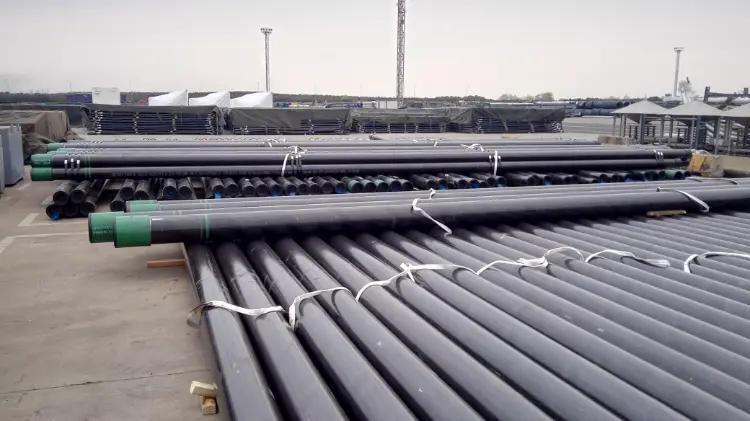
Q550NH Weathering Steel Pipe
Q550NH Weathering Steel Pipe: High-Strength Atmospheric Corrosion Resistance per GB/T 4171
Explore the detailed material properties, chemical composition, mechanical performance, and applications of Q550NH weathering steel pipe under the GB/T 4171 standard.
Hot rolling, Cold forming, Welding, Machining
- Phone : +8618037372205
- Email : [email protected]
- WhatsApp: Contact via Whtsapp
- WeChat: +8618037372205
Q550NH Weathering Steel Pipe Introduction
Q550NH is a high-strength low-alloy structural steel grade specified in the Chinese national standard GB/T 4171, designed for superior atmospheric corrosion resistance. As a weathering steel, it achieves enhanced durability against environmental elements through the addition of alloying elements such as copper, chromium, and nickel, which promote the formation of a dense, protective oxide layer on the surface. This self-healing patina eliminates the need for traditional painting in many applications, significantly reducing maintenance costs over the structure's lifecycle.
The material exhibits a minimum yield strength of 550 MPa, combining robust mechanical properties with good weldability and cold-forming capabilities. It is predominantly utilized in the form of pipes, sheets, and sections for structural applications. Q550NH is engineered for longevity, making it ideal for bridges, towers, containers, railway vehicles, and other long-lifespan industrial and civil engineering projects exposed to outdoor conditions.
Q550NH Weathering Steel Pipe Chemical Composition
The chemical composition of Q550NH steel is meticulously balanced to achieve its hallmark high strength and superior weathering resistance. Carbon content is strictly controlled to ensure good weldability, while manganese provides solid solution strengthening. Key alloying elements like Chromium (Cr), Nickel (Ni), and Copper (Cu) synergistically promote the formation of an adherent, dense, and protective 'patina' during atmospheric exposure. Phosphorus (P) also plays a crucial role in enhancing the corrosion resistance of this weathering steel grade. The data below conforms to the cast analysis limits specified in GB/T 4171-2008.
| Element | Standard Value (wt%) | Remarks |
|---|---|---|
| Carbon (C) | ≤ 0.16 | Controls weldability and toughness |
| Silicon (Si) | ≤ 0.65 | Deoxidizer and strength enhancer |
| Manganese (Mn) | ≤ 2.00 | Primary solid solution strengthener |
| Phosphorus (P) | ≤ 0.035 | Contributes to atmospheric corrosion resistance |
| Sulfur (S) | ≤ 0.030 | Controlled for inclusion control to ensure ductility |
| Chromium (Cr) | 0.40 – 1.20 | Key element for forming the protective surface patina |
| Nickel (Ni) | ≤ 0.65 | Enhances corrosion resistance and low-temperature toughness |
| Copper (Cu) | 0.20 – 0.60 | Essential for the formation of a stable, dense patina |
| Niobium (Nb) | 0.02 – 0.10 | Added for grain refinement and precipitation strengthening |
| Vanadium (V) | 0.02 – 0.10 | Provides additional precipitation strengthening |
| Titanium (Ti) | 0.02 – 0.10 | Grain refiner and precipitation strengthener |
| Molybdenum (Mo) | ≤ 0.20 | Optional addition for improved thick-section strength |
| Aluminum (Al) | ≥ 0.020 | For grain refinement and deoxidation |
Q550NH Weathering Steel Pipe Physical Properties
Physical properties are crucial for design calculations involving thermal loads, stiffness, and electrical conductivity. The values provided are typical for high-strength low-alloy steel at ambient temperature (20°C) unless otherwise noted. Properties like modulus of elasticity (E) and shear modulus (G) are fundamental for structural dynamic analysis. The thermal expansion coefficient (α) dictates the thermal strain in structures subjected to temperature fluctuations, while thermal conductivity (λ) influences heat flow, relevant to fire engineering and welding processes. These values are commonly accepted for this alloy group and can be used for engineering calculations.
| Property | Typical Value | Unit | Test Condition / Remarks |
|---|---|---|---|
| Density (ρ) | 7.85 | g/cm³ | At 20 °C |
| Modulus of Elasticity (E) | 210 | GPa | At 20 °C |
| Shear Modulus (G) | 81 | GPa | Calculated from E and ν at 20 °C |
| Poisson's Ratio (ν) | 0.3 | - | At 20 °C |
| Specific Heat Capacity (Cp) | 452 | J/(kg·K) | At 20 °C |
| Thermal Expansion Coefficient (α) | 11.8 | 10⁻⁶/K | Between 20 °C and 100 °C |
| Thermal Expansion Coefficient (α) | 12.8 | 10⁻⁶/K | Between 20 °C and 200 °C |
| Thermal Expansion Coefficient (α) | 13.5 | 10⁻⁶/K | Between 20 °C and 400 °C |
| Thermal Conductivity (λ) | 42 | W/(m·K) | At 20 °C |
| Thermal Conductivity (λ) | 39 | W/(m·K) | At 300 °C |
| Electrical Resistivity (ρ_e) | 0.25 | µΩ·m | At 20 °C |
Q550NH Weathering Steel Pipe Mechanical Properties
The mechanical properties of Q550NH are established through tensile and impact testing in accordance with GB/T 228 and GB/T 229 methods. The specified values represent the minimum requirements for the longitudinal direction of products in the delivery condition. The yield strength (ReH) is the defining property, with a minimum of 550 MPa for thinner gauges. The impact energy (KV2) test verifies the material's ability to resist brittle fracture at specified test temperatures. As plate thickness increases, the specified strength values decrease moderately due to the inherent behavior of steel solidification and rolling processes.
| Property | Required Value | Unit | Test Condition |
|---|---|---|---|
| Upper Yield Strength (ReH) | ≥ 550 | MPa | Specimen thickness (t) ≤ 16 mm |
| Upper Yield Strength (ReH) | ≥ 530 | MPa | Specimen thickness 16 mm < t ≤ 40 mm |
| Upper Yield Strength (ReH) | ≥ 510 | MPa | Specimen thickness 40 mm < t ≤ 63 mm |
| Upper Yield Strength (ReH) | ≥ 490 | MPa | Specimen thickness 63 mm < t ≤ 80 mm |
| Tensile Strength (Rm) | 620 – 830 | MPa | For all specified thicknesses |
| Elongation after Fracture (A) | ≥ 15 | % | Longitudinal, standard test specimen, 5.65√S0 |
| Elongation after Fracture (A) | ≥ 13 | % | Transverse, standard test specimen, 5.65√S0 |
| Bending Test, 180° | Crack-free | - | Bend diameter (d): 2a for t≤16mm; 3a for t>16mm (where a = specimen thickness) |
| Impact Energy (KV2), Longitudinal | ≥ 47 | J | Test temperature 0 °C |
| Impact Energy (KV2), Longitudinal | ≥ 47 | J | Test temperature -20 °C |
| Impact Energy (KV2), Longitudinal | ≥ 27 | J | Test temperature -40 °C |
Q550NH Weathering Steel Pipe Fully Equivalent Material Standards and Substitutable Grades
| Country/Region | Standard | Grade Designation | Remarks |
|---|---|---|---|
| China | GB/T 4171-2008 | Q550NH | Original standard and base grade for this analysis. High-strength weathering steel. |
| Europe | EN 10025-5:2019 | S550J0W | Equivalent grade with impact energy guaranteed at 0°C. Composition and mechanical properties are closely comparable. |
| Europe | EN 10025-5:2019 | S550J2W | Equivalent grade with impact energy guaranteed at -20°C. Offers enhanced low-temperature performance. |
| United States | ASTM A709/A709M | Grade 70W | Comparable grade for bridges with 70 ksi (485 MPa) minimum yield, but slightly lower than Q550NH. |
| Japan | JIS G 3114:2015 | SMA570W | Hot-rolled atmospheric corrosion-resisting steel for welded structures. One of the closest matches in the JIS standard. |
| International | ISO 4952 | Cor-Ten C Class / Fe 5.5.1 | Weathering steel with improved atmospheric corrosion resistance, chemically and mechanically analogous. |
Q550NH Weathering Steel Pipe Application Introduction
Q550NH weathering steel pipes and profiles are engineered for high-load-bearing structures where long service life with minimal maintenance in an outdoor environment is a priority. The material's ability to form a protective patina makes it uniquely suited to 'paint-free' designs, leading to significant lifecycle cost advantages. Key applications include:
Product Applications: Highway and railway bridges (girder pipes and structural tubes), High-voltage transmission poles and lattice towers, Offshore wind turbine tower sections and platform structural components, Industrial chimneys and exhaust gas ducts, Architectural exposed frameworks and sculptural elements, Cargo containers and dry bulk shipping frames, Railway carriage underframes, bogies, and structural members
Processed into products: Bridgedeck support beams and cross-braces, Flanges and bolted connections for tubular structures, Hot-rolled seamless or welded pipes for truss system chords, Cold-formed rectangular (RHS/SHS) and circular hollow sections (CHS), Welded frames and brackets for heavy machinery housing, Piling elements and foundation columns in corrosive soils
Application industries: Transportation Infrastructure, Energy and Power Transmission, Marine and Offshore Engineering, Rolling Stock and Railway Engineering, Civil Engineering and Architecture, Container and Logistics Equipment
Q550NH Weathering Steel Pipe Similar and Near-Substitute Material Recommendations
| Country/Region | Standard | Grade Designation | Remarks |
|---|---|---|---|
| China | GB/T 4171-2008 | Q460NH | Next lower nominal yield strength class (≥460 MPa) in the same weathering steel family. Suitable for less demanding structural applications. |
| Europe | EN 10025-6:2019 | S550QL/S550QL1 | Quenched and tempered structural steel with identical minimum yield strength but without enhanced weathering resistance. Requires painting. |
| United States | ASTM A588/A588M | Grade K | Weathering steel with a minimum yield strength of 345 MPa (50 ksi). Much lower strength but similar corrosion-resistant concept. |
| China | GB/T 4171-2008 | Q355NH | A lower yield strength (≥355 MPa) grade with the same weathering characteristics. Common where high strength is not critical. |
| Europe | EN 10025-4:2019 | S550M/ML | Thermomechanical rolled weldable fine grain structural steel with identical strength but no specific alloying for weather resistance. |
Notes:
Weldability: Q550NH is generally weldable, but the combination of alloying elements and high strength requires careful control of welding parameters, including preheat and interpass temperature, to avoid cold cracking. Low-hydrogen welding consumables matching the strength level of the base metal are mandatory.
Patina Formation: The protective rust-like layer requires alternating wet and dry cycles to develop effectively. Complete immersion or persistently damp conditions are detrimental to its formation and protective properties. In these environments, traditional protection methods such as painting are recommended.
Performance Verification: Buyers should request a material certificate according to EN 10204 Type 3.1 from the manufacturer, confirming compliance with the ordered standard, mechanical properties, and chemical composition.
- Share



