
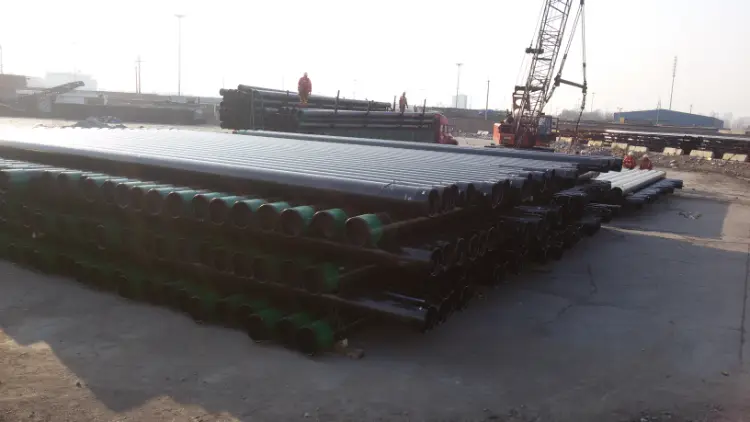
GB/T 4171 Q500NH Weathering Steel Pipe
Q500NH Weathering Steel Pipe: High-Strength Atmospheric Corrosion Resistant Structural Material
Explore Q500NH weathering steel pipe with superior atmospheric corrosion resistance and high yield strength (≥500 MPa). Ideal for bridges, buildings, and outdoor structures exposed to aggressive environments.
Hot rolling, controlled rolling, normalizing rolling, cold forming, welding, cutting, machining
- Phone : +8618037372205
- Email : [email protected]
- WhatsApp: Contact via Whtsapp
- WeChat: +8618037372205
GB/T 4171 Q500NH Weathering Steel Pipe Introduction
Q500NH is a high-strength low-alloy structural steel with enhanced atmospheric corrosion resistance, classified under the GB/T 4171 standard for weathering steels. Its chemical composition includes copper, chromium, and nickel, which promote the formation of a stable, protective rust layer when exposed to the elements, significantly reducing maintenance needs.
- Minimum yield strength of 500 MPa for thin sections ensures excellent load-bearing capacity.
- Good weldability and cold formability enable versatile fabrication.
- Typical applications include bridges, transmission towers, railway vehicles, and architectural structures where durability and strength are critical.
Delivered in hot-rolled, controlled-rolled, or normalized condition, Q500NH pipes and sections are suitable for welding and bolted connections in outdoor environments.
GB/T 4171 Q500NH Weathering Steel Pipe Chemical Composition
The chemical composition of Q500NH is specified in GB/T 4171-2008. The steel relies on alloying elements such as copper, chromium, and nickel to improve atmospheric corrosion resistance. Microalloying elements like niobium, vanadium, and titanium may be added singly or in combination to refine grain size and enhance strength, with their total content not exceeding 0.22%. All values are maximum unless a range is indicated.
| Element | Standard Value (mass%) | Remark |
|---|---|---|
| Carbon (C) | ≤ 0.12 | Key for strength and weldability |
| Silicon (Si) | ≤ 0.75 | Deoxidizer and strength contributor |
| Manganese (Mn) | ≤ 1.50 | Improves strength and hardenability |
| Phosphorus (P) | ≤ 0.025 | Controlled for toughness |
| Sulfur (S) | ≤ 0.020 | Controlled for ductility |
| Copper (Cu) | 0.20 – 0.55 | Essential for atmospheric corrosion resistance |
| Chromium (Cr) | 0.30 – 1.25 | Enhances corrosion resistance and strength |
| Nickel (Ni) | ≤ 0.65 | Improves toughness and corrosion resistance |
| Niobium (Nb) | ≤ 0.11* | Grain refiner (optional) – part of microalloying sum |
| Vanadium (V) | ≤ 0.12* | Precipitation strengthening (optional) |
| Titanium (Ti) | ≤ 0.20* | Grain refiner and nitrogen fixer (optional) |
| Nb+V+Ti | ≤ 0.22 | Sum of microalloying elements when used |
GB/T 4171 Q500NH Weathering Steel Pipe Physical Properties
The following physical properties are typical for Q500NH and similar low-alloy steels. They are not specified in GB/T 4171 but are provided for design purposes. Data are valid at room temperature unless stated otherwise. Slight variations may occur depending on the actual composition and heat treatment.
| Property | Typical Value | Unit | Test Condition |
|---|---|---|---|
| Density (ρ) | 7850 | kg/m³ | 20°C |
| Modulus of elasticity (E) | 206 | GPa | 20°C, tensile |
| Shear modulus (G) | 79.4 | GPa | 20°C, calculated from E and ν |
| Poisson's ratio (ν) | 0.30 | - | 20°C, elastic range |
| Thermal expansion coefficient (α) | 11.5 × 10⁻⁶ | K⁻¹ | 20–100°C average |
| Thermal conductivity (λ) | 35 | W/(m·K) | 20°C |
| Specific heat capacity (cp) | 460 | J/(kg·K) | 20°C |
| Electrical resistivity (ρe) | 0.25 × 10⁻⁶ | Ω·m | 20°C |
GB/T 4171 Q500NH Weathering Steel Pipe Mechanical Properties
Mechanical properties of Q500NH are tested in accordance with GB/T 4171. The yield strength, tensile strength, and elongation depend on the product thickness. Impact toughness is measured at -20°C with a minimum longitudinal absorbed energy of 34 J. Bend tests require a specified mandrel diameter relative to the specimen thickness (a).
| Property | Required Value | Unit | Test Condition |
|---|---|---|---|
| Yield Strength (ReH) | ≥ 500 | MPa | Thickness ≤ 16 mm |
| Yield Strength (ReH) | ≥ 480 | MPa | Thickness 16–40 mm |
| Yield Strength (ReH) | ≥ 460 | MPa | Thickness 40–60 mm |
| Yield Strength (ReH) | ≥ 440 | MPa | Thickness 60–100 mm |
| Tensile Strength (Rm) | 600 – 760 | MPa | Full thickness range |
| Elongation after fracture (A) | ≥ 18 | % | Thickness ≤ 16 mm |
| Elongation after fracture (A) | ≥ 17 | % | Thickness 16–40 mm |
| Elongation after fracture (A) | ≥ 16 | % | Thickness 40–60 mm |
| Elongation after fracture (A) | ≥ 16 | % | Thickness 60–100 mm |
| Bend test (mandrel diameter) | d = 3a | - | Thickness ≤ 16 mm, 180° bend |
| Bend test (mandrel diameter) | d = 4a | - | Thickness 16–40 mm, 180° bend |
| Bend test (mandrel diameter) | d = 5a | - | Thickness 40–60 mm, 180° bend |
| Bend test (mandrel diameter) | d = 6a | - | Thickness 60–100 mm, 180° bend |
| Impact absorbed energy (KV2) | ≥ 34 | J | Longitudinal, -20°C |
GB/T 4171 Q500NH Weathering Steel Pipe Exactly Equivalent Material Standards and Substitution Grades
| Country/Region | Standard | Grade | Remark |
|---|---|---|---|
| China | GB/T 4171 | Q500NH | Original designation – high-strength weathering steel |
GB/T 4171 Q500NH Weathering Steel Pipe Application Introduction
Q500NH combines high strength with excellent atmospheric corrosion resistance, making it suitable for structures that are exposed to weather and where painting or coating is difficult or expensive. It is widely used in infrastructure and transportation projects. Typical design standards allow a reduction in thickness compared to conventional structural steels, leading to weight savings and cost efficiency.
- The protective rust patina forms naturally over time, but accelerated stabilization treatments can be applied.
- Welding requires low-hydrogen processes and suitable filler metals (e.g., AWS E80C-Ni2 or equivalent) to match the strength and corrosion properties.
- It is not recommended for submerged or continuously wet environments without additional protection.
Product Applications: Structural hollow sections (square, rectangular, circular pipes), Welded and seamless pipes for fluid transport and mechanical applications, Hot-rolled plates and sheets for fabrication, Building profiles (H-beams, channels, angles), Pre-fabricated steel bridge components, High-strength bolted and welded assemblies
Processed into products: Bridge girders and truss members, Transmission tower legs and cross-arms, Railway car underframes and body panels, Container corner posts and rails, Architectural exposed structural elements, Wind turbine towers (in lower corrosion categories), Billboard and signage support frameworks, Earth-retaining sheet pile walls
Application industries: Bridge engineering (highway, railway, pedestrian bridges), Construction and architecture (facades, roof structures, canopies), Power transmission (towers, poles), Railway rolling stock (frames, containers), Port and coastal infrastructure (cranes, dockside structures), Industrial plants (chimneys, ducting, storage tanks)
GB/T 4171 Q500NH Weathering Steel Pipe Approximate / Similar Weathering Steel Grades
| Country/Region | Standard | Grade | Remark |
|---|---|---|---|
| USA | ASTM A709/A709M | HPS 70W | High-performance weathering steel; min YS 485 MPa, similar corrosion resistance but slightly lower strength |
| Japan | JIS G3114 | SMA570W | Hot-rolled atmospheric corrosion-resisting steel for welded structure; min YS 570 MPa (for thickness ≤16 mm), higher strength |
| Europe | EN 10025-5 | S355J2W | Lower strength class (min YS 355 MPa), but comparable weathering resistance; often used in identical applications |
| USA | ASTM A871/A871M | Grade 65 | High-strength low-alloy structural steel with atmospheric corrosion resistance; min YS 450 MPa |
Notes:
- For welded structures, consider the carbon equivalent (CEV) to prevent cold cracking; typical CEV for Q500NH is ≤0.50% according to GB/T 4171.
- Surface treatment such as shot blasting is recommended to remove mill scale and encourage uniform patina formation.
- For applications requiring improved toughness at lower temperatures, supplementary Charpy tests at -40°C can be agreed upon.
- The data provided are based on the latest publicly available version of GB/T 4171. For critical applications, consult the steel manufacturer and current standards.
- Share



