
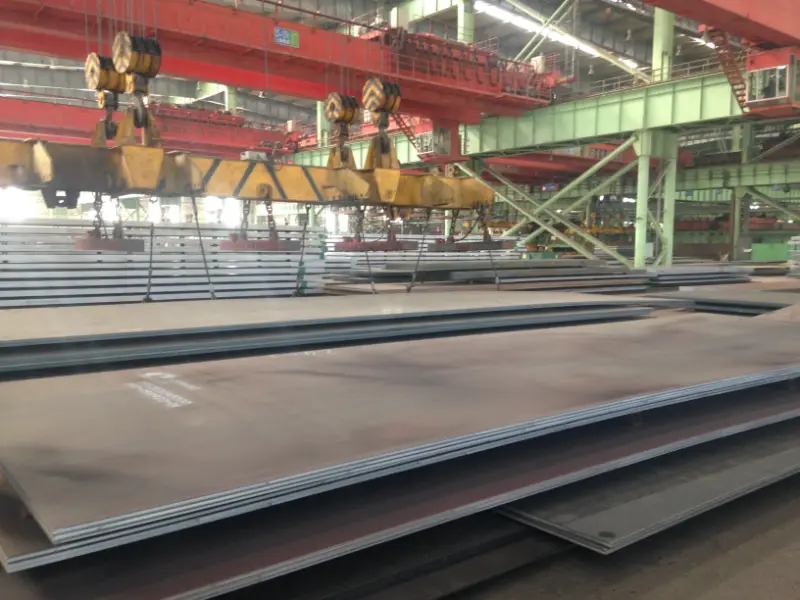
ASME SA514 Grade R Steel
ASME SA514 Grade R Steel: High-Strength Quenched & Tempered Alloy Coil for Structural Use
In-depth technical data for ASME SA514/SA514M Grade R, a high-yield, quenched and tempered alloy steel coil for structural applications.
Hot Rolling, Quenching and Tempering (Q&T), Welding, Forming, Cutting
- Phone : +8618037372205
- Email : [email protected]
- WhatsApp: Contact via Whtsapp
- WeChat: +8618037372205
ASME SA514 Grade R Steel Introduction
ASME SA514/SA514M Grade R is a high-yield, quenched and tempered carbon and low-alloy structural steel coil, specified under the ASME Boiler and Pressure Vessel Code. It is primarily designed for use in welded structures where weight savings and high strength are critical. The material is characterized by its minimum yield strength of 100 ksi (690 MPa) in thicknesses up to 2.5 inches (63.5 mm), achieved through precision heat treatment. Grade R offers an excellent combination of high strength, good weldability with appropriate techniques, and adequate notch toughness, making it suitable for demanding applications in mobile equipment, pressure vessels, and heavy civil construction.
ASME SA514 Grade R Steel Chemical Composition
The chemical composition of ASME SA514 Grade R as per heat analysis. The alloying elements such as Chromium, Molybdenum, Manganese, and Boron are carefully controlled to ensure deep hardenability during the quenching process, resulting in a fully martensitic microstructure after tempering. This composition provides the high strength and toughness balance required for heavy structural applications.
| Chemical Element | Standard Value (max %) | Remarks |
|---|---|---|
| Carbon (C) | 0.12 – 0.21 | Heat analysis range |
| Manganese (Mn) | 0.85 – 1.15 | Heat analysis range |
| Phosphorus (P) | 0.025 | Maximum |
| Sulfur (S) | 0.025 | Maximum |
| Silicon (Si) | 0.20 – 0.35 | Heat analysis range |
| Chromium (Cr) | 0.90 – 1.25 | Heat analysis range |
| Molybdenum (Mo) | 0.15 – 0.25 | Heat analysis range |
| Vanadium (V) | 0.03 – 0.08 | Heat analysis range |
| Boron (B) | 0.001 – 0.005 | Heat analysis range |
ASME SA514 Grade R Steel Thermal and Electrical Physical Properties
Physical properties are indicative of quenched and tempered high-strength low-alloy steels. These values are essential for engineering calculations involving heat transfer, thermal expansion, and structural stiffness. Properties are predominantly measured at room temperature unless otherwise noted.
| Property Item | Standard Required Value | Unit | Test Condition |
|---|---|---|---|
| Density (ρ) | 7.85 | g/cm³ | At room temperature (20 °C) |
| Elastic Modulus (E) | 205 – 210 | GPa | At room temperature (20 °C) |
| Shear Modulus (G) | 80 | GPa | Approximate value at room temperature |
| Poisson's Ratio (ν) | 0.27 – 0.30 | Dimensionless | At room temperature |
| Thermal Expansion Coefficient (α) | 12.5 | 10⁻⁶/°C | For range 20 – 100 °C |
| Thermal Expansion Coefficient (α) | 13.4 | 10⁻⁶/°C | For range 20 – 300 °C |
| Thermal Conductivity (λ) | 38 – 42 | W/(m·°C) | At 100 °C |
| Specific Heat Capacity | 460 – 480 | J/(kg·°C) | At room temperature (20 °C) |
| Electrical Resistivity (ρ_e) | 0.20 – 0.25 | µΩ·m | At room temperature (20 °C) |
ASME SA514 Grade R Steel Mechanical Properties
The mechanical properties are guaranteed by the Quenched and Tempered heat treatment process. Properties are typically tested on transverse test specimens. The high yield strength and tensile strength are the primary design criteria. Notch toughness is verified through Charpy V-notch impact testing to ensure resistance to brittle fracture in service.
| Property Item | Standard Required Value | Unit | Test Condition |
|---|---|---|---|
| Yield Strength (ReH) | ≥ 690 | MPa | Thickness ≤ 2.5 in. (63.5 mm) |
| Yield Strength (ReH) | ≥ 620 | MPa | Thickness > 2.5 in. to 6 in. (63.5 mm to 152.4 mm) |
| Tensile Strength (Rm) | 760 – 895 | MPa | Thickness ≤ 2.5 in. (63.5 mm) |
| Tensile Strength (Rm) | 690 – 825 | MPa | Thickness > 2.5 in. to 6 in. (63.5 mm to 152.4 mm) |
| Elongation (A) in 8 in. (200 mm) | ≥ 14 | % | Thickness ≤ 0.625 in. (15.9 mm) |
| Elongation (A) in 2 in. (50 mm) | ≥ 18 | % | All standard thicknesses |
| Charpy V-notch Impact (KV2) | ≥ 27 (A: 20 ft·lbf) | J | Transverse test at -17.8 °C (0 °F) |
ASME SA514 Grade R Steel Complete Equivalent Material Standards & Replaceable Grade Recommendations
| Country/Region | Standard Specification | Grade/Designation | Remarks |
|---|---|---|---|
| USA | ASTM A514/A514M | Grade R | Identical chemical and mechanical property requirements. ASTM is the parent standard to ASME SA514. |
| Europe | EN 10025-6 | S690QL | Technical equivalent. S690QL is the closest standard European grade for quenched and tempered high-strength structural steel with a 690 MPa yield strength. |
| International | ISO 4950-2 | E690DD | High yield strength flat steel products. DD denotes a guaranteed delivery condition after quenching and tempering. |
| China | GB/T 16270 | Q690D | Equivalent high-strength structural steel in quenched and tempered condition, featuring similar strength and low-temperature toughness (D quality). |
ASME SA514 Grade R Steel Application Introduction
ASME SA514 Grade R steel, supplied as high-strength coil, is engineered for weight-critical, high-load applications. Its excellent strength-to-weight ratio enables the design of lighter, more fuel-efficient mobile equipment. The material can be welded, cut, and formed using shop practices common to high-strength, low-alloy steels, but strict adherence to heat input and hydrogen control measures during welding is essential to maintain its mechanical properties in the heat-affected zone. Direct forming after delivery in the Q&T condition is the standard method.
Product Applications: Mobile Crane Telescopic Booms and Outriggers, Heavy-Duty Haul Truck Chassis and Dump Bodies, Large-Capacity High-Pressure Gas Storage Vessels, Structural Nodes for Long-Span Bridges, Offshore Platform Jack-up Legs and Cantilever Structures, Reactor and Penstock Liner Plates, Pre-engineered Building Components
Processed into products: Crane boom chords and lattice members, Mining truck main frame rails and cross-members, Heavy-duty pipe and roller bed sections for conveyors, Welded beams, girders, and box-sections for structural compression members, Truss connection plates and structural stiffeners, Formed and welded cylindrical shell sections for pressure vessels, Excavator bucket and arm assemblies
Application industries: Heavy Mobile Equipment Manufacturing (Cranes, Mining Trucks), Pressure Vessel and Boiler Fabrication, Bridge and Structural Engineering, Offshore and Marine Engineering, Wind Tower and Heavy Infrastructure Construction
ASME SA514 Grade R Steel Similar / Proximate Alternative Material Recommendations
| Country/Region | Standard Specification | Grade/Designation | Remarks |
|---|---|---|---|
| USA | ASTM A514/A514M | Grade H | Similar 690 MPa yield strength Q&T steel with the same composition ranges but specified for plate, often used as an alternative for coiled product when formability is adequate. |
| USA | ASTM A709/A709M | Grade 690 (100W) | Similar high-strength structural steel designed specifically for bridge construction, offering high yield strength and good weldability. |
| Europe | EN 10025-6 | S690Q | Similar to S690QL but without the specific low-temperature impact test guarantee. Can be a substitute if more lenient toughness requirements are acceptable. |
| Japan | JIS G 3128 | SHY 685 | High yield strength steel for welded structures, featuring similar minimum yield and tensile strength requirements for heavy construction. |
Notes:
Welding must follow AWS D1.1 structural welding code or ASME Section IX for pressure vessels. Low-hydrogen practices are mandatory to prevent cold cracking. Preheating and interpass temperature control are critical and depend on plate thickness and combined heat input. The product is typically not intended for post-forming heat treatment unless verified, as the mechanical properties are derived from the original mill Q&T process. Atmospheric corrosion resistance is similar to plain carbon steel unless Grade R is specified with a copper limitation for improved performance, but it is not equivalent to weathering steels.
- Share



