
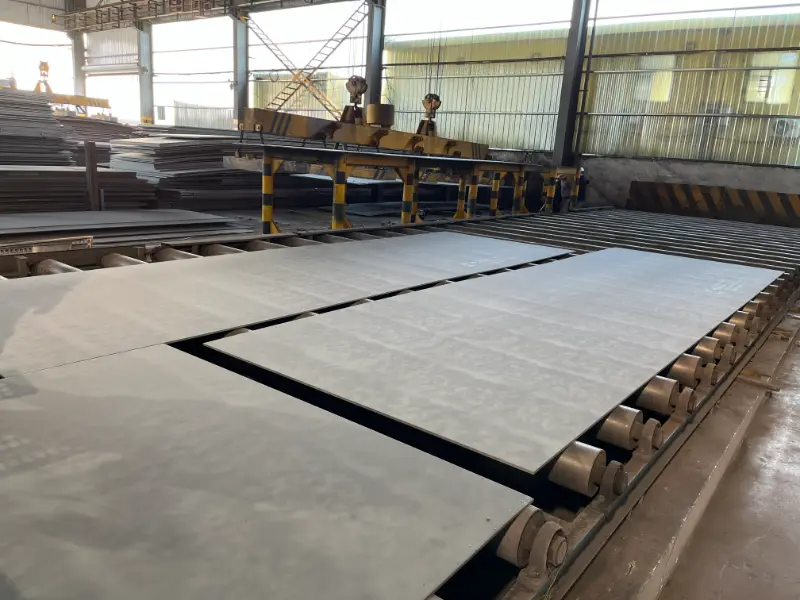
ASME SA514 Grade M High-Strength Q&T Steel Plate
ASME SA514 Grade M Quenched & Tempered Steel Plate Coil Data & Equivalents
Explore properties, chemical composition, mechanical & thermal data, and equivalent grades of ASME SA514 Grade M quenched and tempered steel. Ideal for pressure vessels, heavy equipment.
Hot rolling, quenching and tempering, cutting, cold forming, welding
- Phone : +8618037372205
- Email : [email protected]
- WhatsApp: Contact via Whtsapp
- WeChat: +8618037372205
ASME SA514 Grade M High-Strength Q&T Steel Plate Introduction
ASME SA514 Grade M is a carbon and low-alloy high-strength steel supplied in the quenched and tempered condition, conforming to ASME SA514/SA514M. It offers a minimum yield strength of 690 MPa (100 ksi) with excellent toughness and weldability. The alloy design features low carbon, controlled boron, and a nickel-chromium-molybdenum base, providing deep hardenability and uniform mechanical properties in plate and coil form up to 150 mm (6 in.) thick.
- High strength-to-weight ratio for structural and pressure-retaining applications
- Good low-temperature toughness under Charpy V-notch requirements when specified
- Available as hot-rolled coil or cut-to-length plate
ASME SA514 Grade M High-Strength Q&T Steel Plate Chemical Composition
The chemical composition of ASME SA514 Grade M steel is tightly controlled to achieve the specified strength and toughness after quenching and tempering. Low carbon content ensures good weldability, while boron, nickel, chromium, and molybdenum provide deep hardenability. The limits shown are from ASME SA514/SA514M Table 1.
| Element | Standard Value (wt%) | Remarks |
|---|---|---|
| Carbon (C) | ≤ 0.12 | Low carbon for weldability |
| Manganese (Mn) | 0.45 – 0.70 | Deoxidation and strength |
| Phosphorus (P) | ≤ 0.025 | Max |
| Sulfur (S) | ≤ 0.020 | Max |
| Silicon (Si) | 0.20 – 0.35 | Deoxidation |
| Nickel (Ni) | 1.20 – 1.50 | Hardenability and toughness |
| Chromium (Cr) | ≤ 0.80 | Hardenability |
| Molybdenum (Mo) | 0.45 – 0.60 | Hardenability and temper resistance |
| Boron (B) | 0.001 – 0.005 | Enhances hardenability significantly |
ASME SA514 Grade M High-Strength Q&T Steel Plate Thermal, Electrical and Physical Properties
The following data represent typical physical properties for ASME SA514 Grade M in the quenched and tempered condition. Actual values may vary slightly with specific heat treatment and exact chemistry. These serve as design reference.
| Property | Typical Value | Unit | Test Condition / Temperature |
|---|---|---|---|
| Density (ρ) | 7.85 | g/cm³ | 20 °C |
| Elastic Modulus (E) | 205 | GPa | 20 °C, tensile |
| Shear Modulus (G) | 80 | GPa | 20 °C, calculated |
| Poisson's Ratio (ν) | 0.3 | – | 20 °C |
| Thermal Expansion Coefficient (α) | 12.0 | ×10⁻⁶ /K | 20 – 100 °C |
| Thermal Expansion Coefficient (α) | 13.2 | ×10⁻⁶ /K | 20 – 300 °C |
| Thermal Conductivity (λ) | 35 | W/(m·K) | 20 °C |
| Thermal Conductivity (λ) | 30 | W/(m·K) | 300 °C |
| Specific Heat Capacity (cp) | 0.46 (460) | J/(g·K) [J/(kg·K)] | 20 °C |
| Electrical Resistivity (ρe) | 0.25 × 10⁻⁶ (25 μΩ·cm) | Ω·m | 20 °C |
ASME SA514 Grade M High-Strength Q&T Steel Plate Mechanical Properties
Mechanical properties are guaranteed for the quenched and tempered condition as specified in ASME SA514/SA514M. Yield and tensile strengths are uniform across all thicknesses up to 150 mm. Elongation and bend test requirements vary with plate thickness. Charpy impact tests are optional and must be agreed upon at the time of order; typical values at -40°C are 27 J min.
| Property | Standard Required Value | Unit | Test Condition / Remarks |
|---|---|---|---|
| Yield Strength (ReH) | ≥ 690 (≥ 100 ksi) | MPa | All thicknesses up to 150 mm; transverse test |
| Tensile Strength (Rm) | 760 – 895 (110 – 130 ksi) | MPa | All thicknesses up to 150 mm; transverse test |
| Elongation A (50 mm) | ≥ 18 | % | Thickness ≤ 19 mm (3/4 in.) |
| Elongation A (50 mm) | ≥ 16 | % | 19 mm < thickness ≤ 50 mm (3/4 in. < t ≤ 2 in.) |
| Elongation A (50 mm) | ≥ 14 | % | 50 mm < thickness ≤ 150 mm (2 in. < t ≤ 6 in.) |
| Bend Test (180°) | Bend diameter = 1.5 t (no cracks) | – | Thickness ≤ 19 mm (3/4 in.), specimen width ≥ 1 t |
| Bend Test (180°) | Bend diameter = 2 t (no cracks) | – | 19 mm < thickness ≤ 50 mm |
| Bend Test (180°) | Bend diameter = 3 t (no cracks) | – | 50 mm < thickness ≤ 150 mm |
ASME SA514 Grade M High-Strength Q&T Steel Plate Fully Equivalent Standards and Replaceable Grade Recommendations
| Country/Region | Standard | Grade | Remarks |
|---|---|---|---|
| USA | ASTM A514/A514M | Grade M | Completely identical to ASME SA514 Grade M; same chemical and mechanical requirements. |
ASME SA514 Grade M High-Strength Q&T Steel Plate Application Introduction
ASME SA514 Grade M steel is engineered for demanding applications where high strength, low weight, and good toughness are essential.
- Its quenched and tempered microstructure allows for reduced section thickness, leading to weight savings in large structures.
- Excellent weldability with low-carbon content, but proper preheat and interpass temperature control are necessary.
- Can be cold formed within limits; often supplied as coil for further processing.
Product Applications: Welded Pressure Vessels and Storage Tanks, Crane Booms and Telescopic Arms, Excavator Buckets and Dipper Sticks, Offshore Platform Components (Deck Structures, Nodes), Heavy-Duty Truck Frames and Chassis Reinforcement, Load-Bearing Structural Members in Bridges
Processed into products: High-Strength Plates and Coils for Further Fabrication, Welded Beams and Columns, Load-Bearing Parts (Flanges, Stiffeners, Gussets), Cut-Edge Components after Laser/Plasma Cutting, Formed Sections (Press-Bent Channels, Angles)
Application industries: Pressure Vessel and Boiler Manufacturing, Heavy Machinery and Earthmoving Equipment, Offshore and Marine Engineering, Bridge and Structural Construction, Mining and Material Handling, Transportation (Trailers, Rail Cars)
ASME SA514 Grade M High-Strength Q&T Steel Plate Similar / Alternative Materials with Comparable Strength
| Country/Region | Standard | Grade | Remarks |
|---|---|---|---|
| Europe | EN 10025-6 | S690Q / S690QL | Same 690 MPa yield class; does not contain boron; nickel and molybdenum levels differ. Verify weldability and toughness for substitution. |
| China | GB/T 16270 | Q690D / Q690E / Q690F | High-strength quenched & tempered steel; niobium, vanadium, or titanium may be added; boron not typical. Consult for exact match. |
| Japan | JIS G 3128 | SHY685 (SHY685NS) | Similar yield strength for pressure vessels; composition varies; not identical. Use JIS certified version with caution. |
| International | ISO 4950-2 | E690D / E690DD / E690QL | General high-yield structural steel; comparable strength; detailed analysis required before replacement. |
Notes:
- Welding requires low-hydrogen practices, preheat typically 150–200°C depending on thickness, and immediate post-weld hydrogen bake-out or stress relief for thick sections (>50 mm).
- Charpy impact testing (e.g., 27 J at -40°C) is available upon order agreement; standard specification does not mandate impact values.
- All plates/coils shall be ultrasonically tested if supplementary requirement S1 of ASME SA578/SA578M is invoked.
- This material is not intended for service above 370°C where temper embrittlement may occur.
- Share



