
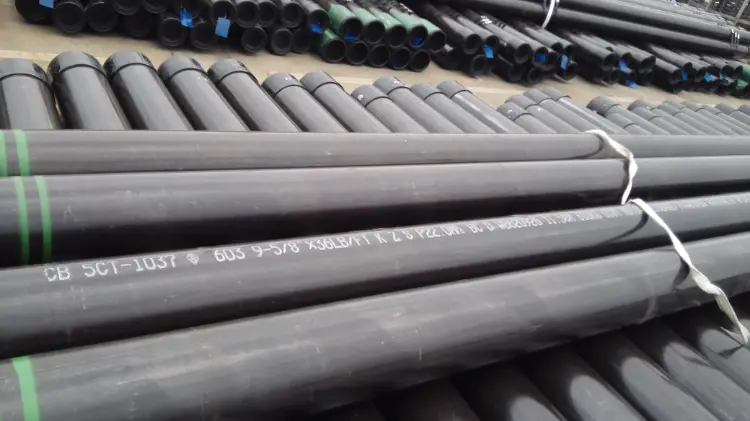
GB/T 4171 Q235NH Weathering Steel Pipe
GB/T 4171 Q235NH Weathering Steel Pipe: Chemical Composition, Mechanical Properties & Equivalents
Comprehensive data sheet for Q235NH weathering steel pipe per GB/T 4171, including chemical composition, mechanical properties, thermal and electrical physical properties, international equivalents, and application guidance.
Hot Rolling, Controlled Rolling, Normalizing, Welding, Bending, Forming
- Phone : +8618037372205
- Email : [email protected]
- WhatsApp: Contact via Whtsapp
- WeChat: +8618037372205
GB/T 4171 Q235NH Weathering Steel Pipe Introduction
Q235NH is a high-strength low-alloy structural weathering steel grade defined in the Chinese standard GB/T 4171. Designed for atmospheric corrosion resistance, it develops a stable, protective rust-like patina when exposed to the weather, eliminating the need for painting in many applications. Key characteristics include superior weldability, good toughness, and enhanced resistance to general atmospheric corrosion compared to plain carbon structural steels like Q235. The addition of trace alloying elements such as copper, chromium, and nickel significantly improves its anti-corrosion properties. It is widely used in structural applications like bridges, railway vehicles, and transmission towers where durability and reduced maintenance are crucial.
GB/T 4171 Q235NH Weathering Steel Pipe Chemical Composition
The chemical composition of Q235NH is strictly controlled according to GB/T 4171. The carefully balanced alloying elements, particularly copper (Cu), chromium (Cr), and nickel (Ni), are essential for improving the steel's resistance to atmospheric corrosion by promoting the formation of a dense, adherent patina. Carbon equivalent (CEV) values are typically limited to ensure good weldability.
| Element | Standard Value (max %) | Remarks |
|---|---|---|
| Carbon (C) | ≤ 0.13 | Crucial for strength and weldability. |
| Silicon (Si) | 0.10 - 0.40 | Deoxidizer, improves strength. |
| Manganese (Mn) | 0.20 - 0.60 | Improves hardenability and strength. |
| Phosphorus (P) | ≤ 0.030 | Enhances corrosion resistance but limited for toughness. |
| Sulfur (S) | ≤ 0.030 | Controlled for improved formability and weldability. |
| Copper (Cu) | 0.20 - 0.40 | Primary element for atmospheric corrosion resistance. |
| Chromium (Cr) | 0.40 - 0.80 | Enhances corrosion resistance and tensile strength. |
| Nickel (Ni) | ≤ 0.65 | Improves toughness and corrosion resistance. |
| Nitrogen (N) | ≤ 0.012 | Limited to prevent strain aging. |
| Residual Elements (Others) | As per standard | Other alloying or residual elements may be added to achieve specific properties without compromising weldability. |
GB/T 4171 Q235NH Weathering Steel Pipe Thermal and Electrical Physical Properties
The physical properties are typical for low-alloy steels and are essential for engineering calculations involving heat transfer, structural stiffness, and electrical applications. These values represent standard reference data at room temperature unless otherwise specified. Variations can occur due to slight differences in chemical composition and heat treatment conditions, but the impact is generally minimal for most structural design purposes.
| Property | Standard Reference Value | Unit | Test Condition / Remarks |
|---|---|---|---|
| Density (ρ) | ~ 7.85 | g/cm³ | At 20°C |
| Modulus of Elasticity (E) | ~ 200 - 210 | GPa | At 20°C |
| Shear Modulus (G) | ~ 79 - 80 | GPa | At 20°C |
| Poisson's Ratio (ν) | ~ 0.27 - 0.30 | - | At 20°C |
| Thermal Expansion Coefficient (α) | ~ 11.0 - 12.2 | 10⁻⁶/K | Between 20°C and 100°C |
| Thermal Expansion Coefficient (α) | ~ 12.0 - 13.0 | 10⁻⁶/K | Between 20°C and 200°C |
| Thermal Expansion Coefficient (α) | ~ 13.0 - 14.0 | 10⁻⁶/K | Between 20°C and 400°C |
| Thermal Conductivity (λ) | ~ 30 - 45 | W/(m·K) | At 20°C; decreases with temperature increase |
| Specific Heat Capacity (c) | ~ 460 - 480 | J/(kg·K) | At 20°C |
| Electrical Resistivity (ρ_e) | ~ 0.15 - 0.25 | Ω·mm²/m | At 20°C |
GB/T 4171 Q235NH Weathering Steel Pipe Mechanical Properties
The mechanical properties below represent minimum requirements for Q235NH weathering steel pipe and structural sections as specified in GB/T 4171. These values are guaranteed for delivery conditions. Impact test results (KV2) are critical for ensuring toughness, especially for structures subjected to dynamic loads or low service temperatures. The properties are dependent on the product thickness, with thicker sections showing slightly lower strength values.
| Property | Standard Requirement Value | Unit | Test Condition / Remarks |
|---|---|---|---|
| Upper Yield Strength (ReH) | ≥ 235 | MPa | For thickness ≤ 16 mm |
| Upper Yield Strength (ReH) | ≥ 225 | MPa | For thickness > 16 mm to ≤ 40 mm |
| Upper Yield Strength (ReH) | ≥ 215 | MPa | For thickness > 40 mm to ≤ 60 mm |
| Tensile Strength (Rm) | 360 - 510 | MPa | For thickness ≤ 16 mm |
| Tensile Strength (Rm) | 360 - 510 | MPa | For thickness > 16 mm to ≤ 40 mm |
| Tensile Strength (Rm) | 360 - 510 | MPa | For thickness > 40 mm to ≤ 60 mm |
| Elongation After Fracture (A) | ≥ 24 | % | Longitudinal, gauge length 5.65√So, for thickness ≤ 16 mm |
| Elongation After Fracture (A) | ≥ 23 | % | Longitudinal, gauge length 5.65√So, for thickness > 16 mm to ≤ 40 mm |
| Elongation After Fracture (A) | ≥ 22 | % | Longitudinal, gauge length 5.65√So, for thickness > 40 mm to ≤ 60 mm |
| Impact Energy (KV2) at 0°C | ≥ 27 | J | Longitudinal, V-notch, test temperature 0°C |
| Bend Test (180°) | d = a | - | Bend mandrel diameter (d) equals specimen thickness (a) for thickness ≤ 16 mm |
| Bend Test (180°) | d = 2a | - | Bend mandrel diameter (d) equals twice specimen thickness (a) for thickness > 16 mm to ≤ 100 mm |
GB/T 4171 Q235NH Weathering Steel Pipe Completely Equivalent Material Standards & Replaceable Grades
The following table lists international standards and grades that are considered direct equivalents or very close matches to Q235NH based on comparable chemical composition, mechanical properties, and corrosion resistance class. Direct substitution should always be verified against the specific requirements of the receiving standard.
| Country/Region | Standard | Grade | Remarks |
|---|---|---|---|
| Europe | EN 10025-5 | S235J0W | Closest strength and weathering class. Often interchangeable. |
| Europe | EN 10025-5 | S235J2W | Higher impact energy requirement at low temperature (-20°C vs. 0°C). |
| Japan | JIS G3114 | SMA400AW | Similar strength and atmospheric corrosion resistance for welded structures. |
| Japan | JIS G3125 | SPA-H | High weathering grade, commonly used, strength range overlaps. |
| Vietnam | TCVN 3105-2 | S235J0W | Adopts equivalent European designation. |
GB/T 4171 Q235NH Weathering Steel Pipe Application Introduction
Q235NH weathering steel pipe is engineered for long-term durability in outdoor structural applications. Its self-protecting patina makes it ideal for exposed environments with alternating wet/dry cycles. Applications range from large-scale civil engineering to architectural cladding and artistic sculptures. It is easily fabricated using standard methods.
Product Applications: Structural tubing for pedestrian and highway bridges, Poles for transmission lines, lighting, and signage, Piping for irrigation systems and agricultural water conveyance, Structural members for railway freight wagons, Architectural columns, exposed trusses, and facade elements, Greenhouse structural frames, Outdoor fencing and guardrails
Processed into products: Bridge columns, girders, and stiffeners, Flanges and joints for pipe towers, Corner posts and frame rails for shipping containers, Mounting structures for solar panels, Exhaust stacks and industrial ducting, Sculptural frameworks and landscape edging
Application industries: Civil Engineering and Infrastructure, Bridge Building and Highway Construction, Railway Transportation (Railcars, Containers), Power Transmission (Towers, Poles), Architecture and Landscape Design, Shipping Container Manufacturing, Agricultural and Irrigation Equipment
GB/T 4171 Q235NH Weathering Steel Pipe Similar / Near-Substitute Materials Recommendation
The following materials are not exact equivalents but share similar strength levels and application scopes. The primary difference often lies in the corrosion resistance mechanism or specific alloy content. For example, ASTM A588 Grade A has higher strength, while A709 36W is used in bridge construction. Paint-coated materials like Q235B are used when cost is a primary factor and a coating system is mandatory.
| Country/Region | Standard | Grade | Remarks |
|---|---|---|---|
| USA | ASTM A588/A588M | Grade A | Higher yield strength (≥345 MPa). Not a direct replacement without re-engineering. |
| USA | ASTM A709/A709M | 36W | Structural steel for bridges with weathering capability, 250 MPa yield. |
| China | GB/T 4171 | Q355NH | Higher strength weathering steel (≥355 MPa) for weight-critical applications. |
| China | GB/T 700 | Q235B | Similar strength but relies on paint systems for corrosion protection. Cost-effective alternative where painting is acceptable. |
| International | ISO 4952 | Fe355W-1C | Structurally similar to Q355NH group, slightly higher strength than Q235NH. |
Notes:
Welding procedures for Q235NH should use low-hydrogen processes and compatible weathering steel filler metals (e.g., AWS E7018-W or equivalent) to ensure the weld zone matches the base metal's corrosion resistance. To develop a uniform protective patina, the steel must undergo natural wet/dry cycles. Continuous immersion or burial in soil without drainage will lead to normal carbon steel corrosion. The surface should be free of heavy scale and oil for optimal patina formation. All performance values are typical and guaranteed for acceptance testing but may be adjusted for specific thickness ranges and product forms according to the full standard text.
- Share



