
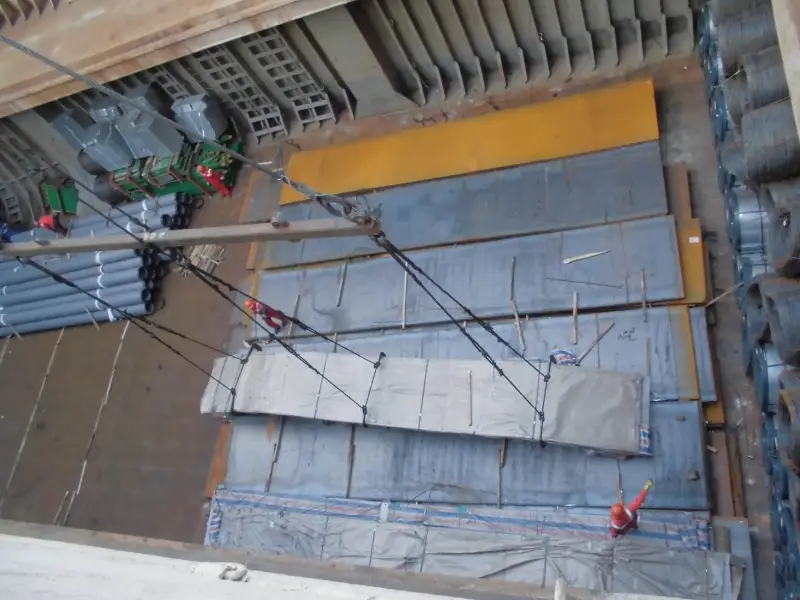
Q265GNH Weathering Steel
Q265GNH Weathering Steel | GB/T 4171 High-Strength Low-Alloy Structural Steel with Atmospheric Corrosion Resistance
Comprehensive technical data for Q265GNH weathering steel under GB/T 4171 standard, including chemical composition, mechanical properties, thermal properties, and international equivalent grades for structural applications with enhanced atmospheric corrosion resistance.
Hot rolling, controlled rolling, normalizing rolling; suitable for cold forming, bending, punching, shearing, gas cutting, arc welding, and resistance welding.
- Phone : +8618037372205
- Email : [email protected]
- WhatsApp: Contact via Whtsapp
- WeChat: +8618037372205
Q265GNH Weathering Steel Introduction
Q265GNH is a high-strength low-alloy structural steel grade specified in the Chinese standard GB/T 4171 for weathering steels with improved atmospheric corrosion resistance. The designation 'Q' indicates yield strength, '265' denotes a minimum yield strength of 265 MPa, 'G' stands for high weathering resistance, 'N' signifies weathering resistance additive elements (such as Cu, Cr, Ni), and 'H' indicates hot-rolled delivery condition. This steel develops a protective rust-like oxide layer when exposed to the atmosphere, which inhibits further corrosion, eliminating the need for painting in many applications. It offers good weldability, formability, and toughness, making it suitable for bridges, containers, railway vehicles, and architectural structures exposed to outdoor environments.
Q265GNH Weathering Steel Chemical Composition
The chemical composition of Q265GNH as per GB/T 4171 standard is precisely controlled to achieve the desired atmospheric corrosion resistance and mechanical strength. Key alloying elements like copper (Cu), chromium (Cr), and nickel (Ni) are added to enhance the formation of a dense, adherent protective patina. Phosphorus (P) is also utilized as a beneficial element for corrosion resistance, hence its upper limit is slightly higher compared to conventional structural steels. The maximum carbon equivalent (CEV) is restricted to 0.44% to ensure good weldability.
| Element | Typical Value (Max unless range) | Remarks |
|---|---|---|
| Carbon (C) | ≤ 0.16 | Key hardenability and strength element |
| Silicon (Si) | 0.20 - 0.50 | Deoxidizer, strength contributor |
| Manganese (Mn) | ≤ 1.10 | Enhances strength and hardenability |
| Phosphorus (P) | 0.07 - 0.12 | Controlled range for atmospheric corrosion resistance |
| Sulfur (S) | ≤ 0.020 | Controlled for cleanliness and ductility |
| Copper (Cu) | 0.20 - 0.50 | Primary element for weathering resistance |
| Chromium (Cr) | 0.30 - 1.25 | Enhances passivation and corrosion resistance |
| Nickel (Ni) | 0.20 - 0.50 | Improves toughness and weathering resistance |
| Titanium (Ti) | 0.020 - 0.10 | Grain refinement; nitrogen fixer preventing strain aging |
| Nitrogen (N) | ≤ 0.012 | Residual element |
| Aluminum (Al, total) | ≥ 0.020 | Grain refining and deoxidizing element |
Q265GNH Weathering Steel Thermal and Electrical Physical Properties
These physical properties are typical for Q265GNH type weathering steel and are crucial for structural design calculations involving thermal loads, stiffness, and electrical grounding. The density is standard for carbon-alloy steels. The modulus of elasticity and Poisson's ratio are key for deflection and stress analysis. Thermal expansion, conductivity, and specific heat are important for evaluating fire resistance and conduction welding thermal cycles. These values are valid at room temperature unless otherwise stated.
| Property | Typical Value | Unit | Test Condition / Remarks |
|---|---|---|---|
| Density (ρ) | 7.85 | g/cm³ | At 20 °C |
| Modulus of Elasticity (E) | 206 | GPa | Room temperature, longitudinal direction |
| Shear Modulus (G) | 79.3 | GPa | Room temperature, estimated from E and ν |
| Poisson's Ratio (ν) | 0.30 | – | At 20 °C, in elastic range |
| Coefficient of Thermal Expansion (α) | 12.5 | 10⁻⁶/K | Mean value between 20 °C and 200 °C |
| Coefficient of Thermal Expansion (α) | 13.2 | 10⁻⁶/K | Mean value between 20 °C and 400 °C |
| Thermal Conductivity (λ) | 32 | W/(m·K) | At 50 °C |
| Thermal Conductivity (λ) | 30 | W/(m·K) | At 100 °C |
| Specific Heat Capacity (Cp) | 470 – 480 | J/(kg·K) | At 50 °C to 100 °C |
| Electrical Resistivity (ρ_e) | 0.25 | μΩ·m | At 20 °C ambient temperature |
Q265GNH Weathering Steel Mechanical Properties
Mechanical properties for Q265GNH are guaranteed for specific thickness ranges as defined in GB/T 4171. The steel exhibits a minimum yield strength of 265 MPa for thicknesses up to 16 mm, with a good ratio of tensile strength to yield strength. The minimum elongation percentage varies with both thickness and specimen orientation (longitudinal vs. transverse). Impact toughness is specified at temperatures of 0°C and -20°C. Formability requirements include a 180° cold bend test around a defined mandrel diameter without cracking.
| Property | Required Value | Unit | Test Condition / Remarks |
|---|---|---|---|
| Yield Strength (ReH/L) | ≥ 265 | MPa | For steel plate/strip nominal thickness ≤ 16 mm |
| Yield Strength (ReH/L) | ≥ 255 | MPa | For thickness > 16 mm to ≤ 40 mm |
| Yield Strength (ReH/L) | ≥ 245 | MPa | For thickness > 40 mm to ≤ 60 mm |
| Tensile Strength (Rm) | 410 - 520 | MPa | For all thicknesses |
| Elongation after Fracture (A) | ≥ 27 | % | Longitudinal, for thickness ≤ 16 mm |
| Elongation after Fracture (A) | ≥ 26 | % | Longitudinal, for thickness > 16 mm to ≤ 40 mm |
| Elongation after Fracture (A) | ≥ 24 | % | Transverse, for thickness ≤ 16 mm |
| Elongation after Fracture (A) | ≥ 22 | % | Transverse, for thickness > 16 mm to ≤ 40 mm |
| Charpy Impact Energy (KV₂) | ≥ 27 | J | At test temperature 0 °C, longitudinal |
| Charpy Impact Energy (KV₂) | ≥ 16 | J | At test temperature -20 °C, longitudinal |
| 180° Cold Bend Test (D = mandrel dia., a = sample thickness) | D = a | – | No cracks, for thickness ≤ 16 mm |
| 180° Cold Bend Test (D = mandrel dia., a = sample thickness) | D = 2a | – | No cracks, for thickness > 16 mm |
Q265GNH Weathering Steel Fully Equivalent Material Standards and Replaceable Grades
| Country/Region | Standard | Grade | Remarks |
|---|---|---|---|
| International (ISO) | ISO 4952:2006 | Fe355W-1A | Closest ISO equivalent for general atmospheric corrosion-resistant structural steel, covering similar yield and tensile strength. |
| European Union | EN 10025-5:2019 | S355J0W | Common European weathering steel grade. Minimum 355 MPa yield, similar corrosion resistance through alloying (Cu, Cr). Substitutable subject to design strength adjustment. |
| Japan | JIS G3125:2015 | SPA-H | High-strength, weather-resistant hot-rolled steel sheet and strip. Primarily used for vehicles, buildings, and containers. A 355 MPa class grade. |
| United States | ASTM A588/A588M-19 | Grade B | High-strength low-alloy structural steel with 345 MPa minimum yield point. Comprehensive weathering properties, widely used for welded bridges and buildings. |
| Canada | CSA G40.21-13 | 350A AT | 350 MPa atmospheric corrosion-resistant weldable steel. Chemical composition (Type AT) ensures similar patina formation and anti-corrosion performance. |
Q265GNH Weathering Steel Application Introduction
Q265GNH steel is specifically engineered for unpainted or minimally maintained structural applications exposed to the atmosphere. Its weathering property relies on the cyclical wetting and drying process to form a dense, self-renewing protective oxide layer. It is not recommended for buried, continuously submerged, or chemically aggressive industrial environments with high concentrations of corrosive agents (e.g., chlorides from sea splash, SOx, NOx) unless a proper protective coating is applied. The steel is easily fabricated using standard structural steel workshop methods.
Product Applications: Weathering-resistant steel plates, sheets, and wide flats, Hot-rolled section steel (H-beams, I-beams, channels, angles), Cold-formed hollow structural sections (HSS) and pipes, Corrugated steel sheeting for roofing and siding, Fabricated structural modules (bridge segments, panelized wall systems)
Processed into products: Girder webs and flanges in modern steel bridges, Container corrugated side panels and corner posts, Bogie frames and body-in-white structures of railway carriages, Laminated core plates for torque-resistant transmission poles, Architecturally exposed structural steel (AESS) brackets and trusses, High-altitude antenna and microwave tower legs and bracings, Support legs and shell sheets for outdoor industrial silos
Application industries: Transportation (railway cars, truck frames, shipping containers), Civil and Bridge Engineering (steel bridge girders, pedestrian bridges, highway guardrails), Power Transmission (lattice transmission towers, utility poles), Architecture and Construction (building facades, roofing, cladding, sculptural elements, greenhouses), Environmental Engineering (chimneys, flue gas ducts, silos, water tanks in non-aggressive atmospheric conditions)
Q265GNH Weathering Steel Similar / Analogous Alternative Material Recommendations
| Country/Region | Standard | Grade | Remarks |
|---|---|---|---|
| China | GB/T 4171 | Q235GNH / Q295GNH | Lower yield strength (235/295 MPa) weathering grades within the same Chinese standard family, offering general corrosion resistance but lower mechanical load capacity compared to Q265GNH. |
| European Union | EN 10025-5 | S355J2W | European weathering steel with higher Charpy impact energy requirement at -20°C (27J min). Suitable as an upgrade if higher toughness is needed. |
| India | IS 11587:2015 | WR 350 Grade A / C | Indian standard weathering structural steel with 350 MPa yield strength. Similar Cu-Cr-Ni alloy concept for atmospheric corrosion resistance. |
| Germany (historical) | SEW 087 | WTSt 37-3 | Older German standard weathering fine-grain structural steel. Comparable composition (Cu 0.25-0.55%, Cr 0.50-1.00%). A historical equivalent for Q265GNH. |
Notes:
Welding Considerations: A low-hydrogen welding process (SMAW with low-hydrogen electrodes, GMAW, SAW) is recommended to prevent hydrogen-induced cold cracking. The carbon equivalent (CEV) of Q265GNH is controlled to ≤ 0.44%, generally providing good weldability without preheating for moderate plate thicknesses under normal ambient conditions. However, a preheat of 50-150 °C may be advisable for thicknesses over 25 mm or in cold climates.
Patina Formation: The development of a stable, aesthetically pleasing dark-brown protective patina requires alternating wet/dry cycles and can take 6 months to 3 years depending on the climate. Early runoff water may contain iron oxide discoloration; design should incorporate measures to prevent staining of adjacent materials like concrete or stone.
- Share



