
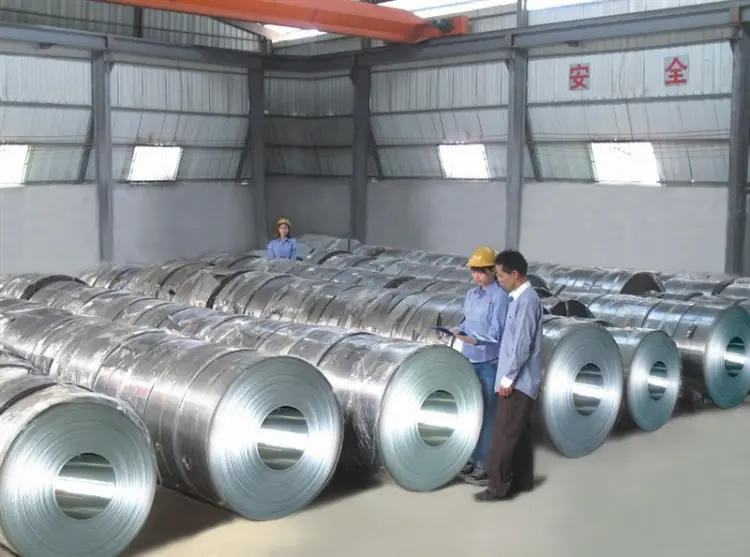
ASME SA514 Grade E Quenched & Tempered High-Strength Steel Coil
ASME SA514 Grade E Quenched & Tempered High-Strength Steel Coil for Pressure Vessels
Complete technical data for ASME SA514/SA514M Grade E carbon and low-alloy high-strength steel coil including chemical composition, mechanical properties, physical constants, international equivalents, similar grades, and application guidance.
Hot rolling, Quenching and Tempering (Q&T)
- Phone : +8618037372205
- Email : [email protected]
- WhatsApp: Contact via Whtsapp
- WeChat: +8618037372205
ASME SA514 Grade E Quenched & Tempered High-Strength Steel Coil Introduction
ASME SA514/SA514M Grade E is a quenched and tempered carbon and low-alloy high-strength structural steel plate/coil intended primarily for use in welded pressure vessels and other demanding structural applications. It belongs to the SA514 family of steels, which are characterized by their high yield strength (minimum 690 MPa / 100 ksi) combined with good weldability and notch toughness. Grade E is a Cr-Mo-V-Ti-B microalloyed grade that achieves its properties through a precisely controlled heat treatment cycle. Key attributes include excellent strength-to-weight ratio, good formability under controlled conditions, and suitability for heavily loaded welded structures. The material is typically supplied in the quenched and tempered condition and is used where weight saving and high load-carrying capacity are critical.
Main Features:
- Minimum yield strength of 690 MPa (100 ksi) for thicknesses up to 63.5 mm.
- Good weldability with recommended low-hydrogen practices.
- Available as coil, plate, or cut-to-length sheet.
- Meets stringent requirements of ASME Boiler and Pressure Vessel Code, Section II, Part A.
ASME SA514 Grade E Quenched & Tempered High-Strength Steel Coil Chemical Composition
The chemical requirements for ASME SA514 Grade E are shown below. The alloy design relies on a balanced addition of chromium, molybdenum, vanadium, titanium, and controlled boron to achieve deep hardenability and high strength after quenching and tempering. Phosphorus and sulfur are kept low to ensure good cleanliness and toughness. These limits are mandatory per the product standard and apply to the heat analysis.
| Element | Required Value (wt%) | Remarks |
|---|---|---|
| Carbon (C) | 0.12 – 0.20 | |
| Manganese (Mn) | 0.40 – 0.70 | For thickness ≤ 1.5 in. (38 mm); may be adjusted for thicker material |
| Phosphorus (P) | ≤ 0.025 | Max |
| Sulfur (S) | ≤ 0.025 | Max |
| Silicon (Si) | 0.15 – 0.35 | |
| Chromium (Cr) | 0.40 – 0.60 | |
| Molybdenum (Mo) | 0.40 – 0.60 | |
| Vanadium (V) | 0.03 – 0.08 | |
| Titanium (Ti) | 0.01 – 0.03 | |
| Boron (B) | 0.001 – 0.005 |
ASME SA514 Grade E Quenched & Tempered High-Strength Steel Coil Thermal and Electrical Physical Properties
The physical properties provided below are typical reference values for quenched and tempered low-alloy high-strength steels similar to SA514 Grade E. They are not mandatory specification requirements but are useful for design and thermal calculations. Properties may vary slightly depending on the exact heat treatment and thickness. The data are representative for room temperature unless otherwise noted.
| Property | Typical Value | Unit | Test Condition / Remarks |
|---|---|---|---|
| Density (ρ) | 7.80 – 7.85 | g/cm³ | Room temperature |
| Modulus of Elasticity (E) | 200 – 210 | GPa | Tension, RT |
| Shear Modulus (G) | 75 – 80 | GPa | Calculated from E and ν |
| Poisson's Ratio (ν) | 0.27 – 0.30 | – | Elastic range, RT |
| Thermal Expansion Coefficient (α) | 11.0 – 12.5 | 10⁻⁶/K | 20 – 100 °C; increases with temperature |
| Thermal Expansion Coefficient (α) | 12.5 – 13.5 | 10⁻⁶/K | 20 – 200 °C |
| Thermal Expansion Coefficient (α) | 13.0 – 14.0 | 10⁻⁶/K | 20 – 300 °C |
| Thermal Conductivity (λ) | 35 – 40 | W/(m·K) | At 20 °C |
| Thermal Conductivity (λ) | 34 – 38 | W/(m·K) | At 100 °C |
| Thermal Conductivity (λ) | 32 – 36 | W/(m·K) | At 200 °C |
| Specific Heat Capacity (c) | 440 – 480 | J/(kg·K) | At 20 °C |
| Specific Heat Capacity (c) | 460 – 500 | J/(kg·K) | At 100 °C |
| Specific Heat Capacity (c) | 480 – 520 | J/(kg·K) | At 200 °C |
| Electrical Resistivity (ρ_e) | 0.25 – 0.35 | μΩ·m | RT |
ASME SA514 Grade E Quenched & Tempered High-Strength Steel Coil Mechanical Properties
The following mechanical properties are the minimum/maximum requirements for ASME SA514 Grade E steel in the quenched and tempered condition, as specified for plate and coil products. Values depend on product thickness. The tensile test is conducted in the transverse direction unless otherwise agreed. Bending tests are performed on specimens with the axis of bend transverse to the rolling direction. Impact toughness (Charpy V-notch) is not mandated by the base standard but may be specified by supplementary requirements.
| Property | Required Value | Unit | Test Condition / Remarks |
|---|---|---|---|
| Yield Strength (ReH) | ≥ 690 | MPa | Thickness ≤ 2.5 in. (63.5 mm); 0.2% offset method |
| Yield Strength (ReH) | ≥ 620 | MPa | Thickness > 2.5 in. to 4 in. (63.5–101.6 mm) |
| Yield Strength (ReH) | ≥ 550 | MPa | Thickness > 4 in. to 6 in. (101.6–152.4 mm) |
| Tensile Strength (Rm) | 760 – 895 | MPa | Thickness ≤ 2.5 in. (63.5 mm) |
| Tensile Strength (Rm) | 690 – 895 | MPa | Thickness > 2.5 in. to 4 in. (63.5–101.6 mm) |
| Tensile Strength (Rm) | 620 – 895 | MPa | Thickness > 4 in. to 6 in. (101.6–152.4 mm) |
| Elongation (A) | ≥ 18 | % | Gauge length 2 in. (50 mm); thickness ≤ 2.5 in. |
| Elongation (A) | ≥ 17 | % | Gauge length 2 in. (50 mm); thickness > 2.5 in. to 6 in. |
| Bend Test (D = bend diameter, t = specimen thickness) | D = 1t (180° bend) | Thickness ≤ 0.375 in. (9.5 mm) | |
| Bend Test | D = 1.25t (180° bend) | Thickness > 0.375 in. to 0.500 in. (9.5–12.7 mm) | |
| Bend Test | D = 1.5t (180° bend) | Thickness > 0.500 in. to 0.750 in. (12.7–19.0 mm) | |
| Bend Test | D = 2t (180° bend) | Thickness > 0.750 in. to 1.000 in. (19.0–25.4 mm) | |
| Bend Test | D = 2.5t (180° bend) | Thickness > 1.000 in. to 1.500 in. (25.4–38.1 mm) | |
| Bend Test | D = 3t (180° bend) | Thickness > 1.500 in. to 2.5 in. (38.1–63.5 mm) |
ASME SA514 Grade E Quenched & Tempered High-Strength Steel Coil Fully Equivalent Material Standards and Substitute Grades
| Country/Region | Standard | Grade/Designation | Remarks |
|---|---|---|---|
| USA | ASTM A514/A514M | Grade E | Identical chemical and mechanical requirements; ASME SA514 is the ASME Boiler Code adoption of ASTM A514. |
| International | ISO 4950-2 / ISO 4951 | E550DD (S690Q concept) | Not a direct copy; strength level and alloy design similar; requires supplier agreement. |
| Europe | EN 10025-6 | S690Q +AR or +QT | Comparable strength; chemical composition differs (no B requirement); may need qualification per ASME. |
ASME SA514 Grade E Quenched & Tempered High-Strength Steel Coil Application Introduction
ASME SA514 Grade E is engineered for applications where high strength, good toughness, and excellent weldability are required under static and dynamic loads. Its high strength enables significant weight reduction in fabricated structures, which is particularly advantageous in mobile equipment and large pressure vessels. The material is readily weldable using low-hydrogen processes, and when proper preheat and interpass temperatures are maintained, it delivers reliable performance in harsh environments. Typical end uses span pressure-containing equipment, heavy machinery, bridges, and offshore structures.
Product Applications: Welded pressure vessels and storage tanks (ASME Code stamped vessels), Crane booms, lattice booms, and mobile crane chassis, Heavy-duty truck frames and trailer components, Bridge girders and structural beams, Hydraulic cylinders and thick-walled tubes, Offshore jacket structures and deck beams, Mining truck bodies and shovel components, Reinforcement ribs and high-load connections
Processed into products: Pressure vessel shells, heads, and flanges, Crane telescopic boom sections, Dump truck frames and wear plates, Bridge box girders and splice plates, Offshore node cans and joint reinforcements, Excavator booms and arms, Wind turbine tower flanges and door frames, Pressed and bent parts such as stiffeners, brackets, and gussets
Application industries: Pressure Vessel and Boiler Manufacturing, Heavy Engineering and Construction Machinery, Bridge Building and Infrastructure, Offshore Oil & Gas Platforms, Mining and Earthmoving Equipment, Shipbuilding (special high-strength zones), Wind Energy (tower and foundation components)
ASME SA514 Grade E Quenched & Tempered High-Strength Steel Coil Similar/Alternative Materials with Comparable Performance
| Country/Region | Standard | Grade/Designation | Remarks |
|---|---|---|---|
| Europe | EN 10025-6 | S690QL / S690QL1 | Fine-grain high-strength structural steel; higher toughness, similar strength; boron not mandatory. |
| Japan | JIS G 3128 | SHY685 / SHY685N | High yield strength steel for welded structures; Cr-Mo-V design; requires verification of application limits. |
| China | GB/T 16270 | Q690D / Q690E | Quenched and tempered high-strength structural steel; lower alloy content; impact test requirements differ. |
| USA | ASTM A709/A709M | Grade 100 (Type B) | Bridge steel with 690 MPa yield; similar weldability; may be used in structural non-pressure applications. |
| USA | ASTM A517/A517M | Grade E | Same alloy concept but for pressure vessel plates in the quenched and tempered condition; identical to SA517 Grade E. |
Notes:
Additional Notes:
- Welding: Low-hydrogen processes (SMAW, SAW, GMAW, FCAW) are recommended. Preheat and interpass temperatures should be controlled according to thickness and hydrogen level, typically 100–150 °C for moderate thicknesses. Post-weld heat treatment (PWHT) is usually avoided to prevent strength loss; if PWHT is required, time-temperature parameters must be carefully validated.
- Forming: Cold forming is possible with adequate bend radii; hot forming should be followed by a new quench and temper to restore properties.
- Thickness range: SA514 Grade E is typically produced in thicknesses up to 6 in. (152 mm); coil products are commonly supplied in thicknesses up to 12.7 mm (0.5 in.). For coil applications, the properties apply in the as-delivered Q&T condition, and subsequent leveling or straightening does not usually alter the strength significantly.
- Inspection: Ultrasonic testing may be specified per ASME SA435/SA435M or SA577/SA577M. Tolerances on thickness and flatness conform to ASME SA20/SA20M.
- Certification: Material is supplied with mill test reports (MTRs) complying with EN 10204 Type 3.1 or 3.2 as required.
- Share



