
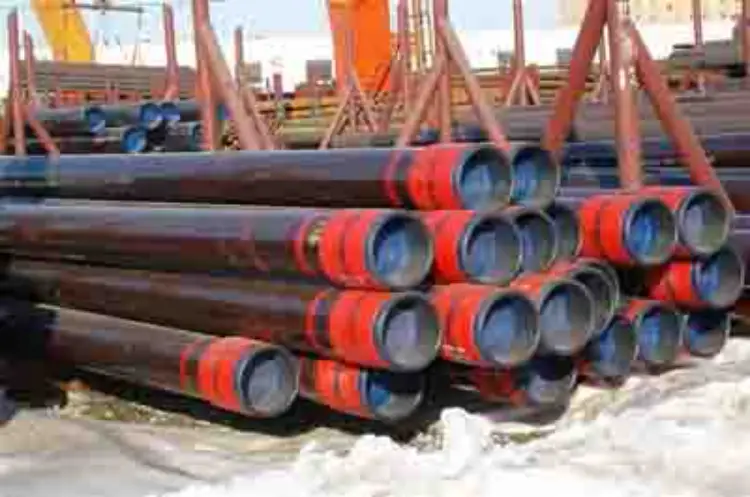
GB/T 4171 Q295GNH Weathering Steel Pipe
GB/T 4171 Q295GNH Weathering Steel Pipe - High-Strength Atmospheric Corrosion Resistant Alloy
Detailed material data for Q295GNH weathering steel pipe according to GB/T 4171, including chemical composition, mechanical properties, physical properties, international equivalents, and applications.
Hot rolling, cold forming, welding, bending, cutting, normalizing (if required)
- Phone : +8618037372205
- Email : [email protected]
- WhatsApp: Contact via Whtsapp
- WeChat: +8618037372205
GB/T 4171 Q295GNH Weathering Steel Pipe Introduction
Q295GNH is a high-strength, low-alloy structural steel with enhanced atmospheric corrosion resistance, specified in Chinese standard GB/T 4171. It belongs to the weathering steel family and is designed for long-term exposure to outdoor environments without protective coating. The 'GNH' suffix indicates it is suitable for general structural applications in corrosive atmospheres. Its balanced alloying with copper, chromium, and nickel forms a dense, adherent patina that slows further corrosion. Typical delivery conditions include hot-rolled or normalized state. Q295GNH offers a minimum yield strength of 295 MPa and good weldability, making it an economical choice for bridges, railway vehicles, containers, and structural pipes.
GB/T 4171 Q295GNH Weathering Steel Pipe Chemical Composition
The chemical composition of Q295GNH as per GB/T 4171-2008 is designed to provide improved atmospheric corrosion resistance. The alloying elements Cu, Cr, and Ni are key to the protective patina formation. Optional microalloying elements (Nb, V, Ti) may be added individually or in combination to refine grain size and enhance strength, but their total content shall not exceed 0.12%. Values below are maximum unless a range is specified.
| Element | Standard Value | Remarks |
|---|---|---|
| C | ≤0.12 | Essential for strength |
| Si | 0.10 – 0.40 | Deoxidizer and strength enhancer |
| Mn | 0.20 – 0.50 | Strength and toughness |
| P | ≤0.030 | Impurity; improves atmospheric corrosion resistance slightly but kept low |
| S | ≤0.030 | Impurity; controlled for ductility |
| Cu | 0.25 – 0.45 | Key for corrosion resistance; promotes patina formation |
| Cr | 0.30 – 0.65 | Increases corrosion resistance and strength |
| Ni | 0.25 – 0.50 | Enhances corrosion resistance and toughness |
| Nb | ≤0.060 (optional) | Optional microalloy; if added, total Nb+V+Ti ≤ 0.12% |
| V | ≤0.12 (optional) | Optional microalloy; if added, total Nb+V+Ti ≤ 0.12% |
| Ti | ≤0.10 (optional) | Optional microalloy; if added, total Nb+V+Ti ≤ 0.12% |
GB/T 4171 Q295GNH Weathering Steel Pipe Thermal and Electrical Physical Properties
The following physical properties are typical for low-alloy structural steels similar to Q295GNH. These values are not explicitly mandated by GB/T 4171 but are derived from standard material data for weathering steels and may vary slightly depending on exact composition and heat treatment. They serve as design estimates.
| Property | Standard Requirement | Unit | Test Condition |
|---|---|---|---|
| Density (ρ) | 7.85 × 10³ | kg/m³ | At 20 °C |
| Modulus of Elasticity (E) | 206 | GPa | At 20 °C |
| Shear Modulus (G) | 79 | GPa | At 20 °C |
| Poisson's Ratio (ν) | 0.30 | – | At 20 °C |
| Coefficient of Thermal Expansion (α) | 11.6 × 10⁻⁶ | 1/K | 20 – 100 °C |
| Thermal Conductivity (λ) | 45 | W/(m·K) | At 20 °C |
| Specific Heat Capacity | 460 | J/(kg·K) | At 20 °C |
| Electrical Resistivity (ρ_e) | 0.20 × 10⁻⁶ | Ω·m | At 20 °C |
GB/T 4171 Q295GNH Weathering Steel Pipe Mechanical Properties
Mechanical properties are specified in GB/T 4171-2008 for plates and strips from which pipes are formed. The values vary with product thickness. Longitudinal tensile test specimens are used. Impact test is generally required at +20°C for thickness ≤60 mm. Bending test is mandatory with the specified bend diameter. Actual properties of pipes may be influenced by the pipe-making process (e.g., welded seam).
| Property | Standard Requirement | Unit | Test Condition |
|---|---|---|---|
| Yield Strength (ReH) | ≥295 | MPa | Thickness ≤16 mm |
| Yield Strength (ReH) | ≥285 | MPa | 16 mm < Thickness ≤40 mm |
| Yield Strength (ReH) | ≥275 | MPa | 40 mm < Thickness ≤60 mm |
| Yield Strength (ReH) | ≥255 | MPa | 60 mm < Thickness ≤100 mm |
| Tensile Strength (Rm) | 430 – 560 | MPa | All thicknesses |
| Elongation after fracture (A) | ≥24 | % | Thickness ≤40 mm (longitudinal) |
| Elongation after fracture (A) | ≥23 | % | 40 mm < Thickness ≤60 mm (longitudinal) |
| Elongation after fracture (A) | ≥22 | % | 60 mm < Thickness ≤100 mm (longitudinal) |
| Bending Test (180°) | d = 2a | – | Thickness ≤16 mm |
| Bending Test (180°) | d = 3a | – | 16 mm < Thickness ≤100 mm |
| Impact Energy (KV2) | ≥34 | J | +20 °C; thickness ≤60 mm; standard 10×10×55 mm specimen |
GB/T 4171 Q295GNH Weathering Steel Pipe Exactly Equivalent Material Standards and Substitutable Grades
| Country/Region | Standard | Grade | Remarks |
|---|---|---|---|
| China | GB/T 4171 | Q295GNH | Original standard grade; no direct international equivalent |
GB/T 4171 Q295GNH Weathering Steel Pipe Application Introduction
Q295GNH weathering steel pipe is ideal for structural and conveying applications where atmospheric corrosion resistance is required without protective coatings. Under alternating wet-dry cycles, it develops a stable, protective rust layer. Typical industries include construction, transportation, and energy. The material can be processed using common steel fabrication methods – welding, cutting, bending, and forming – but low-hydrogen welding procedures are recommended to avoid cracking.
Product Applications: Weathering steel welded pipes (structural tubes), Seamless pipes for fluid transport, Spiral welded pipes for piling, Structural hollow sections (square, rectangular, circular), Pipe trusses and space frames, Guardrails and crash barriers
Processed into products: Bridge support pipes and bearings, Railway bogie frames and underframe components, Container corner posts and rails, Pipe piles and foundation tubes, Outdoor staircases and handrails, Wind turbine tower internals (as platform framing)
Application industries: Bridge construction (pedestrian bridges, highway overpasses), Railway vehicles and infrastructure, Container manufacturing (shipping containers, frames), Architectural and outdoor steel structures (facades, sculptures), Transmission towers and power infrastructure, Pipe systems for outdoor water, oil, and gas transport
GB/T 4171 Q295GNH Weathering Steel Pipe Similar / Alternative Weathering Steel Grades
| Country/Region | Standard | Grade | Remarks |
|---|---|---|---|
| China | GB/T 4171 | Q355GNH | Higher yield strength (≥355 MPa), similar corrosion resistance; suitable upgrade for higher loads |
| Europe | EN 10025-5 | S355J2W | Yield strength 355 MPa, improved atmospheric corrosion resistance; stronger than Q295GNH |
| Europe | EN 10025-5 | S355J0W | Same as S355J2W but with lower impact toughness guarantee (0°C vs -20°C) |
| USA | ASTM A588/A588M | Grade A | Minimum yield 345 MPa; very similar weathering steel, widely used in structural applications |
| USA | ASTM A242/A242M | Type 1 | Yield strength 290–345 MPa depending on thickness; closer in strength level but less common for pipes |
| Japan | JIS G3125 | SPA-H | Minimum yield 355 MPa for thickness ≤16 mm; commonly used for corrosion-resistant structural components |
Notes:
- Q295GNH is often supplied in as-rolled condition; normalizing can be applied if improved toughness is required.
- Welding: preheat not usually necessary for thicknesses below 30 mm, but low-hydrogen consumables are mandatory. Post-weld heat treatment is typically not required.
- The steel's weathering performance depends on correct alloy content and adequate wet/dry cycling; the patina may need up to 2 years to stabilize.
- When used in marine or heavily polluted industrial atmospheres, periodic washing may be needed to maintain the protective layer.
- For pipe applications, hydrostatic testing or non-destructive examination (NDE) should be agreed upon at the time of order.
- Share



