
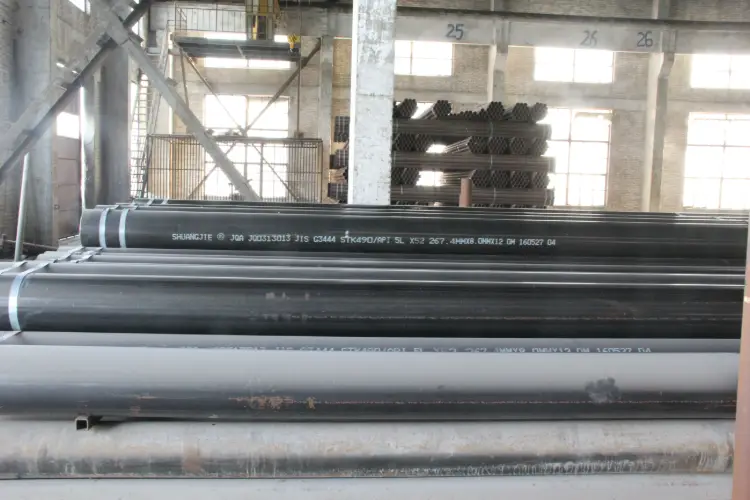
API 5L PSL1 X52 (L360) Pipeline Steel Plate
API 5L PSL1 X52 (L360) Pipeline Steel Plate: High‑Strength Low‑Alloy Steel for Critical Energy Transport Systems
In-depth analysis of API 5L PSL1 X52 (L360) pipeline steel plate, covering chemical composition, mechanical and physical properties, international equivalents, and application guidance for the oil and gas industry.
Thermomechanical rolling (TMCP), normalizing rolling, hot rolling; subsequent forming into welded pipe (SAW, ERW) or seamless pipe
- Phone : +8618037372205
- Email : [email protected]
- WhatsApp: Contact via Whtsapp
- WeChat: +8618037372205
API 5L PSL1 X52 Pipeline Steel Plate Introduction
API 5L PSL1 X52 (L360) is a high‑strength low‑alloy (HSLA) steel intended for welded and seamless pipe used in pipeline transportation systems for oil, gas, and water. The designation X52 indicates a minimum yield strength of 52 ksi (approximately 360 MPa), while L360 is the corresponding ISO grade. As a PSL 1 product, it is supplied to basic requirements without mandatory notch toughness testing. The material offers a balanced combination of strength, weldability, and ductility, making it suitable for moderate‑to‑high pressure onshore and offshore pipelines. Typical plate thicknesses range from 6 mm to over 25 mm, and the steel is often thermomechanically rolled or normalized to achieve the required mechanical properties and good low‑temperature crack arrest behaviour. Its controlled chemistry, typically with low carbon and manganese, ensures ease of forming, welding, and resistance to weld cracking under standard procedures.
API 5L PSL1 X52 Pipeline Steel Plate Chemical Composition
The chemical composition of API 5L PSL1 X52 steel is defined by Table 4 of API Spec 5L. Only the elements shown below are subject to mandatory limits. Other elements such as Nb, V, Ti, Al, Si, and N may be deliberately added for grain refinement or strengthening, but no maximum limits are specified in PSL 1 – their presence must be reported if added. The carbon equivalent CEIIW is typically controlled to ≤ 0.43 % to ensure good field weldability, though exact CE limits are by agreement for PSL 1.
| Element | Standard Value (max, unless range) | Remarks |
|---|---|---|
| Carbon (C) | 0.28 % | Max. for product analysis may be slightly higher by 0.02 %. |
| Manganese (Mn) | 1.40 % | Max.; Mn may be increased beyond 1.40 % if CE limit is respected, by agreement. |
| Phosphorus (P) | 0.030 % | Max. |
| Sulfur (S) | 0.030 % | Max. |
| Niobium (Nb) | Not specified | If added, report in ladle analysis. |
| Vanadium (V) | Not specified | If added, report in ladle analysis. |
| Titanium (Ti) | Not specified | If added, report in ladle analysis. |
| Aluminium (Al) | Not specified | Typically added for deoxidation (0.015‑0.060 % total Al). |
| Silicon (Si) | Not specified | Often 0.15‑0.40 %; full killed steel practice. |
| Carbon Equivalent (CEIIW) | ≤ 0.43 % (agreed) | CE = C + Mn/6 + (Cr+Mo+V)/5 + (Cu+Ni)/15; typical for good weldability. |
API 5L PSL1 X52 Pipeline Steel Plate Physical Properties
The following physical properties are typical for API 5L X52 (L360) steel and are provided for design and engineering guidance. These values are not mandatory per API 5L but are representative of low‑carbon microalloyed steel with ferritic‑pearlitic microstructure. Actual values may vary with final processing route and minor chemistry variations.
| Property | Typical Value | Unit | Condition / Temperature |
|---|---|---|---|
| Density (ρ) | 7.85 | g/cm³ | Room temperature |
| Modulus of Elasticity (E) | 205 – 210 | GPa | Ambient temperature |
| Shear Modulus (G) | 80 – 82 | GPa | Calculated (E and ν) |
| Poisson's Ratio (ν) | 0.29 – 0.30 | – | Elastic range |
| Thermal Expansion Coefficient (α) | 11.7 × 10⁻⁶ | /K | 20 – 100 °C |
| Thermal Expansion Coefficient (α) | 12.2 × 10⁻⁶ | /K | 20 – 200 °C |
| Thermal Expansion Coefficient (α) | 13.0 × 10⁻⁶ | /K | 20 – 400 °C |
| Thermal Conductivity (λ) | 45 – 48 | W/(m·K) | At 20 °C |
| Thermal Conductivity (λ) | 40 – 43 | W/(m·K) | At 200 °C |
| Thermal Conductivity (λ) | 34 – 37 | W/(m·K) | At 400 °C |
| Specific Heat Capacity (cp) | 460 – 480 | J/(kg·K) | 20 – 100 °C |
| Electrical Resistivity (ρe) | 0.20 – 0.25 × 10⁻⁶ | Ω·m | At 20 °C |
API 5L PSL1 X52 Pipeline Steel Plate Mechanical Properties
Mechanical property requirements are taken from API 5L Tables 6 and 7 for PSL 1 pipe and plate. Values apply to transverse samples at room temperature. For plate to be formed into pipe, the reported properties generally refer to the finished pipe body; however, the specified limits for the plate (as‑rolled condition) are equivalent. Charpy V‑notch impact test is not required for PSL 1 unless specified in the purchase order (e.g., supplementary requirement SR5). The elongation values are based on a gauge length of 2 in (50.8 mm) for rectangular test pieces; for other gauge lengths the specified minimum elongation is calculated according to the specified formula.
| Property | Requirement | Unit | Test Condition |
|---|---|---|---|
| Yield Strength (ReH or Rt0.5) | ≥ 360 (52) | MPa (ksi) | Transverse strip test, 0.5 % total extension under load; minimum for wall thickness ≤ 25.4 mm. |
| Tensile Strength (Rm) | 460 – 760 (67 – 110) | MPa (ksi) | Transverse strip test; upper and lower limits apply. |
| Elongation (A50.8mm) | 27 (for t ≤ 7.9 mm) | % | Gauge length 2 in (50.8 mm), rectangular specimen, transverse; see formula for thicker sections. |
| Elongation (A50.8mm) | 22 (for t = 12.7 mm typical) | % | For plate thickness 12.7 mm; calculated value per API 5L Eq. (2) using Rm = 540 MPa, A0 = 620 mm². |
| Elongation (A=5.65√S0) | Min. ≈ 20–24 | % | Proportional gauge length; depends on actual Rm and cross‑sectional area per API 5L formula. |
| Bend Test (Guided Bend) | No cracks or openings | – | Bend diameter = 2t for t ≤ 12.7 mm; = 3t for t > 12.7 mm. Bend angle 180°. |
API 5L PSL1 X52 Pipeline Steel Plate Fully Equivalent Material Grades and Replaceable Standards
| Country / Region | Standard | Grade | Remarks |
|---|---|---|---|
| International | ISO 3183:2019 | L360 (PSL 1 analogous) | Pipe-grade L360; identical base requirements; applies to both seamless and welded pipe. |
| Europe | EN 10208‑2 | L360MB (optionally L360GA) | M‑series corresponds to TMCP plate; with agreed composition and CE, directly replaceable. |
| China | GB/T 9711‑2023 | L360 | Aligned with ISO 3183; PSL 1 equivalent; used for oil and gas pipelines. |
| Canada | CSA Z245.1‑18 | Grade 359 (X52) | Comparable yield strength; additional Charpy requirements may apply. |
| Australia / New Zealand | AS 2885.1 | X52 / L360 | Adopts ISO 3183 and API 5L grades; material to AS 2885 is ordered with supplementary toughness. |
| Russia | GOST R 52079 | К52 (K52) | Yield strength class 52; chemistry and tensile requirements match X52 with minor differences in Mn. |
| Brazil | ABNT NBR 14810 | X52 (L360) | Based on API 5L; seamless and welded pipe. |
API 5L PSL1 X52 Pipeline Steel Plate Application Introduction
API 5L PSL1 X52 (L360) steel plate is engineered for the safe and economical transport of hydrocarbons and other fluids. Its balanced properties enable the construction of long‑distance pipelines, process piping, and structural applications in moderately sour service. The material is easily formed into pipe by longitudinal or spiral welding, and it can be fabricated into a variety of fittings and pressure‑containing components. Because PSL 1 imposes no mandatory toughness, it is typically used where compliance with general pipeline regulations is sufficient and the risk of brittle fracture is managed by material selection and operating conditions.
Product Applications: Line pipe (spiral‑welded, longitudinal‑welded, seamless), Pipeline bends, elbows, tees, and reducers, Flanges and blind flanges (to matching pressure ratings), Riser pipes and platform bracing, LNG plant process piping, Water injection lines and fire‑fighting mains, Jacket legs and structural tubulars for offshore platforms
Processed into products: Spiral‑weld pipe (up to 60‑inch diameter), Longitudinal‑weld (LSAW) pipe (thick‑wall, high‑diameter), Pipe‑to‑pipe connectors and pup pieces, Hot‑formed induction bends (radius ≥ 3D), Welding neck flanges (to ASME B16.5), Branch outlet fittings (welded tees), Anchor forgings and support pedestals
Application industries: Oil and gas extraction (upstream), Midstream pipeline transmission (onshore and offshore), Petrochemical refining and processing, Water treatment and desalination (large‑diameter water mains), Slurry and mineral concentrate transport, Civil engineering (structural hollow sections, piling), Shipbuilding (structural members for marine terminals)
API 5L PSL1 X52 Pipeline Steel Plate Similar / Alternative Steel Grades for Consideration
| Country / Region | Standard | Grade | Remarks |
|---|---|---|---|
| International | API 5L / ISO 3183 | X46 / L320 | Lower strength; suitable for lower pressure or less demanding conditions; more formable. |
| International | API 5L / ISO 3183 | X56 / L390 | Higher strength (390 MPa yield); suitable for thinner wall design; similar weldability. |
| International | API 5L / ISO 3183 | X60 / L415 | Higher strength; requires stricter welding procedures; often used in high‑pressure long‑distance pipelines. |
| Europe | EN 10025‑4 | S460ML / S460M | Structural steel with comparable yield; toughness classes available; not intended for pipeline service but mechanically similar. |
| USA | ASTM A572 | Grade 50 (Type 1) | Yield 345 MPa; lower strength but similar weldability and cost; used in structural applications. |
| USA | ASTM A1011 / A1018 | Grade 50 / HSLAS Grade 50 | HSLA sheet/plate with 340‑450 MPa yield; may substitute in non‑pipeline static applications. |
Notes:
PSL 1 vs. PSL 2: This material grade under PSL 1 does not require mandatory Charpy V‑notch toughness testing; for low‑temperature or sour service applications, consider ordering PSL 2 with supplementary requirements (e.g., CVN, NACE MR‑0175/ISO 15156 compliance).
Weldability: X52 has excellent field weldability with low‑hydrogen electrodes and standard procedures. Preheating is normally not required above +5 °C, but the carbon equivalent should be checked for the specific heat. Post‑weld heat treatment is rarely needed unless thick sections or severe service conditions demand.
Formability: The steel can be cold‑formed to typical pipe radius without cracking, but hot forming (induction bending) is commonly performed at 850–1000 °C and may require subsequent normalising to restore mechanical properties.
Coating and corrosion protection: Standard external coatings (3‑layer PE/PP, FBE) and internal coatings (epoxy) are fully compatible with X52. For mildly sour service, hardness control (e.g., ≤ 22 HRC) and HIC‑resistant grades (extra‑processed, with low S) may be required.
- Share



