
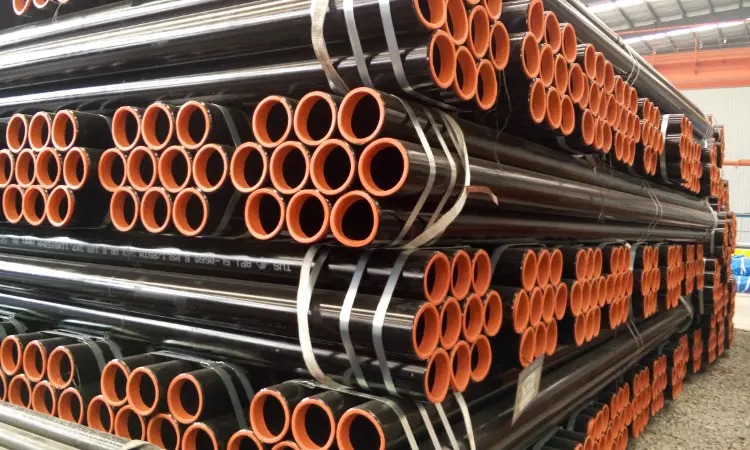
API 5L PSL1 Grade B (L245) Pipeline Steel Plate
API 5L PSL1 Grade B (L245) Pipeline Steel Plate - Composition, Properties & Global Equivalents
Detailed material data for API 5L PSL1 Grade B (L245) pipeline steel plate: chemical composition, mechanical properties, thermal and electrical properties, full equivalents, and application guidance.
Welding, cold forming, hot forming, cutting, machining
- Phone : +8618037372205
- Email : [email protected]
- WhatsApp: Contact via Whtsapp
- WeChat: +8618037372205
API 5L PSL1 Grade B Pipeline Steel Plate Introduction
API 5L PSL1 Grade B (L245) is a carbon-manganese structural steel designed primarily for welded line pipe used in oil, gas, and water transportation. As a PSL1 product, it meets basic quality requirements with moderate strength and good weldability. The designation L245 indicates a minimum yield strength of 245 MPa. It is supplied in plate form for subsequent forming into spiral or longitudinal welded pipes. Typical delivery condition is as-rolled, normalized, or thermomechanically rolled. This grade is widely adopted globally and has numerous international equivalents, making it a cost-effective choice for standard pipeline applications.
API 5L PSL1 Grade B Pipeline Steel Plate Chemical Composition
The chemical composition conforms to API Spec 5L, 46th Edition, Table 4 for PSL 1 welded pipe (plate feedstock). Elements not listed may be present as residuals from the steelmaking process but are not intentionally added.
- Carbon and manganese levels are balanced to provide adequate strength while maintaining excellent weldability.
- Phosphorus and sulfur are limited to ensure ductility and toughness.
| Element | Standard Value | Remarks |
|---|---|---|
| C | ≤ 0.22% | Welded pipe; ladle analysis |
| Mn | ≤ 1.20% | Typical range 0.90–1.20% |
| P | ≤ 0.030% | |
| S | ≤ 0.030% | |
| Si | ≤ 0.45% | Common for deoxidation; not mandatory in standard |
| Nb, V, Ti | ≤ 0.15% each (if added) | Microalloying optional, not required for PSL1 |
API 5L PSL1 Grade B Pipeline Steel Plate Thermal and Electrical Properties
These physical properties are typical for low-carbon steel equivalent to API 5L Grade B and are not part of the delivery condition specification. Values are provided for general design calculations.
- The density and moduli are standard for carbon steel.
- Thermal expansion and conductivity are mean values in the indicated temperature ranges.
| Property | Typical Value | Unit | Test Condition / Temperature |
|---|---|---|---|
| Density (ρ) | 7.85 | g/cm³ | 20 °C |
| Elastic modulus (E) | 205 | GPa | Room temperature |
| Shear modulus (G) | 80 | GPa | Room temperature |
| Poisson's ratio (ν) | 0.29 | – | Room temperature |
| Thermal expansion coefficient (α) | 12.1 × 10⁻⁶ | K⁻¹ | 20–100 °C |
| Thermal expansion coefficient (α) | 13.8 × 10⁻⁶ | K⁻¹ | 20–400 °C |
| Thermal conductivity (λ) | 52 | W/(m·K) | 20 °C |
| Thermal conductivity (λ) | 45 | W/(m·K) | 400 °C |
| Specific heat capacity (cp) | 470 | J/(kg·K) | 20 °C |
| Electrical resistivity (ρe) | 0.17 × 10⁻⁶ | Ω·m | 20 °C |
API 5L PSL1 Grade B Pipeline Steel Plate Mechanical Properties
Mechanical properties per API Spec 5L, Tables 5 and 6 for Grade B PSL1 welded pipe body (applicable to plate before forming).
- Yield and tensile values apply to transverse specimens for pipe body; for plate in the as-supplied condition the same limits are generally guaranteed.
- Bend test: no cracks after 180° bending around a mandrel with diameter equal to the plate thickness.
- Impact test is not required for PSL1 base material unless specified in a supplementary requirement.
| Property | Specified Value | Unit | Test Condition |
|---|---|---|---|
| Yield Strength (Rt0.5) | 245 min | MPa | Transverse, room temperature |
| Yield Strength (Rt0.5) | 450 max | MPa | Transverse, room temperature |
| Tensile Strength (Rm) | 415 min | MPa | Transverse, room temperature |
| Tensile Strength (Rm) | 760 max | MPa | Transverse, room temperature |
| Elongation after fracture (A) | Calculated per API 5L formula | % | 50 mm gauge length; typically ≥ 22% for t ≤ 19.1 mm |
| Bend test | No cracks | – | 180° bend, mandrel diameter = plate thickness |
API 5L PSL1 Grade B Pipeline Steel Plate Fully Equivalent Material Standards and Replaceable Grades
| Country/Region | Standard | Designation | Remarks |
|---|---|---|---|
| International | ISO 3183 | L245 (PSL 1) | Identical to API 5L Grade B, PSL 1 |
| Europe | EN 10208-1 | L245GA | Gas pipelines; similar chemistry and properties |
| Europe | EN 10208-1 | L245NB | Normalized variant for improved toughness |
| China | GB/T 9711 | L245 (PSL 1) | Direct equivalent of ISO 3183 L245 |
| USA | ASTM A53/A53M | Grade B | Welded and seamless pipe; slight differences in elongation requirements |
| USA | ASTM A106/A106M | Grade B | Seamless pipe only; often used interchangeably for pressure piping |
API 5L PSL1 Grade B Pipeline Steel Plate Application Introduction
API 5L PSL1 Grade B (L245) plate is primarily used for oil and gas pipeline production. It is formed into longitudinally or spirally welded pipes ranging from small to large diameters. The material is also suitable for water and slurry transportation, as well as structural applications where proven toughness and weldability are required.
Product Applications: Spiral welded line pipes (up to 60 inch OD), Longitudinal welded pipes (ERW / UOE / JCOE), Pipe fittings (elbows, tees, reducers, flanges) made from plate, Storage tank shells and roofs, Structural hollow sections
Processed into products: Pipeline segments for cross-country transmission, Risers and gathering lines, Casing and conductor pipes for wells, Penstocks and water mains, Support braces and structural members in modular pipe racks
Application industries: Oil and gas (upstream, midstream), Water treatment and supply, Mining (slurry pipelines), Construction (structural pipes, piling), Chemical process (low-pressure lines)
API 5L PSL1 Grade B Pipeline Steel Plate Similar / Alternative Materials with Comparable Performance
| Country/Region | Standard | Designation | Remarks |
|---|---|---|---|
| USA | API 5L PSL1 | Grade A (L210) | Lower strength (min yield 210 MPa); suitable for less demanding service |
| USA | API 5L PSL1 | Grade X42 (L290) | Higher strength (min yield 290 MPa); often used for higher pressure lines |
| USA | ASTM A36/A36M | Grade A36 | Structural carbon steel; yield 250 MPa but less stringent on through-thickness properties |
| Europe | EN 10025-2 | S235JR | Structural steel with similar strength; not designed for tight weldability requirements of pipelines |
| China | GB/T 700 | Q235B | General purpose carbon steel; comparable mechanicals but no demanding weld/ductility requirements |
Notes:
Supplementary requirements (e.g., Charpy impact testing, stricter chemistry, ultrasonic examination) may be applied by the purchaser; these are not part of the basic PSL1 specification. For sour service or other special conditions, PSL2 grades with appropriate hydrogen-induced cracking (HIC) resistance are recommended. The data provided pertain to the plate product; after pipe forming and expansion, slight changes in properties may occur.
- Share



