
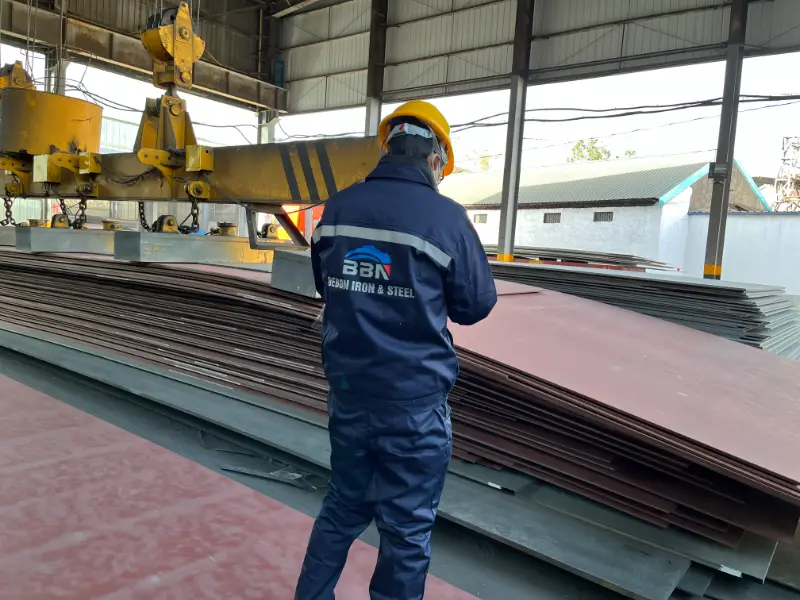
40Cr13 (4Cr13) Martensitic Stainless Steel Plate & Coil under GB/T 4237
40Cr13 (4Cr13) Martensitic Stainless Steel Plate & Coil under GB/T 4237 | Hardened Grade for Cutting Tools
Explore the complete technical profile of 40Cr13 (4Cr13) martensitic stainless steel plate and coil as per GB/T 4237. Includes chemical composition, mechanical properties, physical data, international equivalents, and typical applications in cutlery, surgical instruments, and wear parts.
Hot rolling, cold rolling (after annealing), blanking, punching, bending (in annealed condition), machining, heat treatment (quenching and tempering), grinding, polishing
- Phone : +8618037372205
- Email : [email protected]
- WhatsApp: Contact via Whtsapp
- WeChat: +8618037372205
40Cr13 Martensitic Stainless Steel Plate & Coil under GB/T 4237 Introduction
40Cr13 (formerly designated 4Cr13) is a high-carbon martensitic stainless steel standardized in GB/T 4237 for hot-rolled stainless steel plates and coils. With approximately 0.40% carbon and 13% chromium, it can be hardened by heat treatment to achieve high hardness and good wear resistance, while retaining moderate corrosion resistance. Key characteristics include:
- Excellent hardenability and achievable hardness above 50 HRC after quenching and tempering.
- Good resistance to mild acids, fresh water, and atmospheric corrosion.
- Superior edge retention and cutting performance in the hardened condition.
- Typically supplied in the annealed condition for easy forming and machining, then hardened by the end user.
This grade is widely employed for producing surgical instruments, cutlery, bearings, valve parts, and other components requiring high strength and wear resistance.
40Cr13 Martensitic Stainless Steel Plate & Coil under GB/T 4237 Chemical Composition
Chemical composition according to GB/T 4237 (heat analysis). Limits for 40Cr13 grade are listed. Elements not quoted shall not be intentionally added, and residual elements (e.g., Cu, Ni, Mo) shall comply with the standard's general requirements.
| Element | Specified Value (%) | Remarks |
|---|---|---|
| Carbon (C) | 0.36 – 0.45 | Main hardening element |
| Silicon (Si) | ≤ 0.60 | Deoxidizer; limit ensures toughness |
| Manganese (Mn) | ≤ 0.80 | Improves hot workability |
| Phosphorus (P) | ≤ 0.040 | Maximum for all product forms |
| Sulfur (S) | ≤ 0.030 | Maximum for all product forms |
| Chromium (Cr) | 12.00 – 14.00 | Primary corrosion resistance and carbide-forming element |
| Nickel (Ni) | ≤ 0.60 (not intentionally added) | Residual control, not required |
40Cr13 Martensitic Stainless Steel Plate & Coil under GB/T 4237 Thermal and Electrical Physical Properties
Physical properties are typical values at room temperature unless otherwise stated. These are not mandatory specification limits but provide design reference. Values may vary slightly with heat treatment and specific production route. Elastic moduli are for the annealed condition.
| Property | Typical Value | Unit | Test Condition / Remarks |
|---|---|---|---|
| Density (ρ) | 7.75 | g/cm³ | At 20°C |
| Modulus of Elasticity (E) | 200 | GPa | At 20°C, annealed |
| Shear Modulus (G) | 78 | GPa | Calculated from E and Poisson's ratio |
| Poisson's Ratio (ν) | 0.30 | — | Typical for martensitic stainless steels |
| Thermal Expansion Coefficient (α) | 10.5 (20–100°C); 11.0 (20–200°C); 11.5 (20–400°C) | 10⁻⁶/K | Mean coefficient, depends on temperature range |
| Thermal Conductivity (λ) | 25 | W/(m·K) | At 20°C |
| Specific Heat Capacity | 460 | J/(kg·K) | At 20°C |
| Electrical Resistivity (ρ_e) | 0.55 | 10⁻⁶ Ω·m | At 20°C |
40Cr13 Martensitic Stainless Steel Plate & Coil under GB/T 4237 Mechanical Properties
As per GB/T 4237, the plate/coil is normally supplied in the soft annealed condition. Only hardness requirements are specified for the as-delivered material. No tensile test is mandated in the annealed state for these thicknesses, but typical achievable properties after heat treatment are provided for design guidance. Note: The hardness value is a mandatory requirement; the others are typical values obtainable after suitable hardening and tempering.
| Property | Required/ Typical Value | Unit | Test Condition |
|---|---|---|---|
| Brinell Hardness (as-delivered) | ≤ 235 | HBW | Annealed at 800–900°C, slow cool |
| Hardness after quenching & tempering | approx. 50–55 | HRC | Quenched 1000–1050°C, oil/air cool; tempered 200–300°C |
| Tensile Strength (Rm) - hardened | ≥ 1700 | MPa | After hardening to ≥50 HRC (typical guide value) |
| Yield Strength (Rp0.2) - hardened | ≥ 1400 | MPa | After hardening (typical guide value) |
| Elongation (A) - hardened | ≥ 2 | % | After hardening, gauge length L0=50 mm (typical guide value) |
| Impact Energy (KV) - hardened | approx. 8–15 | J | Charpy-V at room temp. (typical value) |
40Cr13 Martensitic Stainless Steel Plate & Coil under GB/T 4237 Fully Equivalent Material Standards and Substitute Grades
| Country / Region | Standard | Grade Designation | Remarks |
|---|---|---|---|
| China | GB/T 4237 | 40Cr13 (4Cr13) | Original plate/coil standard |
| China | GB/T 1220 | 40Cr13 | Bars and forgings – same chemical composition |
| European Union | EN 10088-2 | X46Cr13 (1.4034) | Chemically equivalent; slight carbon range difference (0.43–0.50) |
| International | ISO 15510 | X46Cr13 | Equivalent hot-rolled stainless steel plate |
| Russia | GOST 5632 | 40Ch13 (40Х13) | Chemically and technically equivalent |
| Japan | JIS G4304 | SUS420J2 modified* | No direct equivalent; SUS420J2 is 30Cr13 |
40Cr13 Martensitic Stainless Steel Plate & Coil under GB/T 4237 Application Introduction
Due to its combination of high attainable hardness, good wear resistance, and adequate corrosion resistance, 40Cr13 is mainly used in the hardened and tempered condition. It can be shaped, machined, and blanked in the soft annealed state, then locally hardened or through-hardened. The alloy can be polished to a high mirror finish, making it suitable for visible parts and cutting edges. Major application areas are outlined below.
Product Applications: Surgical scalpels, scissors, forceps, and dental instruments, Household and professional kitchen knives, shears, Ball bearings, roller bearings, and thrust washers, Valve seats, check valves, and pump shafts, Injection moulds for plastics, lightly corrosive environments, Springs (flat or coil) requiring moderate corrosion resistance and high strength
Processed into products: Blade blanks and cutlery blades, Wear-resistant strips and liners, Shaft sleeves and bushings for pumps, Surgical instrument jaws and needle holders, Precision-ground gauge blocks and tooling pins, Template dies and stamping punches
Application industries: Medical and surgical instrument manufacturing, Cutlery and kitchen knife industry, Bearing and pump manufacturing, Mould and tool making, Food processing and packaging equipment
40Cr13 Martensitic Stainless Steel Plate & Coil under GB/T 4237 Similar or Close Substitution Materials
| Country / Region | Standard | Grade Designation | Remarks / Analysis |
|---|---|---|---|
| China | GB/T 4237 | 30Cr13 (3Cr13) | Lower carbon (0.26–0.35%), lower as-quenched hardness but better toughness; suitable where maximum edge retention is not critical |
| USA | ASTM A240 | 420 (S42000) | Carbon 0.15% min, but actual typical carbon is lower than 40Cr13; lower hardness and wear resistance |
| USA | ASTM A276/A276M | 440A (S44002) | Higher chromium (16–18%) and carbon (0.60–0.75%), better corrosion resistance and hardness, but less tough; often used for cutlery |
| European Union | EN 10088-2 | X39Cr13 (1.4031) | Similar carbon level but lower chromium tolerance; usable substitute with comparable hardenability |
| Japan | JIS G4305 | SUS440A | Cold-rolled sheet, similar application range, higher carbon and chromium |
Notes:
Heat treatment recommendations: Soft annealing at 800–880°C, slow cooling down to 600°C. Hardening: preheat at 600–800°C, then austenitise at 1000–1050°C, quench in oil or forced air. Tempering at 180–250°C to achieve surface hardness >50 HRC while retaining satisfactory toughness. Tempering between 400 and 600°C should be avoided due to quenched martensite embrittlement. Welding: Due to high carbon content, welding is not generally recommended; if unavoidable, preheat to 200–300°C and use austenitic filler metals (e.g., E308-16) to avoid cracking.
- Share



