
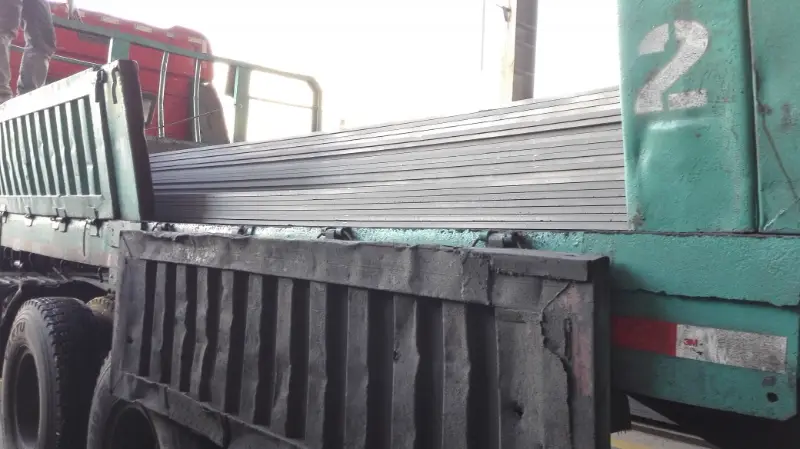
17Cr16Ni2 Martensitic Stainless Steel Plate/Coil
17Cr16Ni2 Martensitic Stainless Steel Plate/Coil - High Strength & Corrosion Resistance
17Cr16Ni2 is a hardenable martensitic stainless steel supplied as hot-rolled plate or coil, offering a balanced combination of high mechanical strength and good corrosion resistance, ideal for structural parts in mildly corrosive environments.
Suitable for hot forming, cold forming (limited), machining, welding (with precautions), and heat treatment (quenching and tempering, annealing).
- Phone : +8618037372205
- Email : [email protected]
- WhatsApp: Contact via Whtsapp
- WeChat: +8618037372205
17Cr16Ni2 Martensitic Stainless Steel Plate/Coil Introduction
17Cr16Ni2 (new designation 12Cr16Ni2 under GB/T 20878) is a martensitic stainless steel defined in GB/T 4237 for hot-rolled plates and coils. It contains approximately 16% chromium and 2% nickel, which provides good hardenability and corrosion resistance superior to plain chromium martensitic grades. Through appropriate heat treatment (quenching and tempering), this steel achieves high tensile strength (>800 MPa) and moderate ductility, making it suitable for components that require both strength and resistance to mild corrosive media such as fresh water, steam, and organic acids. Typical applications include shafts, bolts, valve parts, and structural components in the chemical, food processing, and power generation industries. The material can be supplied in annealed or quenched-and-tempered condition, facilitating subsequent machining or forming operations.
17Cr16Ni2 Martensitic Stainless Steel Plate/Coil Chemical Composition
Typical chemical composition according to GB/T 4237 for grade 17Cr16Ni2 (old designation). The alloy is designed with a balanced Cr and Ni content to achieve martensitic microstructure upon cooling and high strength after tempering. Carbon content is controlled to ensure hardenability while maintaining toughness.
- Values are in weight percent (mass%).
- Phosphorus and sulfur are kept low to enhance cleanliness and toughness.
| Element | Standard Value (%) | Remarks |
|---|---|---|
| Carbon (C) | 0.12 – 0.22 | Provides strength and hardenability |
| Silicon (Si) | ≤ 1.00 | Deoxidizer, improves oxidation resistance |
| Manganese (Mn) | ≤ 1.50 | Improves hot workability and strength |
| Phosphorus (P) | ≤ 0.040 | Impurity, kept low for toughness |
| Sulfur (S) | ≤ 0.030 | Impurity, kept low for machinability and toughness |
| Chromium (Cr) | 15.00 – 17.00 | Essential for corrosion resistance and hardenability |
| Nickel (Ni) | 1.50 – 2.50 | Improves corrosion resistance and toughness, aids hardenability |
| Iron (Fe) | Balance | Base element |
17Cr16Ni2 Martensitic Stainless Steel Plate/Coil Thermal and Electrical Physical Properties
Physical properties at room temperature and elevated temperatures. These are typical values for 17Cr16Ni2 (similar to 1.4057 / SUS431) and are not specified in GB/T 4237 but are useful for design.
- Properties may vary slightly with heat treatment condition.
| Property | Standard Requirement Value | Unit | Test Condition |
|---|---|---|---|
| Density (ρ) | 7.7 | g/cm³ | At 20°C |
| Modulus of Elasticity (E) | 215 | GPa | At 20°C, tension |
| Shear Modulus (G) | 83 | GPa | At 20°C, calculated from E and ν |
| Poisson's Ratio (ν) | 0.27 – 0.30 | — | At 20°C, typical |
| Thermal Expansion Coefficient (α) | 10.5 | 10⁻⁶/K | Between 20°C and 100°C |
| Thermal Conductivity (λ) | 25 | W/(m·K) | At 20°C |
| Specific Heat Capacity | 460 | J/(kg·K) | At 20°C |
| Electrical Resistivity (ρ_e) | 0.70 | µΩ·m | At 20°C |
17Cr16Ni2 Martensitic Stainless Steel Plate/Coil Mechanical Properties
Mechanical properties are for plates in quenched and tempered condition as per GB/T 4237. Values are minimum requirements unless noted. Heat treatment: Quenching at 950–1050°C (oil or water) followed by tempering at 275–350°C. Mechanical testing performed at room temperature.
- For plates > 3 mm thickness, properties may vary slightly; consult standard for full details.
| Property | Standard Requirement | Unit | Test Condition |
|---|---|---|---|
| Tensile Strength (Rm) | ≥ 800 | MPa | Room temperature, quenched & tempered |
| Yield Strength (Proof Strength, Rp0.2) | ≥ 600 | MPa | Room temperature, quenched & tempered |
| Elongation after fracture (A) | ≥ 12 | % | Gauge length 50 mm (or proportional), room temperature |
| Hardness (Brinell) | Typical 240 – 320 | HBW | Quenched & tempered condition (for reference only, not a mandatory requirement in GB/T 4237) |
17Cr16Ni2 Martensitic Stainless Steel Plate/Coil Fully Equivalent Material Standards & Substitutable Grades
| Country/Region | Standard | Designation | Remarks |
|---|---|---|---|
| China | GB/T 4237 (old) | 17Cr16Ni2 | Hot-rolled stainless steel plate and coil (old grade) |
| China | GB/T 20878, GB/T 4237 (new) | 12Cr16Ni2 | Unified designation, replaces 17Cr16Ni2 in new editions |
| European Union | EN 10088-2 | X17CrNi16-2 (1.4057) | Chemically equivalent; covers hot-rolled plate/strip |
| Germany | DIN 17440 (withdrawn), DIN EN 10088-2 | 1.4057 | Equivalent to X17CrNi16-2 |
| Japan | JIS G4304 | SUS431 | Hot-rolled stainless steel plate, closely matches chemical composition |
| USA | ASTM A240 | UNS S43100 (Type 431) | Slight variations in carbon range (max 0.20%); commonly accepted substitute |
17Cr16Ni2 Martensitic Stainless Steel Plate/Coil Application Introduction
17Cr16Ni2 is selected for applications requiring a combination of high mechanical strength (after heat treatment) and moderate corrosion resistance. It is not intended for highly corrosive chloride environments but performs well in fresh water, steam, mild acids, and organic media. Its martensitic nature allows hardening through quenching and tempering, enabling the production of durable components for various industries.
Product Applications: Shafts, axles, and spindles for pumps and motors, Bolts, nuts, and high-strength fasteners, Valve stems, seats, and discs, Fittings and flanges for moderate corrosive service, Structural brackets and supports, Cutting tools and dies (when higher hardness is required)
Processed into products: Pump impellers and shafts (fresh water/chemical service), Hydro turbine shafts and wear rings, Food processing blades and knives, Compressor blades and rotors, Fastening elements for corrosive environments, Precision machined parts requiring dimensional stability after heat treatment
Application industries: Chemical processing, Food and beverage equipment, Power generation (turbine components), Marine hardware (above waterline), General mechanical engineering, Pump and valve manufacturing
17Cr16Ni2 Martensitic Stainless Steel Plate/Coil Similar/Alternative Material Recommendations
| Country/Region | Standard | Designation | Remarks |
|---|---|---|---|
| China | GB/T 1220 | 14Cr17Ni2 (formerly 1Cr17Ni2) | Higher Cr (16-18%) and slightly lower Ni (1.5-2.5%), similar applications but slight difference in heat treatment response |
| China | GB/T 4237 | 20Cr13 (2Cr13) | Martensitic stainless steel with lower Ni (≤0.60%), higher carbon (0.16-0.25%), higher strength but lower corrosion resistance |
| EU | EN 10088-2 | X20Cr13 (1.4021) | Similar martensitic grade, lower Ni and higher C, often used for cutlery and turbine blades |
| USA | ASTM A240 | UNS S42000 (Type 420) | Higher carbon martensitic stainless, good hardenability but reduced toughness compared to 17Cr16Ni2 |
| Japan | JIS G4304 | SUS420J1 | Analogous to Type 420, alternative for higher hardness applications with moderate corrosion resistance |
Notes:
Welding: 17Cr16Ni2 can be welded, but preheating (200–300°C) and post-weld heat treatment are recommended to avoid cracking. Filler metal should match the base composition or use austenitic stainless steel fillers (e.g., 309 type) for less critical applications. Machining is best performed in the annealed condition; after hardening, carbide tools are necessary. For optimum corrosion resistance, the surface should be passivated after final machining. The material exhibits good scaling resistance up to approximately 750°C. For detailed thickness tolerances, flatness, and edge conditions, refer to GB/T 4237.
- Share



