
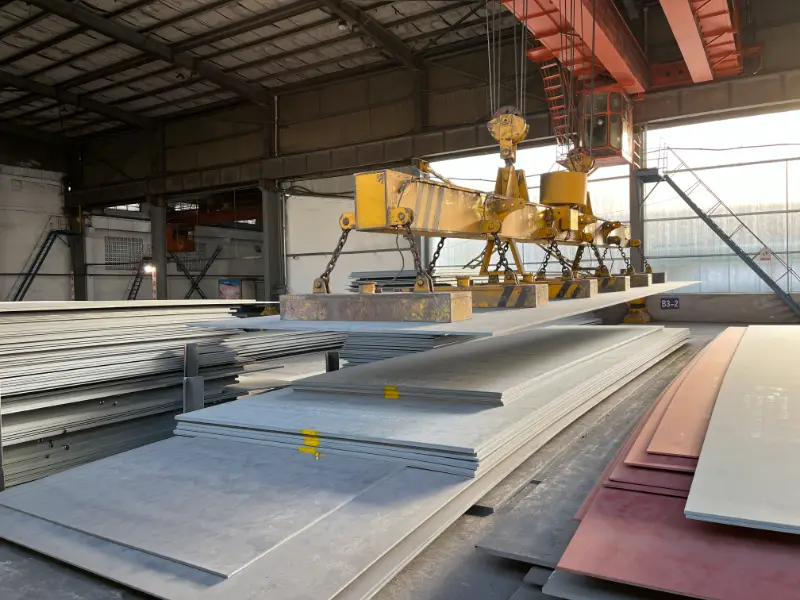
30Cr13 (3Cr13) Martensitic Stainless Steel
30Cr13 (3Cr13) Martensitic Stainless Steel Plate - GB/T 4237 Data & Global Equivalents
Complete material profile for 30Cr13 (3Cr13) martensitic stainless steel plates and coils under GB/T 4237, covering chemical composition, mechanical and physical properties, international equivalents, and application guidance.
Hot rolling, cold rolling, annealing, quenching and tempering, machining, limited welding
- Phone : +8618037372205
- Email : [email protected]
- WhatsApp: Contact via Whtsapp
- WeChat: +8618037372205
30Cr13 Martensitic Stainless Steel Introduction
30Cr13 (formerly 3Cr13) is a martensitic stainless steel standardized under GB/T 4237 for hot-rolled stainless steel plates and coils. It contains approximately 0.30% carbon and 13% chromium, providing high hardness and wear resistance after heat treatment. The alloy is hardenable by quenching and tempering, reaching tensile strengths above 735 MPa and hardness up to 27 HRC.
Key features include good corrosion resistance in mildly aggressive environments, excellent polishability, and excellent dimensional stability after hardening. It is magnetic and widely used for cutlery, surgical instruments, valve parts, springs, and wear-resistant components. The steel can be delivered in annealed or quenched-and-tempered condition.
30Cr13 Martensitic Stainless Steel Chemical Composition
The chemical composition complies with GB/T 4237-2015 for martensitic grade 30Cr13. All values are in weight percent. Nickel is normally a residual element with a maximum of 0.60%. Phosphorus and sulfur are strictly controlled to ensure good hot workability and machinability.
| Chemical Element | Standard Value (wt.%) | Remark |
|---|---|---|
| Carbon (C) | 0.26~0.35 | |
| Silicon (Si) | ≤1.00 | |
| Manganese (Mn) | ≤1.00 | |
| Phosphorus (P) | ≤0.040 | |
| Sulfur (S) | ≤0.030 | |
| Chromium (Cr) | 12.00~14.00 | |
| Nickel (Ni) | ≤0.60 | Residual |
30Cr13 Martensitic Stainless Steel Thermal and Electrical Physical Properties
Typical physical properties for 30Cr13 martensitic stainless steel at room and elevated temperatures. Data are compiled from authoritative engineering material handbooks and represent average values; actual properties may vary slightly with processing history.
| Property | Typical Value | Unit | Test Condition |
|---|---|---|---|
| Density (ρ) | 7.75 | g/cm³ | 20°C |
| Modulus of elasticity (E) | 215 | GPa | 20°C |
| Modulus of elasticity (E) | 203 | GPa | 200°C |
| Modulus of elasticity (E) | 183 | GPa | 500°C |
| Shear modulus (G) | 83 | GPa | 20°C |
| Poisson's ratio (ν) | 0.28 | - | 20°C |
| Thermal expansion coefficient (α) | 10.5 | 10⁻⁶/°C | 20~100°C |
| Thermal expansion coefficient (α) | 11.0 | 10⁻⁶/°C | 20~200°C |
| Thermal expansion coefficient (α) | 11.5 | 10⁻⁶/°C | 20~300°C |
| Thermal conductivity (λ) | 25.1 | W/(m·K) | 20°C |
| Thermal conductivity (λ) | 25.5 | W/(m·K) | 200°C |
| Specific heat capacity (c) | 460 | J/(kg·K) | 20°C |
| Electrical resistivity (ρ_e) | 0.55 | μΩ·m | 20°C |
30Cr13 Martensitic Stainless Steel Mechanical Properties
Mechanical properties as specified in GB/T 4237-2015. In the annealed condition, the maximum hardness is 235 HBW. When supplied in quenched and tempered condition, the steel must meet minimum tensile, yield, elongation, reduction of area, and impact requirements, along with specified hardness ranges.
| Property | Required Value | Unit | Test Condition |
|---|---|---|---|
| Yield strength (Rp0.2) | ≥540 | MPa | Quenched & tempered |
| Tensile strength (Rm) | ≥735 | MPa | Quenched & tempered |
| Elongation after fracture (A) | ≥12 | % | Quenched & tempered |
| Reduction of area (Z) | ≥40 | % | Quenched & tempered |
| Impact absorbed energy (KV2) | ≥24 | J | Quenched & tempered |
| Hardness (HBW) | 217~269 | - | Quenched & tempered |
| Hardness (HRC) | 21~27 | - | Quenched & tempered |
| Hardness (HBW) | ≤235 | - | Annealed |
30Cr13 Martensitic Stainless Steel Fully Equivalent Material Standards and Substitute Grades
| Country/Region | Standard | Grade | Remark |
|---|---|---|---|
| China | GB/T 4237 | 30Cr13 (3Cr13) | Original standard grade |
| International (ISO) | ISO 683-17 | X30Cr13 | Full equivalent martensitic stainless |
| European Union | EN 10088-2 | X30Cr13 (1.4028) | Martensitic, chemically identical |
| USA | ASTM A240/A240M | 420 (UNS S42000) | Broad carbon range, typical 0.30%C |
| Japan | JIS G4303 | SUS420J2 | Similar composition and properties |
| Germany | DIN EN 10088-2 | X30Cr13 | Same as EN grade |
30Cr13 Martensitic Stainless Steel Application Introduction
30Cr13 is extensively employed where high hardness, moderate corrosion resistance, and good wear properties are required. Typical applications span from domestic cutlery to industrial valve components. The following outlines recommended industries, products, and specific machined parts.
Product Applications: Kitchen knives, Scissors, Razor blades, Surgical scalpels, Dental instruments, Valve seats and stems, Spring washers, Ball bearings, Pump shafts
Processed into products: Blade edges, Valve stems, Spindle shafts, Wear plates, Bushings, Mold inserts, Collets, Measuring tool jaws
Application industries: Cutlery and kitchenware, Medical and surgical instruments, Mechanical engineering, Pumps and valves, Measuring tools and gauges, Spring manufacturing, Mold and die making
30Cr13 Martensitic Stainless Steel Similar or Alternative Material Recommendations
| Country/Region | Standard | Grade | Remark |
|---|---|---|---|
| China | GB/T 4237 | 20Cr13 (2Cr13) | Lower carbon (0.16-0.25%), higher toughness, lower achievable hardness |
| China | GB/T 4237 | 40Cr13 (4Cr13) | Higher carbon (0.36-0.45%), greater hardness after heat treatment |
| China | GB/T 1220 | 14Cr17Ni2 (1Cr17Ni2) | Higher Cr and Ni; improved corrosion resistance and toughness |
| USA | ASTM A276 | 440C (UNS S44004) | High-carbon martensitic for maximum wear resistance |
| Japan | JIS G4303 | SUS420J1 | Lower carbon than SUS420J2, similar to 20Cr13 |
Notes:
- 30Cr13 has limited weldability; if welding is necessary, preheating to 200-300°C and post-weld annealing or tempering are recommended to avoid cracking.
- The steel is magnetic both in annealed and hardened condition.
- Heat treatment: hardening by heating to 950-1000°C, oil or air quenching, then tempering at 200-300°C for high hardness, or 600-750°C for improved toughness.
- For applications requiring higher corrosion resistance, consider a higher chromium grade or a duplex stainless steel.
- Share



