
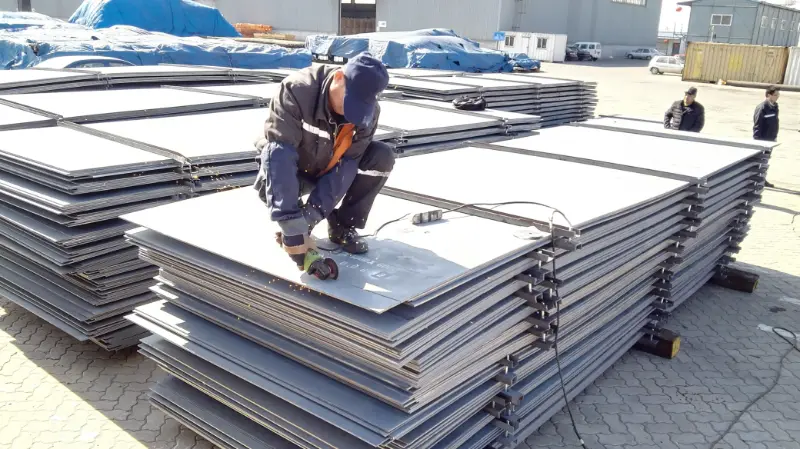
20Cr13 (2Cr13) Martensitic Stainless Steel Plate/Coil per GB/T 4237
20Cr13 (2Cr13) Martensitic Stainless Steel Plate/Coil per GB/T 4237: Properties and Equivalent Grades
Complete technical guide for 20Cr13 (2Cr13) stainless steel plate/coil according to GB/T 4237, featuring chemical composition, mechanical and thermal properties, global equivalent standards, and application insights.
Hot rolling, cold rolling, annealing, quenching and tempering, machining, welding (with preheating and post-weld heat treatment)
- Phone : +8618037372205
- Email : [email protected]
- WhatsApp: Contact via Whtsapp
- WeChat: +8618037372205
20Cr13 Martensitic Stainless Steel Plate/Coil per GB/T 4237 Introduction
20Cr13 (formerly 2Cr13) is a martensitic stainless steel grade covered by GB/T 4237 for hot-rolled plates and coils. It contains approximately 0.20% carbon and 13% chromium, offering a good balance of corrosion resistance and high strength achievable through quenching and tempering.
- Ferromagnetic and hardenable by heat treatment
- Delivers high tensile strength and moderate toughness after suitable heat treatment
- Supplied typically in annealed condition to facilitate machining and forming
- Used predominantly for components requiring wear resistance and strength, such as turbine blades, valve parts, and surgical instruments
20Cr13 Martensitic Stainless Steel Plate/Coil per GB/T 4237 Chemical Composition
The chemical composition conforms to GB/T 4237 for grade 20Cr13 and is designed to provide satisfactory hardenability and corrosion resistance. The controlled carbon and chromium contents ensure the formation of martensite during quenching.
- Low phosphorus and sulfur levels are maintained to preserve ductility.
- Nickel is limited to avoid stabilization of austenite.
| Element | Specification Range | Remarks |
|---|---|---|
| C | 0.16 – 0.25 | Carbon |
| Si | ≤ 1.00 | Silicon |
| Mn | ≤ 1.00 | Manganese |
| P | ≤ 0.040 | Phosphorus |
| S | ≤ 0.030 | Sulfur |
| Ni | ≤ 0.60 | Nickel |
| Cr | 12.00 – 14.00 | Chromium |
20Cr13 Martensitic Stainless Steel Plate/Coil per GB/T 4237 Thermal and Electrical Physical Properties
The physical properties presented are typical values for 20Cr13 martensitic stainless steel at room temperature and various elevated temperatures. These data are derived from authoritative metallurgical handbooks and serve as engineering references.
- Properties such as thermal expansion and conductivity change noticeably with temperature, influencing design for thermal cycling applications.
- Magnetic transformation occurs near the Curie temperature (approximately 700 °C).
| Property | Typical Value | Unit | Test Condition |
|---|---|---|---|
| Density (ρ) | 7.75 | g/cm³ | At 20 °C |
| Elastic Modulus (E) | 200 | GPa | At 20 °C |
| Shear Modulus (G) | 77 | GPa | At 20 °C |
| Poisson's Ratio (ν) | 0.27 – 0.30 | – | At 20 °C |
| Coefficient of Thermal Expansion (α) | 10.5 | 10⁻⁶/K | 20–100 °C |
| Coefficient of Thermal Expansion (α) | 11.5 | 10⁻⁶/K | 20–300 °C |
| Coefficient of Thermal Expansion (α) | 12.5 | 10⁻⁶/K | 20–500 °C |
| Thermal Conductivity (λ) | 24.9 | W/(m·K) | At 100 °C |
| Thermal Conductivity (λ) | 28.5 | W/(m·K) | At 500 °C |
| Specific Heat Capacity | 460 | J/(kg·K) | At 20 °C |
| Electrical Resistivity (ρₑ) | 0.55 | μΩ·m | At 20 °C |
20Cr13 Martensitic Stainless Steel Plate/Coil per GB/T 4237 Mechanical Properties
Mechanical properties are determined on test pieces taken from plates/coils and heat treated according to GB/T 4237. The specified heat treatment consists of quenching in oil from 920–980 °C followed by tempering at 600–750 °C with rapid cooling.
- Values represent minimum requirements; actual values may exceed these depending on the exact heat treatment.
- Hardness in the annealed delivery condition guarantees good machinability.
| Property | Required Value | Unit | Test Condition |
|---|---|---|---|
| Tensile Strength (Rm) | ≥ 640 | MPa | After quenching (920–980°C, oil) + tempering (600–750°C, rapid cooling) |
| Yield Strength (Rp0.2) | ≥ 440 | MPa | After quenching (920–980°C, oil) + tempering (600–750°C, rapid cooling) |
| Elongation (A) | ≥ 20 | % | Gauge length 50 mm, after quenched and tempered condition |
| Hardness (HBW) – Annealed | ≤ 223 | HBW | Annealed delivery condition |
| Hardness (HBW) – Tempered | 192 – 235 | HBW | Typical range after tempering at 600–750°C |
20Cr13 Martensitic Stainless Steel Plate/Coil per GB/T 4237 Complete Equivalent Material Standards and Substitutable Grades
| Country/Region | Standard | Grade | Remarks |
|---|---|---|---|
| China | GB/T 4237 | 20Cr13 (2Cr13) | Original designation |
| USA | ASTM A240/A240M | 420 (UNS S42000) | Very close chemistry; minor differences in P/S limits |
| European Union | EN 10088-2 | 1.4021 (X20Cr13) | Fully equivalent |
| Japan | JIS G4304 | SUS420J1 | Fully equivalent |
| International | ISO 15510 | X20Cr13 | Fully equivalent |
20Cr13 Martensitic Stainless Steel Plate/Coil per GB/T 4237 Application Introduction
20Cr13 stainless steel plate and coil serve in environments requiring moderate corrosion resistance combined with high mechanical strength. The alloy is widely adopted after quenching and tempering to reach hardness levels needed for wear parts. Typical usage covers:
- Power generation: steam and gas turbine stationary blades, last‑stage blades, and blade rings.
- Valves and pumps: valve seats, stems, discs, and pump shafts for mildly corrosive media.
- Medical instruments: surgical scalpels, scissors, forceps, and dental chisels.
- Cutlery and tools: high‑quality knife blades, kitchen knives, and industrial cutting inserts.
- General engineering: molds for plastics, die components, springs, and hydraulic cylinder rods.
Product Applications: Hot‑rolled plates for structural parts and pressure vessels, Cold‑rolled coils for stamping and forming of blades, cutlery, and spring washers, Valve bodies, discs, and bonnets, Surgical instrument blanks, Mold bases and mold inserts for plastic injection, Machined spring components and disc springs
Processed into products: Turbine last‑stage blades and stationary blades, Pump impellers, shafts, and wear rings, Valve stems, seats, and plugs, Hydraulic cylinder rods and pistons, Surgical scissors, forceps tips, and dental curettes, Knife blades and industrial cutting knives, Spring washers and disc spring elements
Application industries: Power Generation (steam and gas turbines), Oil & Gas (valves, pumps, and downhole tools), Medical Devices and Surgical Instruments, Food Processing Equipment, Cutlery and Tool Manufacturing, Automotive (engine and transmission components)
20Cr13 Martensitic Stainless Steel Plate/Coil per GB/T 4237 Similar/Alternative Material Recommendations
| Country/Region | Standard | Grade | Remarks |
|---|---|---|---|
| China | GB/T 4237 | 12Cr13 (1Cr13) | Lower carbon, lower strength but better toughness and weldability; suitable for less demanding corrosion applications. |
| China | GB/T 4237 | 30Cr13 (3Cr13) | Higher carbon content, providing greater hardness and wear resistance, but reduced ductility and toughness. |
| USA | ASTM A240 | 410 (S41000) | Equivalent to 12Cr13; lower strength, easier to form and weld. |
| Japan | JIS G4304 | SUS420J2 | Equivalent to 30Cr13; used for higher hardness components such as cutlery and bearings. |
Notes:
Heat treatment guidance:
Hardening: heat to 920–980 °C, hold sufficient time, then oil quench. Tempering: reheat to 600–750 °C according to desired strength/toughness balance, cool in air or oil.
Annealing: heat to 800–900 °C and slow cool (furnace) to obtain a soft structure suitable for machining.
Welding recommendations:
Preheat to 200–300 °C before welding. Use electrodes matching the base material (e.g., AWS E420). Immediately perform post‑weld heat treatment at 700–750 °C to avoid cracking. Peening between passes may help relieve stresses.
Cautions:
Avoid prolonged exposure at 400–550 °C to prevent temper embrittlement. For maximum corrosion resistance, surfaces should be polished and free from scale after heat treatment.
- Share



