
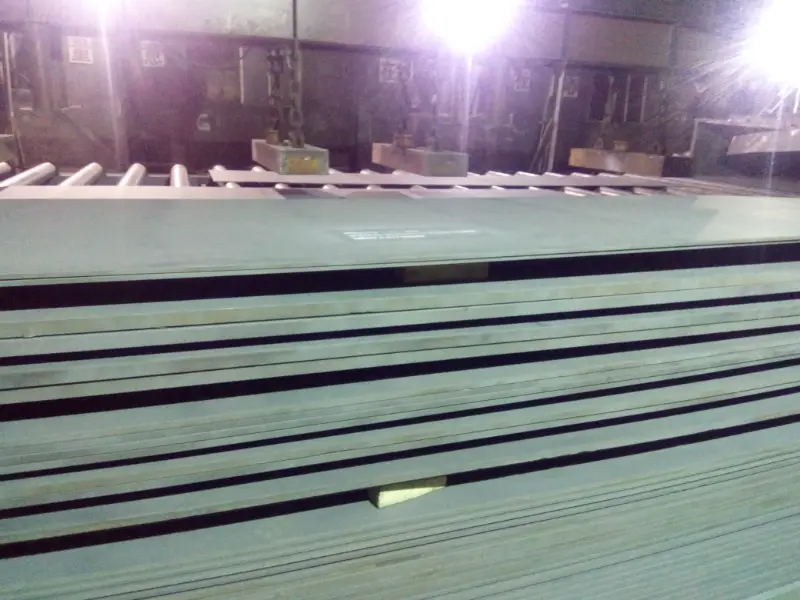
10Cr17Mo (1Cr17Mo) Ferritic Stainless Steel
10Cr17Mo (1Cr17Mo) Ferritic Stainless Steel: Complete Data Sheet to GB/T 4237
Chemical composition, mechanical and physical properties, international equivalents and application guide of 10Cr17Mo ferritic stainless steel according to GB/T 4237.
Welding, bending, deep drawing, stamping, blanking, limited machining
- Phone : +8618037372205
- Email : [email protected]
- WhatsApp: Contact via Whtsapp
- WeChat: +8618037372205
10Cr17Mo Ferritic Stainless Steel Introduction
10Cr17Mo (formerly 1Cr17Mo) is a ferritic stainless steel standardized in GB/T 4237-2015 for hot-rolled plates and coils. It contains 16–18% chromium and 0.75–1.25% molybdenum, which significantly improves corrosion resistance, particularly in mildly aggressive environments and against pitting and crevice corrosion compared to plain chromium ferritic grades.
The alloy offers good ductility, moderate strength, and is non-hardenable by heat treatment. Typical delivery condition is annealed and descaled. It is widely used in automotive exhaust systems, kitchenware, architectural trim, and heat exchanger components where cost-effective stainless steel with enhanced corrosion performance is required. The material is magnetic and can be welded with appropriate procedures, though ferritic grades require careful heat input control to avoid grain growth.
10Cr17Mo Ferritic Stainless Steel Chemical Composition according to GB/T 4237-2015
Composition limits for 10Cr17Mo heat analysis. All values are maximum unless a range is given. Elements not listed are not intentionally added and present as residuals only within limits permitted by the standard.
| Chemical Element | Standard Value (wt. %) | Remarks |
|---|---|---|
| Carbon (C) | <=0.12 | |
| Silicon (Si) | <=1.00 | |
| Manganese (Mn) | <=1.00 | |
| Phosphorus (P) | <=0.040 | |
| Sulfur (S) | <=0.030 | |
| Chromium (Cr) | 16.00–18.00 | Key for corrosion resistance |
| Molybdenum (Mo) | 0.75–1.25 | Enhances pitting resistance |
| Nickel (Ni) | <=0.60 | Residual element; not required |
10Cr17Mo Ferritic Stainless Steel Thermal and Electrical Physical Properties
Physical properties for 10Cr17Mo ferritic stainless steel in the annealed state. These are representative data; exact values can vary slightly with processing. Thermal expansion and conductivity influence design for elevated temperature service.
| Property | Typical Value | Unit | Test Condition / Temperature |
|---|---|---|---|
| Density (ρ) | 7.70 | g/cm³ | 20 °C |
| Modulus of Elasticity (E) | 200 | GPa | 20 °C |
| Shear Modulus (G) | 77 | GPa | 20 °C (calculated) |
| Poisson's Ratio (ν) | 0.28 | - | 20 °C (typical for ferritic SS) |
| Thermal Expansion Coefficient (α) | 10.4 | 10⁻⁶/K | 20–100 °C |
| Thermal Expansion Coefficient (α) | 10.8 | 10⁻⁶/K | 20–200 °C |
| Thermal Expansion Coefficient (α) | 11.3 | 10⁻⁶/K | 20–300 °C |
| Thermal Expansion Coefficient (α) | 11.7 | 10⁻⁶/K | 20–400 °C |
| Thermal Conductivity (λ) | 26.0 | W/(m·K) | 100 °C |
| Thermal Conductivity (λ) | 25.5 | W/(m·K) | 300 °C |
| Thermal Conductivity (λ) | 25.0 | W/(m·K) | 500 °C |
| Specific Heat Capacity (cₚ) | 460 | J/(kg·K) | 20–100 °C |
| Electrical Resistivity (ρ_e) | 0.60 | μΩ·m | 20 °C |
10Cr17Mo Ferritic Stainless Steel Mechanical Properties at room temperature
Mechanical properties for annealed plates/coils according to GB/T 4237-2015. Tensile test transverse or longitudinal as agreed. Hardness values listed are separate acceptance criteria; only one method (HBW, HRB, or HV) is typically specified. Bend test ≤180° with no cracking.
| Property | Standard Requirement | Unit | Test Condition |
|---|---|---|---|
| Yield Strength (Rp0.2) | >=205 | MPa | Room temperature, annealed |
| Tensile Strength (Rm) | >=450 | MPa | Room temperature, annealed |
| Elongation (A) | >=22 | % | Gauge length 50 mm (or as specified) |
| Bend Test | d = 2a, 180° | - | No cracks permitted |
| Hardness, Brinell (HBW) | <=183 | - | Annealed condition |
| Hardness, Rockwell B (HRB) | <=89 | - | Annealed condition |
| Hardness, Vickers (HV) | <=200 | - | Annealed condition |
10Cr17Mo Ferritic Stainless Steel Full Equivalent Material Standards and Designations
| Country/Region | Standard | Designation / Grade | Remarks |
|---|---|---|---|
| China | GB/T 4237 | 10Cr17Mo (1Cr17Mo) | Original standard; hot-rolled plate/coil |
| USA | ASTM A240/A240M | UNS S43400 (Type 434) | Slight difference in C (≤0.12) and Mo (0.75–1.25) |
| EU | EN 10088-2 | 1.4113 X6CrMo17-1 | C ≤0.08 max; Mo 0.90–1.40; Cr 16.0–18.0 |
| Japan | JIS G4304 | SUS434 | Cr 16.00–18.00, Mo 0.75–1.25, C ≤0.12 |
| International | ISO 15510 | X6CrMo17-1 | Similar to EN grade |
10Cr17Mo Ferritic Stainless Steel Application Introduction
10Cr17Mo delivers a balance of corrosion resistance, mechanical strength and cost. Its molybdenum addition broadens the range of service environments compared to standard 430 steel. Typical applications include:
- Automotive exhaust system parts where condensate corrosion resistance is needed
- Kitchen sinks, cutlery and catering equipment requiring occasional exposure to mild acids
- Architectural interior and exterior panels
- Heat exchanger plates and tubing for non-severe chemical environments
Product Applications: Exhaust pipes, mufflers, catalytic converter shells, Cutlery (knives, forks, spoons), kitchen sinks, Decorative trim, elevator panels, roofing sheets, Heat exchanger plates, condenser tubing, Food storage and preparation equipment
Processed into products: Exhaust flanges, hangers, brackets, Knife blades (stamped, hardened by cold work), Fasteners (screws, bolts) and rivets, Stamped baffles and flow guides, Structural brackets requiring moderate corrosion resistance
Application industries: Automotive, Household Appliances, Architecture and Construction, Food Processing and Catering, Heat Exchanger Manufacturing
10Cr17Mo Ferritic Stainless Steel Similar / Closely Related Materials
| Country/Region | Standard | Designation | Remarks |
|---|---|---|---|
| China | GB/T 4237 | 10Cr17 (SUS430 equivalent) | No Mo addition; lower pitting resistance; less costly |
| China | GB/T 4237 | 10Cr17MoNb (SUS436 equivalent) | Includes Nb for stabilization; better intergranular corrosion resistance |
| China | GB/T 3280 | 022Cr18Ti (SUS430LX equivalent) | Ultra-low carbon, Ti stabilized; improved formability |
| USA | ASTM A240 | UNS S43000 (Type 430) | Similar base but no Mo; may serve where Mo is not required |
| EU | EN 10088-2 | 1.4016 X6Cr17 | Cr-only ferritic, no Mo; lower corrosion resistance |
Notes:
Welding: Can be welded by most common methods (TIG, MIG, resistance). Ferritic stainless steels are susceptible to grain growth in the heat-affected zone; use low heat input and consider post-weld annealing for critical applications. Filler metal matching or slightly over-alloyed (e.g., AWS E/ER430 or 308L for dissimilar joints) may be used.
Heat Treatment: Not hardenable by heat treatment. Annealing at 750–850 °C followed by rapid cooling restores ductility.
Cold Working: Can be moderately cold formed, but springback is higher than austenitic grades; deep drawing requires attention to grain size.
- Share



