
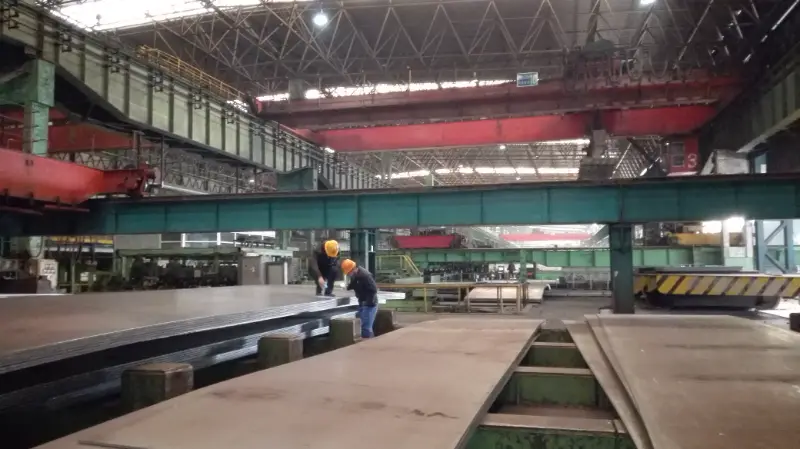
022Cr17Ti (00Cr17) Ferritic Stainless Steel
022Cr17Ti (00Cr17) Ferritic Stainless Steel: Properties, Equivalents & Applications per GB/T 4237
Comprehensive data on 022Cr17Ti (00Cr17) ferritic stainless steel plate and coil from GB/T 4237, including chemical composition, mechanical and thermal properties, international equivalents, and application guidance.
Cutting, bending, forming, welding (with proper procedure), drawing
- Phone : +8618037372205
- Email : [email protected]
- WhatsApp: Contact via Whtsapp
- WeChat: +8618037372205
022Cr17Ti Ferritic Stainless Steel Introduction
022Cr17Ti (formerly 00Cr17) is a low-carbon ferritic stainless steel stabilized with titanium, defined in Chinese standard GB/T 4237 (Hot rolled stainless steel plate, sheet and strip). With a maximum carbon content of 0.025%, this grade exhibits excellent resistance to intergranular corrosion after welding, good ductility, and high-temperature oxidation resistance. The titanium addition fixes carbon and nitrogen, preventing chromium carbide precipitation and preserving corrosion resistance. It offers moderate strength, good formability, and is cost-effective compared to austenitic grades. Typical applications include architectural decoration, kitchen equipment, automotive exhaust components, and domestic appliances. The material is usually supplied in annealed and pickled condition, suitable for further forming, bending, and mild drawing operations.
022Cr17Ti Ferritic Stainless Steel Chemical Composition
The chemical composition of 022Cr17Ti strictly follows GB/T 4237. Titanium is added to stabilize the structure and improve intergranular corrosion resistance, typically in the range of 5×(C+N) to 0.80%. All values are mass fraction in percent. Controlled low carbon ensures weldability and ductility.
| Element | Specification (wt%) | Remarks |
|---|---|---|
| Carbon (C) | ≤0.025 | |
| Silicon (Si) | ≤1.00 | |
| Manganese (Mn) | ≤1.00 | |
| Phosphorus (P) | ≤0.040 | |
| Sulfur (S) | ≤0.030 | |
| Chromium (Cr) | 16.00 – 19.00 | |
| Nickel (Ni) | ≤0.60 | Residual element |
| Titanium (Ti) | 5×(C+N) – 0.80 | Stabilizing element |
022Cr17Ti Ferritic Stainless Steel Thermal and Electrical Physical Properties
Typical physical properties of 022Cr17Ti ferritic stainless steel at room temperature. Thermal expansion and conductivity values are crucial for applications involving temperature changes. These values are reference data and may slightly vary with processing.
| Property | Typical Value | Unit | Condition / Temperature |
|---|---|---|---|
| Density (ρ) | 7.70 | g/cm³ | At 20°C |
| Elastic Modulus (E) | 200 | GPa | At 20°C |
| Shear Modulus (G) | 77 | GPa | At 20°C |
| Poisson's Ratio (ν) | 0.28 | — | At 20°C |
| Thermal Expansion Coefficient (α) | 10.4 | 10⁻⁶/K | 20 – 100°C |
| Thermal Expansion Coefficient (α) | 10.8 | 10⁻⁶/K | 20 – 200°C |
| Thermal Expansion Coefficient (α) | 11.2 | 10⁻⁶/K | 20 – 300°C |
| Thermal Conductivity (λ) | 25.0 | W/(m·K) | At 20°C |
| Specific Heat Capacity | 460 | J/(kg·K) | At 20°C |
| Electrical Resistivity (ρ_e) | 0.60 | μΩ·m | At 20°C |
022Cr17Ti Ferritic Stainless Steel Mechanical Properties
Mechanical properties are for annealed condition at room temperature as specified in GB/T 4237. Values may vary with product thickness. The minimum elongation is specified for thickness ≤8 mm. The material shows good strength and ductility suitable for forming.
| Property | Value | Unit | Test condition / Remarks |
|---|---|---|---|
| Yield Strength (Rp0.2) | ≥280 | MPa | Transverse, annealed |
| Tensile Strength (Rm) | ≥450 | MPa | Transverse, annealed |
| Elongation after fracture (A) | ≥20 | % | Gauge length 50 mm, thickness ≤8 mm |
| Bend test (180°) | d=2a | — | Bend angle 180°, mandrel diameter twice thickness |
| Hardness | ≤200 | HV | Vickers hardness reference value |
022Cr17Ti Ferritic Stainless Steel Fully Equivalent Material Standards and Replaceable Grades
| Country/Region | Standard | Grade | Remarks |
|---|---|---|---|
| China | GB/T 4237, GB/T 3280 | 022Cr17Ti (00Cr17) | Original specification |
| ISO | ISO 15510 | X2CrTi17 | Equivalent low-carbon Ti-stabilized |
| Europe | EN 10088-2, EN 10088-3 | 1.4520 (X2CrTi17) | Fully equivalent |
| Japan | JIS G4304, JIS G4305 | SUS430LX | Low-carbon, Ti/Nb stabilized, compatible |
022Cr17Ti Ferritic Stainless Steel Application Introduction
022Cr17Ti is widely used where a combination of moderate corrosion resistance, good formability, and weldability is needed without the higher cost of austenitic stainless steels. The Ti stabilization prevents sensitization during welding, making it suitable for welded structures. It is not recommended for highly corrosive environments such as strong acids or chlorides above moderate levels. Typical applications include:
- Automotive exhaust systems and mufflers
- Kitchen sinks, countertops, and household appliances
- Architectural cladding, roofing, and decorative panels
- Heat exchangers and solar water heater tanks
- Industrial tanks for mild corrosive media
Product Applications: Stainless steel plates and coils, Welded tubes and pipes, Kitchen sinks, Exhaust mufflers, Water heater tanks, Decorative panels
Processed into products: Bent and formed panels, Drawn sink bowls, Welded exhaust manifold parts, Stamped brackets, Heat exchanger plates, Roofing sheets
Application industries: Architecture and Construction, Automotive, Home Appliances, Food Processing Equipment, Solar Energy
022Cr17Ti Ferritic Stainless Steel Similar/Alternative Material Recommendations
| Country/Region | Standard | Grade | Remarks |
|---|---|---|---|
| USA | ASTM A240/A240M | 439 (UNS S43035) | Higher carbon (≤0.07%), Ti stabilized, similar corrosion resistance but not identical |
| Europe | EN 10088-2 | 1.4510 (X3CrTi17) | Higher carbon (≤0.05%), similar application |
| China | GB/T 4237 | 022Cr17 (00Cr17) | Without Ti specification, may have Nb or lower stabilization |
Notes:
For welding, low heat input and appropriate filler metal (e.g., AWS E430 or ER430, or stabilized grades) should be used to avoid grain growth. Post-weld annealing is usually not required for thin sections. Machining requires sharp tools and cooling lubricants due to the ferritic structure. The data provided are based on GB/T 4237 standard and typical published values; for exact design values, consult the official standard or mill certificates.
- Share



