
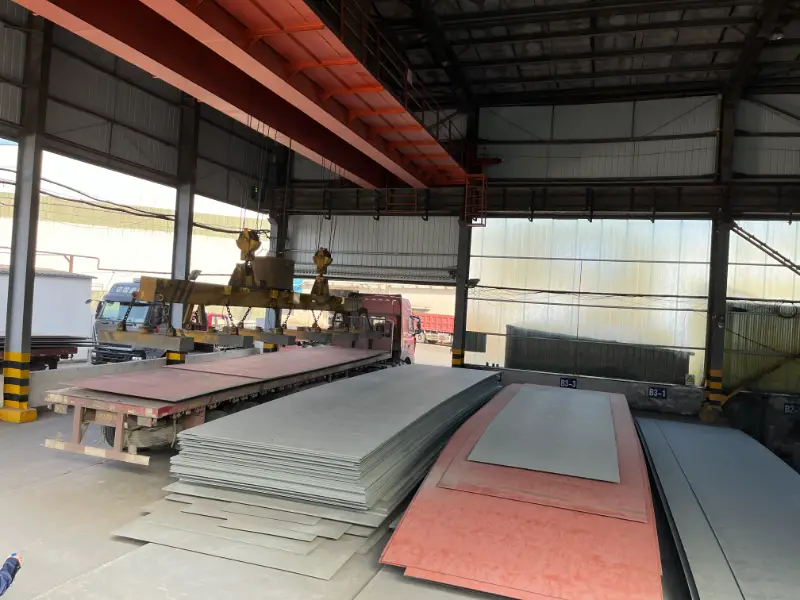
019Cr18MoTi Ferritic Stainless Steel
019Cr18MoTi Ferritic Stainless Steel | GB/T 4237 Plate/Coil Data
Comprehensive datasheet for 019Cr18MoTi ferritic stainless steel to GB/T 4237, including chemistry, mechanical properties, thermal and electrical data, equivalents, and applications.
Hot rolling, cold rolling, annealing, pickling, cutting, forming, welding, stamping, deep drawing
- Phone : +8618037372205
- Email : [email protected]
- WhatsApp: Contact via Whtsapp
- WeChat: +8618037372205
019Cr18MoTi Ferritic Stainless Steel Introduction
019Cr18MoTi is a low-carbon, titanium-stabilized ferritic stainless steel supplied as hot-rolled plate and coil under Chinese standard GB/T 4237. Its combination of 16–19% chromium and 0.75–1.50% molybdenum provides good resistance to pitting and crevice corrosion in chloride environments, while titanium addition improves intergranular corrosion resistance after welding. The material offers excellent formability, weldability, and high-temperature oxidation resistance up to 800°C. It is widely used in automotive exhaust systems, heat exchangers, and domestic appliances where a balance of corrosion resistance, thermal fatigue resistance, and cost-effectiveness is required. This grade avoids the costly nickel content found in austenitic stainless steels.
019Cr18MoTi Ferritic Stainless Steel Chemical Composition
Chemical composition limits for 019Cr18MoTi according to GB/T 4237-2015. Titanium content is designed to stabilize the structure against sensitization during welding. All values are maximum unless a range is given.
| Chemical Element | Standard Value (wt%) | Remarks |
|---|---|---|
| Carbon (C) | ≤ 0.025 | Ultra-low carbon for improved weldability and corrosion resistance |
| Silicon (Si) | ≤ 1.00 | Deoxidation element |
| Manganese (Mn) | ≤ 1.00 | Deoxidation and strength contribution |
| Phosphorus (P) | ≤ 0.040 | Impurity control |
| Sulfur (S) | ≤ 0.030 | Impurity control; lower improves hot workability |
| Chromium (Cr) | 16.00 – 19.00 | Primary corrosion resistance and ferrite stabilizer |
| Molybdenum (Mo) | 0.75 – 1.50 | Enhances pitting and crevice corrosion resistance |
| Titanium (Ti) | 0.10 – 1.00 | Stabilizing element; commonly Ti ≥ 8×(C+N) |
| Nitrogen (N) | ≤ 0.025 | Controlled to reduce sensitization risk |
| Nickel (Ni) | ≤ 0.60 | Residual austenite former; minimal content |
019Cr18MoTi Ferritic Stainless Steel Thermal & Electrical Physical Properties
Typical physical properties for 019Cr18MoTi ferritic stainless steel at reference temperatures. These values are for engineering guidance and may vary with processing history.
| Property | Typical Value | Unit | Test Condition / Temperature |
|---|---|---|---|
| Density (ρ) | 7.70 | g/cm³ | Room temperature |
| Modulus of Elasticity (E) | 200 | GPa | 20°C |
| Shear Modulus (G) | 77 | GPa | Estimated, 20°C |
| Poisson's Ratio (ν) | 0.30 | - | 20°C |
| Thermal Expansion Coefficient (α) | 10.5 | 10⁻⁶/K | 20–100°C |
| Thermal Expansion Coefficient (α) | 11.0 | 10⁻⁶/K | 20–200°C |
| Thermal Expansion Coefficient (α) | 11.5 | 10⁻⁶/K | 20–400°C |
| Thermal Conductivity (λ) | 23 | W/(m·K) | 100°C |
| Thermal Conductivity (λ) | 25 | W/(m·K) | 500°C |
| Specific Heat Capacity | 460 | J/(kg·K) | 20°C |
| Electrical Resistivity (ρ_e) | 0.60 | μΩ·m | 20°C |
019Cr18MoTi Ferritic Stainless Steel Mechanical Properties
Mechanical properties at room temperature for hot-rolled annealed condition as specified in GB/T 4237. The values are minimum requirements unless stated otherwise. Test specimen orientation is transverse.
| Property | Standard Requirement Value | Unit | Test Condition / Remarks |
|---|---|---|---|
| Yield Strength (ReH) | ≥ 175 | MPa | 0.2% proof strength; room temperature |
| Tensile Strength (Rm) | ≥ 410 | MPa | Room temperature |
| Elongation after fracture (A) | ≥ 20 | % | Gauge length 50 mm; thickness ≥ 0.5 mm |
| Hardness (HBW) | ≤ 183 | HBW | Typical annealed hardness |
| Hardness (HRB) | ≤ 88 | HRB | Alternative hardness scale |
| Bend Test (bend diameter) | d = 2a | - | 180° bend with mandrel diameter twice specimen thickness; no cracks |
| Impact Energy (KV₂) | Not specified in GB/T 4237 | - | Ferritic stainless steel impact toughness may be lower at low temperatures; Charpy V-notch values typically > 40 J at 20°C for thin gauge |
019Cr18MoTi Ferritic Stainless Steel Fully Equivalent Material Standards & Substitute Grades
| Country / Region | Standard | Grade | Remarks |
|---|---|---|---|
| China | GB/T 4237 | 019Cr18MoTi | Base standard; hot-rolled plate and coil |
| China | GB/T 3280 | 019Cr18MoTi | Cold-rolled stainless steel strip/plate variant |
019Cr18MoTi Ferritic Stainless Steel Application Introduction
019Cr18MoTi is primarily designed for applications requiring good corrosion resistance in moderately aggressive environments, especially where welded structures must resist intergranular attack without post-weld heat treatment. Its resistance to chloride stress corrosion cracking is superior to standard austenitic grades. Typical uses span automotive, energy, and household sectors.
Product Applications: Exhaust manifolds, mufflers, catalytic converter shells, Hot water storage tanks, solar collector panels, Oven liners, dishwasher tubs, washing machine drums, Heat exchanger plates and tubes, Evaporators and condensers, Roofing and curtain wall panels, Cooking utensils, sinks, countertops
Processed into products: Welded pipes and tubes for automotive exhaust, Deep-drawn components such as sinks and bowls, Rolled profiles for structural applications, Cut and formed brackets, flanges, and connectors, Stamped heat exchanger plates, Laser-welded assemblies for solar systems, Formed architectural cassettes and flashings
Application industries: Automotive and transportation, Renewable energy (solar thermal, heat pumps), Household appliances (white goods), Food processing and kitchen equipment, Architectural and building cladding, Chemical process equipment (mild chemical tanks), Water treatment and piping
019Cr18MoTi Ferritic Stainless Steel Similar / Alternative Material Recommendations
| Country / Region | Standard | Grade | Remarks |
|---|---|---|---|
| Europe | EN 10088-2 | 1.4521 (X2CrMoTi18-2) | Closest European match; Cr 17.0–20.0%, Mo 1.8–2.5%, Ti-stabilized ferritic. Slightly higher Mo than 019Cr18MoTi but comparable performance. |
| USA | ASTM A240 | UNS S44400 | Similar Cr-Mo-Ti(Nb) ferritic grade (00Cr18Mo2), typical Mo 1.75–2.50%. 019Cr18MoTi falls within its Mo range but uses Ti only; S44400 often Ti+Nb stabilized. |
| Japan | JIS G4304 | SUS444 | Equivalent to S44400; Mo 1.75–2.50%, Nb+Ti stabilization. Slightly higher pitting resistance. |
| China | GB/T 4237 | 019Cr19Mo2NbTi (S44400 equivalent) | Higher Mo (1.75–2.50%) and Nb+Ti; higher pitting resistance but similar general properties. Can substitute when enhanced corrosion is needed. |
| USA | ASTM A240 | 439 (UNS S43035) | 022Cr18Ti ferritic without Mo; lower pitting resistance, suitable for less aggressive environments. |
Notes:
Welding considerations: Use low heat input and matching or slightly over-alloyed filler metal (e.g., ER430Ti, ER316LSi if dissimilar). Interpass temperature should be kept below 150°C. No post-weld heat treatment is typically required due to Ti stabilization.
Toughness: This ferritic stainless steel exhibits a ductile-to-brittle transition; Charpy impact values drop significantly below room temperature. Not recommended for cryogenic or critical low-temperature structural applications.
Surface finish: Available in standard mill finishes like No.1 (hot-rolled, annealed, pickled), 2D, and 2B (cold-rolled). Passivation treatments are recommended to maximize corrosion resistance after fabrication.
Testing: Intergranular corrosion tests (e.g., GB/T 4334 Method E) are often specified for welded components.
- Share



