
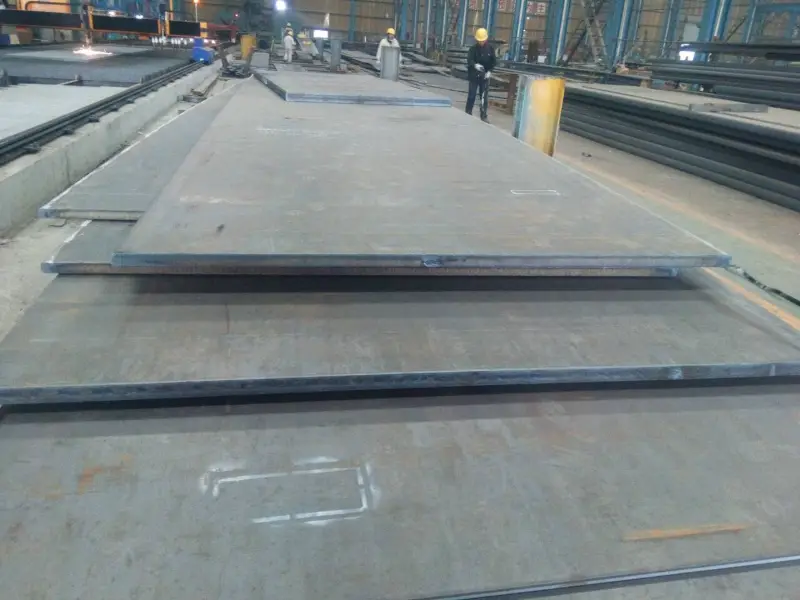
06Cr23Ni13 (0Cr23Ni13) Austenitic Stainless Steel
06Cr23Ni13 (0Cr23Ni13) Austenitic Stainless Steel for High-Temperature Structural Applications per GB/T 4237
GB/T 4237 06Cr23Ni13 (formerly 0Cr23Ni13) is an austenitic stainless steel with excellent oxidation resistance up to 1050°C, designed for high-temperature structural parts. It features good strength and ductility in solution-treated condition and is widely used for furnace components, heat treatment fixtures, and radiant tubes.
Hot rolling, cold rolling, solution annealing, pickling, descaling, cutting, welding, forming
- Phone : +8618037372205
- Email : [email protected]
- WhatsApp: Contact via Whtsapp
- WeChat: +8618037372205
06Cr23Ni13 Austenitic Stainless Steel Introduction
06Cr23Ni13, also known by its former designation 0Cr23Ni13, is a low-carbon, high-chromium-nickel austenitic stainless steel specified in GB/T 4237 (hot-rolled stainless steel plates and strips). With nominal chromium content of 23% and nickel of 13%, it belongs to the Cr-Ni series and is engineered primarily for elevated-temperature service where resistance to oxidation and carburization is essential.
- Excellent oxidation resistance in air up to approximately 1050°C under continuous service.
- Maintains structural integrity and sufficient creep strength at temperatures typically up to 900°C.
- Good weldability and formability in the solution-annealed condition.
- Lower carbon content minimizes sensitization and intergranular corrosion, making it suitable for welded structures without post-weld heat treatment in thin sections.
06Cr23Ni13 Austenitic Stainless Steel Chemical Composition
Chemical composition according to GB/T 4237 for grade 06Cr23Ni13. The tight control of carbon and phosphorus content enhances resistance to intergranular corrosion and hot cracking.
- Carbon (C) limited to 0.08% to prevent sensitization in welded conditions.
- Chromium (Cr) around 23% ensures high-temperature oxidation and scaling resistance.
- Nickel (Ni) at 12 - 15% stabilizes the austenitic structure and improves ductility and toughness.
| Element | Standard Value (%) | Remarks |
|---|---|---|
| Carbon (C) | ≤ 0.08 | Low carbon grade for improved corrosion resistance |
| Silicon (Si) | ≤ 1.00 | Supports oxidation resistance at high temperature |
| Manganese (Mn) | ≤ 2.00 | Austenite stabilizer |
| Phosphorus (P) | ≤ 0.045 | Controlled to avoid hot shortness |
| Sulfur (S) | ≤ 0.030 | Controlled for machinability and hot working |
| Chromium (Cr) | 22.00 – 24.00 | Primary element for oxidation and corrosion resistance |
| Nickel (Ni) | 12.00 – 15.00 | Stabilizes austenite and enhances mechanical properties |
06Cr23Ni13 Austenitic Stainless Steel Physical and Thermal Properties
Typical values for fully austenitic Cr-Ni stainless steel of similar composition. These data are not mandated by GB/T 4237 but are commonly accepted for engineering design.
- The density is slightly higher than that of standard 18-8 grades due to increased Cr and Ni content.
- Thermal expansion coefficient is relatively high, necessitating allowance for expansion in high-temperature designs.
- Thermal conductivity is lower than that of carbon steel, which must be considered for heat transfer calculations.
| Property | Typical Value | Unit | Test Condition / Remarks |
|---|---|---|---|
| Density (ρ) | 7.98 | g/cm³ | At 20°C |
| Modulus of Elasticity (E) | 193 – 200 | GPa | At 20°C; decreases with temperature |
| Shear Modulus (G) | 77 | GPa | Calculated from E and Poisson's ratio |
| Poisson's Ratio (ν) | 0.27 – 0.30 | Typical for austenitic stainless steels | |
| Thermal Expansion Coefficient (α) | 16.0 (20–100°C) / 17.0 (20–300°C) / 18.0 (20–500°C) | 10⁻⁶/K | Mean coefficient of linear thermal expansion |
| Thermal Conductivity (λ) | 14.0 (100°C) / 16.3 (300°C) / 18.8 (500°C) | W/(m·K) | Temperature-dependent |
| Specific Heat Capacity (c) | 500 | J/(kg·K) | At 20°C |
| Electrical Resistivity (ρₑ) | 0.78 | μΩ·m | At 20°C |
06Cr23Ni13 Austenitic Stainless Steel Mechanical Properties
Mechanical properties as per GB/T 4237 for solution-annealed hot-rolled plate at room temperature. The values apply to thicknesses up to about 13 mm.
- Tensile strength (Rm) minimum 520 MPa ensures adequate load-bearing capacity.
- Yield strength (ReH/Rp0.2) minimum 205 MPa shows good formability.
- Elongation (A) minimum 40% indicates high ductility.
- Hardness values are maximum limits; lower hardness facilitates cold forming.
| Property | Standard Requirement | Unit | Test Condition |
|---|---|---|---|
| Tensile Strength (Rm) | ≥ 520 | MPa | Room temperature, longitudinal sample |
| Yield Strength (Rp0.2) | ≥ 205 | MPa | Room temperature, longitudinal sample |
| Elongation (A) | ≥ 40 | % | Gauge length 50 mm, 12.5 mm wide specimen |
| Hardness (HBW) | ≤ 187 | HBW | Brinell hardness, 10 mm ball, 3000 kgf |
| Hardness (HRB) | ≤ 90 | HRB | Rockwell B scale |
| Hardness (HV) | ≤ 200 | HV | Vickers hardness |
| Bend Test | 180° bend, d = a | Bend radius equals plate thickness (a) for thickness ≤ 12.7 mm |
06Cr23Ni13 Austenitic Stainless Steel Fully Equivalent Material Standards and Replaceable Grades
| Country/Region | Standard | Grade | Remarks |
|---|---|---|---|
| China | GB/T 4237 | 06Cr23Ni13 (0Cr23Ni13) | Original specification, S30908 in GB/T 20878 |
| USA | ASTM A240/A240M | 309S (UNS S30908) | Identical chemical composition and similar mechanical requirements |
| Japan | JIS G4304 / G4305 | SUS 309S | Same Cr-Ni range and carbon limit, widely interchangeable |
| International | ISO 15510 | X8CrNi23-13 | Chemical composition aligns with the Chinese grade; reference correspondence |
06Cr23Ni13 Austenitic Stainless Steel Application Introduction
06Cr23Ni13 is extensively used in environments that demand high-temperature oxidation resistance and moderate mechanical loads. Its low carbon content makes it suitable for welded fabrications and components that cannot be solution-treated after welding.
- Commonly employed in industrial furnaces, heat treatment equipment, and petrochemical processing where long-term exposure to hot gases occurs.
- Select this grade when 304 or 321 do not provide sufficient oxidation resistance at temperatures above 900°C.
- For applications requiring maximum creep strength above 900°C, consider higher nickel or more highly alloyed heat-resistant grades.
Product Applications: Furnace muffles, retorts, and radiant tubes, Heat treatment baskets, trays, and mesh belts, Annealing and carburizing boxes, High-temperature thermocouple protection tubes, Structural supports for heating elements, Conveyor rollers in hot zones
Processed into products: Welded ducts and expansion joints for flue gas systems, Burner nozzles and combustion chambers, Heat exchanger plates and baffles for waste heat recovery, High-temperature bolt, nut, and fastener assemblies, Clamps and guides in continuous annealing lines, Pins and shafts for rotary kiln supports
Application industries: Industrial furnace construction, Heat treatment and metal processing, Petrochemical and refinery heater tubes, Power generation (gas turbine and boiler components), Automotive exhaust systems (high-performance)
06Cr23Ni13 Austenitic Stainless Steel Similar or Closely Related Material Recommendations
| Country/Region | Standard | Grade | Remarks |
|---|---|---|---|
| Europe | EN 10088-2 | 1.4833 (X12CrNi23-13) | Similar Cr-Ni content but higher carbon (≤0.15%) – higher hot strength but less weldable; acceptable for some furnace applications |
| China | GB/T 4237 | 16Cr23Ni13 (2Cr23Ni13) | Higher carbon variant (0.15–0.20%) with better high-temperature strength but reduced corrosion resistance |
| USA | ASTM A240/A240M | 309 (UNS S30900) | Higher carbon version, more prone to sensitization; for applications where carbon is acceptable |
| Europe | EN 10095 | 1.4828 (X15CrNiSi20-12) | Another heat-resistant grade with lower Ni and added Si, oxidation-resistant but not an exact substitute |
Notes:
- The mechanical properties given above are valid for hot-rolled plate in the solution-annealed condition per GB/T 4237. Cold-rolled sheet may exhibit slightly higher strength and lower elongation.
- For thicker sections or highly restrained welded joints, a stabilizing treatment or use of a low-carbon filler (e.g., 309LSi) is recommended to avoid sensitization.
- The physical property data are typical for the 23Cr-13Ni alloy family and may vary slightly depending on exact composition and processing. Use these values as reference for design; confirm with mill certificates for critical applications.
- At temperatures above 1000°C, excessive grain growth may occur in this grade, reducing ductility – repeated solution annealing is not practical for large structures, so design limits should reflect this.
- Share



