
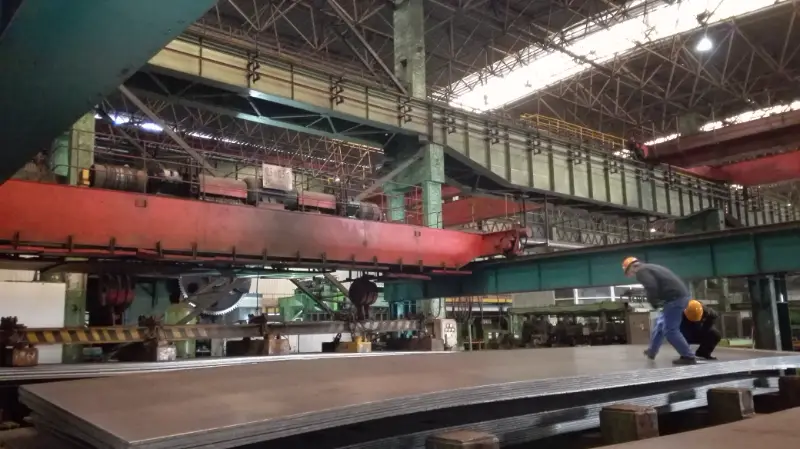
06Cr19Ni10N (0Cr19Ni9N) Austenitic Stainless Steel
06Cr19Ni10N (0Cr19Ni9N) Austenitic Stainless Steel - Enhanced Strength Nitronic Alloy for Demanding Applications
Explore the GB/T 4237 06Cr19Ni10N austenitic stainless steel, a nitrogen-alloyed variant of 304 offering higher strength without sacrificing corrosion resistance. Ideal for pressure vessels, structural parts, and food processing equipment.
Hot rolling, cold forming, welding, machining, solution annealing
- Phone : +8618037372205
- Email : [email protected]
- WhatsApp: Contact via Whtsapp
- WeChat: +8618037372205
06Cr19Ni10N Austenitic Stainless Steel Introduction
06Cr19Ni10N, formerly designated 0Cr19Ni9N in China, is an austenitic stainless steel plate and coil grade specified under GB/T 4237. It is a nitrogen-enhanced version of the widely used 304 (06Cr19Ni10) alloy. The intentional addition of nitrogen (0.10–0.16%) significantly raises the yield and tensile strengths while preserving excellent ductility, toughness, and corrosion resistance typical of austenitic stainless steels. This alloy is particularly suited for applications requiring higher mechanical performance than conventional 304, such as in welded pressure vessels, chemical tanks, and structural components. The steel is supplied in the solution-annealed condition, ensuring an optimal balance of properties. Compared to 304, 06Cr19Ni10N offers approximately 25–30% higher yield strength, making it a cost-effective alternative for lightweight or load-bearing designs.
06Cr19Ni10N Austenitic Stainless Steel Chemical Composition
The chemical composition of 06Cr19Ni10N conforms to GB/T 20878-2007 and is verified against GB/T 4237. Nitrogen is the key alloying element that boosts strength. All values are in weight percent.
| Element | Specified Value (wt%) | Remarks |
|---|---|---|
| Carbon (C) | ≤ 0.08 | |
| Silicon (Si) | ≤ 1.00 | |
| Manganese (Mn) | ≤ 2.00 | Typical 1.0–1.5; aids nitrogen solubility |
| Phosphorus (P) | ≤ 0.045 | |
| Sulfur (S) | ≤ 0.030 | |
| Chromium (Cr) | 18.00 – 20.00 | |
| Nickel (Ni) | 8.00 – 11.00 | |
| Nitrogen (N) | 0.10 – 0.16 | Responsible for higher yield strength |
06Cr19Ni10N Austenitic Stainless Steel Thermal and Electrical Physical Properties
Physical properties are typical for nitrogen-alloyed 18-8 stainless steel in the annealed condition. Values may vary slightly depending on specific processing.
| Property | Typical Value | Unit | Test Condition / Temperature |
|---|---|---|---|
| Density (ρ) | 7.93 | g/cm³ | 20°C |
| Elastic Modulus (E) | 196 | GPa | 20°C |
| Shear Modulus (G) | 77 | GPa | Calculated from E and ν (ν≈0.27) |
| Poisson's Ratio (ν) | 0.27–0.30 | - | 20°C |
| Thermal Expansion (α) | 16.5 | 10⁻⁶/K | 20–100°C |
| Thermal Expansion (α) | 17.5 | 10⁻⁶/K | 20–300°C |
| Thermal Expansion (α) | 18.5 | 10⁻⁶/K | 20–500°C |
| Thermal Conductivity (λ) | 16.2 | W/(m·K) | at 100°C |
| Thermal Conductivity (λ) | 21.5 | W/(m·K) | at 500°C |
| Specific Heat Capacity (c) | 500 | J/(kg·K) | 20°C |
| Electrical Resistivity (ρ_e) | 0.72 | µΩ·m | 20°C |
06Cr19Ni10N Austenitic Stainless Steel Mechanical Properties
Mechanical properties are as required by GB/T 4237-2015 for solution-annealed 06Cr19Ni10N plates and strips. The elongation requirement varies with thickness. Hardness is given as a reference maximum.
| Property | Required Value | Unit | Test Condition / Remarks |
|---|---|---|---|
| Yield Strength (Rp0.2) | ≥ 240 | MPa | Transverse or longitudinal, room temperature |
| Tensile Strength (Rm) | ≥ 550 | MPa | Room temperature |
| Elongation (A) | ≥ 30 | % | Thickness ≤ 3 mm, gauge length 50 mm |
| Elongation (A) | ≥ 35 | % | Thickness > 3 mm, gauge length 50 mm |
| Brinell Hardness (HBW) | ≤ 217 | - | Reference maximum |
| Rockwell Hardness (HRB) | ≤ 95 | - | Reference maximum |
| Vickers Hardness (HV) | ≤ 220 | - | Reference maximum |
06Cr19Ni10N Austenitic Stainless Steel Fully Equivalent Material Standards and Replaceable Grade Designations
| Country/Region | Standard | Grade | Remarks |
|---|---|---|---|
| China | GB/T 4237, GB/T 20878 | 06Cr19Ni10N (0Cr19Ni9N) | Original specification |
| USA | ASTM A240/A240M | 304N (UNS S30451) | Chemically and mechanically equivalent |
| European Union | EN 10088-3 | 1.4315 (X5CrNiN19-9) | Same nitrogen range and mechanicals |
| Japan | JIS G4304 | SUS304N1 | Closely matches, check thickness tolerances |
| International | ISO 15510 | X5CrNiN19-9 | ISO equivalent to EN grade |
06Cr19Ni10N Austenitic Stainless Steel Application Introduction
06Cr19Ni10N offers a unique combination of higher strength and excellent corrosion resistance, bridging the gap between standard 304 and high-strength stainless steels. Its nitrogen strengthening does not compromise toughness, making it ideal for welded structures in corrosive environments.
- Pressure vessels and tanks – where higher design stress reduces wall thickness and weight.
- Chemical and petrochemical equipment – handling organic and inorganic chemicals at moderate temperatures.
- Food and beverage processing – equipment requiring high cleanliness and corrosion resistance with added mechanical robustness.
- Architecture and construction – load-bearing panels, structural supports.
- Automotive and transportation – exhaust components, structural brackets.
Product Applications: Hot-rolled plates and coils for fabrication, Welded pipes and tubes, Pressure vessels and storage tanks, Heat exchangers, Structural sections and supports, Kitchen and food processing equipment
Processed into products: Pressure vessel shells and heads, Heat exchanger plates and tube sheets, Flanges and fittings, Structural brackets and fasteners, Food mixer bowls and conveyors, Chemical tank linings, Architectural cladding panels
Application industries: Chemical processing, Oil & gas (non-sour service), Food and dairy, Pharmaceuticals, Architecture, Transportation
06Cr19Ni10N Austenitic Stainless Steel Similar/Low-Cost Alternative Material Recommendations
| Country/Region | Standard | Grade | Remarks |
|---|---|---|---|
| China | GB/T 4237 | 06Cr19Ni10 (0Cr18Ni9 / 304) | Lower strength (~205 MPa yield), same corrosion resistance. Suitable if high strength is not required. |
| China | GB/T 4237 | 022Cr19Ni10N (304LN) | Extra-low carbon variant of 06Cr19Ni10N for improved weldability and intergranular corrosion resistance. |
| USA | ASTM A240 | 304 (UNS S30400) | Classic 18-8, standard strength. Common alternative where cost is priority over higher strength. |
| USA | ASTM A240 | 304L (UNS S30403) | Low-carbon 304, better for welded sections but lower strength than 304N. |
Notes:
This alloy is not intended for severe sour service (H₂S) due to the nickel content. For welded structures, post-weld solution annealing is recommended to restore full corrosion resistance. Cold forming after annealing may require intermediate softening. The grade shows excellent toughness at cryogenic temperatures, superior to standard 304.
- Share



