
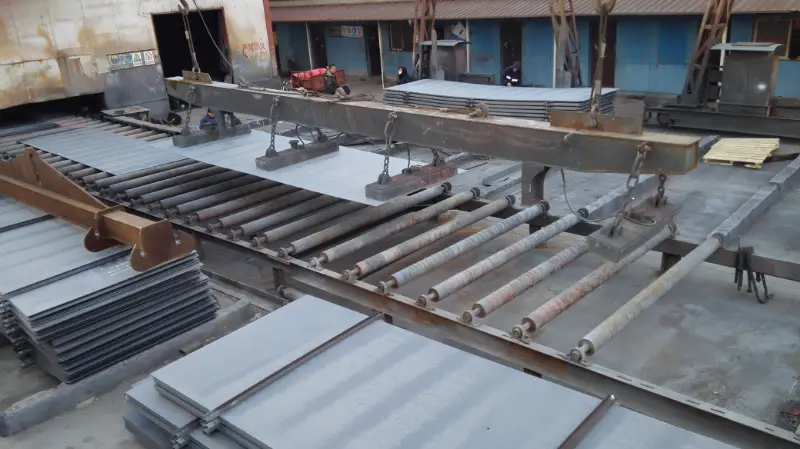
05Cr19Ni10Si2N Stainless Steel
05Cr19Ni10Si2N Stainless Steel | GB/T 4237 Austenitic Plate & Coil Data
Comprehensive technical data for 05Cr19Ni10Si2N austenitic stainless steel under GB/T 4237 standard. Includes chemical composition, mechanical properties, physical properties, and international equivalent grades for high-temperature, high-strength applications.
Welding, forming, bending, machining, cold rolling
- Phone : +8618037372205
- Email : [email protected]
- WhatsApp: Contact via Whtsapp
- WeChat: +8618037372205
05Cr19Ni10Si2N Stainless Steel Introduction
05Cr19Ni10Si2N is a nitrogen-enhanced, austenitic stainless steel standardized under GB/T 4237 for hot-rolled steel plates and coils. The addition of nitrogen (N) and increased silicon (Si) content compared to standard 304 grades significantly improves high-temperature strength, oxidation resistance, and creep resistance. This material maintains excellent corrosion resistance and good weldability while offering higher yield strength. The microstructure is fully austenitic, making it non-magnetic in solution-annealed condition. It is specifically designed for applications requiring structural integrity and scaling resistance at elevated temperatures.
05Cr19Ni10Si2N Stainless Steel Chemical Composition
The chemistry of 05Cr19Ni10Si2N is engineered for thermal stability. The increased Silicon (Si) content enhances sulfidation and carburization resistance, while Nitrogen (N) acts as an austenite stabilizer and solid-solution strengthener, elevating mechanical properties. The carbon content is controlled to ensure good intergranular corrosion resistance after welding.
| Element | Standard Value | Remarks |
|---|---|---|
| Carbon (C) | ≤0.06 | Optimized for high-temperature strength (Approx. 0.04-0.06) |
| Silicon (Si) | 1.40 - 2.50 | Key element for high-temperature scaling resistance |
| Manganese (Mn) | ≤1.00 | Standard austenitic matrix control |
| Phosphorus (P) | ≤0.040 | Residual impurity limit |
| Sulfur (S) | ≤0.015 | Low sulfide content ensures ductility |
| Chromium (Cr) | 18.00 - 20.00 | Primary pitting and oxidation resistance element |
| Nickel (Ni) | 9.00 - 12.00 | Austenite phase stabilizer |
| Nitrogen (N) | 0.12 - 0.20 | Solid-solution strengthening agent |
| Cerium (Ce) | Reference: 0.03 - 0.08 | Rare earth addition per specific manufacturer protocols for oxidation adherence (Note: Check specific mill certificate) |
| Iron (Fe) | Balance | Remainder |
05Cr19Ni10Si2N Stainless Steel Thermal and Electrical Physical Properties
Physical constants are critical for thermal analysis. The higher Silicon content adjusts the thermal conductivity and electrical resistivity. The melting range is slightly wider than standard 304. Data is based on standard handbook values for this stabilized grade at 20°C unless specified otherwise.
| Property Item | Standard Requirement Value | Unit | Test Condition |
|---|---|---|---|
| Density (ρ) | 7.88 | kg/dm³ | 20°C |
| Elastic Modulus (E) | 195 | GPa | 20°C |
| Shear Modulus (G) | 75 | GPa | 20°C (Calculated) |
| Poisson's Ratio (ν) | 0.30 | - | 20°C |
| Thermal Expansion (α) | 16.0 | 10⁻⁶/K | 20-100°C |
| Thermal Expansion (α) | 17.0 | 10⁻⁶/K | 20-200°C |
| Thermal Expansion (α) | 17.5 | 10⁻⁶/K | 20-400°C |
| Thermal Expansion (α) | 18.0 | 10⁻⁶/K | 20-500°C |
| Thermal Conductivity (λ) | 14.5 | W/m·K | 20°C |
| Thermal Conductivity (λ) | 18.0 | W/m·K | 100°C |
| Thermal Conductivity (λ) | 22.0 | W/m·K | 500°C |
| Specific Heat Capacity | 500 | J/kg·K | 20°C |
| Electrical Resistivity (ρ_e) | 0.78 | Ω·mm²/m | 20°C |
| Melting Range | 1375 - 1400 | °C | Solidus/Liquidus |
05Cr19Ni10Si2N Stainless Steel Mechanical Properties
Mechanical properties reflect the strengthening effects of Silicon and Nitrogen. The high-temperature tensile test values demonstrate the material's superior performance under thermal load compared to standard 304 (1.4301). The room temperature values are the minimum requirements for solution-annealed plates/coils per GB/T 4237.
| Property Item | Standard Requirement Value | Unit | Test Condition |
|---|---|---|---|
| Yield Strength (ReH) | ≥310 | MPa | Room Temperature (Solution Annealed) |
| Tensile Strength (Rm) | 580 - 780 | MPa | Room Temperature (Solution Annealed) |
| Elongation (A) | ≥40 | % | Room Temperature, Gauge Length 50mm |
| Bend Test (Mandrel Diameter) | D = 2a | - | Bending angle 180° (a = sample thickness) |
| Hardness (HBW) | 160 - 200 | HBW | Solution Annealed |
| Tensile Strength (Rm) | ≥400 | MPa | Elevated Temp. 550°C |
| Yield Strength (ReH) | ≥120 | MPa | Elevated Temp. 550°C |
| Elongation (A) | ≥30 | % | Elevated Temp. 550°C |
| Tensile Strength (Rm) | ≥250 | MPa | Elevated Temp. 700°C |
| Yield Strength (ReH) | ≥80 | MPa | Elevated Temp. 700°C |
05Cr19Ni10Si2N Stainless Steel Fully Equivalent Material Standards and Substitutable Grades
| Country/Region | Standard | Grade | Remarks |
|---|---|---|---|
| China | GB/T 4238 (Heat resistant plate) | 16Cr20Ni14Si2 | Higher Nickel and Si variant; fully interchangeable in specific thermal applications due to superior scaling resistance. |
| USA | ASTM A240 / A167 | S30615 / 305 | Alloy 305 has matching Si levels, though S30615 offers better carburization resistance at equivalent Si ranges. Verify Si limits per ASTM edition. |
| Europe | EN 10095 | 1.4818 | Heat resistant steel with comparable Si and Cr base. Check Ce and N additions per supplier agreement. |
05Cr19Ni10Si2N Stainless Steel Application Introduction
Due to its enhanced high-temperature strength and oxidation resistance up to 900°C, 05Cr19Ni10Si2N is ideal for fabrication by hot working and welding. It is specifically advantageous where carburization or sulfidation atmospheres are present, thanks to the protective silica scale. Machining requires tools for tough, work-hardening austenitic alloys.
Product Applications: Hot rolled stainless steel plates for pressure vessels, Boiler tubes and superheater coils, Furnace muffles, retorts, and conveyor belts, Automotive exhaust manifolds and catalytic converter housings, Pyrolysis centrifuges and thermal reactor shells
Processed into products: Welded baffles and tube sheets for heat exchangers, Flue gas dampers and expansion joints, High-temperature burner nozzles and lances, Cyclone separators and ducting flanges, Engine valve stems and seat inserts
Application industries: Industrial Furnace and Boiler Manufacturing, Petrochemical Refining and Cracking Units, Automotive Engine and Turbocharger Components, Power Generation (Heat Exchanger Tubes and Plates), Cement and Mineral Processing (Kiln parts), Food Processing (High-temp baking ovens)
05Cr19Ni10Si2N Stainless Steel Similar/Proximate Alternative Material Recommendations
| Country/Region | Standard | Grade | Remarks |
|---|---|---|---|
| International | ISO 4954 | X6CrNiSiNCe19-10 | Closest chemical analog specifically defined for high-temperature strength with controlled S and N. |
| USA | ASTM A240 | 304H (S30409) | Similar base chemistry but lacks the deliberate Silicon boost; lower high-temperature strength but more readily available. |
| Europe | EN 10088-2 | 1.4301 (Standard 304) | Standard austenitic grade; may match ductility but significantly lower yield strength at room and elevated temperatures. |
| Europe | EN 10095 | 1.4828 (15Cr-12Ni-1.8Si) | Higher Silicon heat-resistant grade offering better scaling resistance above 900°C, but different Chromium/Nickel balance. |
Notes:
Special Considerations: Nitrogen addition increases the strength but slightly reduces cold formability compared to non-nitrogen grades. Interpass temperature during welding should be kept below 150°C to prevent hot cracking, and a matching or over-alloyed filler (like ER309LSi or proprietary high-Si fillers) is recommended for gas tungsten arc welding (GTAW). Surface preparation must remove cutting scale utterly to maintain inherent corrosion resistance.
- Share



