
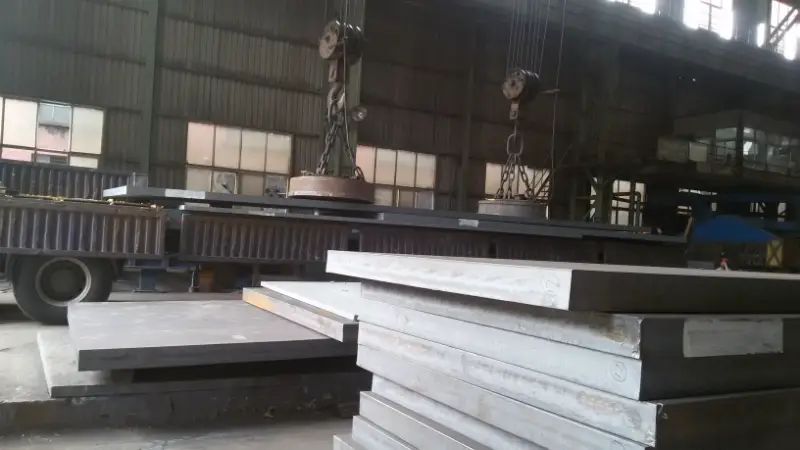
06Cr18Ni12Mo2Cu2 (0Cr18Ni12Mo2Cu2) Austenitic Stainless Steel
06Cr18Ni12Mo2Cu2 (0Cr18Ni12Mo2Cu2) Austenitic Stainless Steel - GB/T 4237 Plate/Coil Grade
An austenitic stainless steel containing molybdenum and copper for enhanced resistance to sulfuric acid and other reducing environments, supplied as hot-rolled plate and coil per GB/T 4237.
Welding, bending, deep drawing, machining, solution annealing
- Phone : +8618037372205
- Email : [email protected]
- WhatsApp: Contact via Whtsapp
- WeChat: +8618037372205
06Cr18Ni12Mo2Cu2 Austenitic Stainless Steel Introduction
06Cr18Ni12Mo2Cu2, formerly designated 0Cr18Ni12Mo2Cu2, is an austenitic stainless steel specifically alloyed with molybdenum (approx. 2–3%) and copper (approx. 1–3%) to improve corrosion resistance in sulfuric acid, phosphoric acid, and other reducing media. The low carbon content (max 0.06%) minimizes intergranular corrosion after welding. It is delivered in solution-annealed condition and exhibits good formability, weldability, and toughness. Typical applications include chemical process equipment, heat exchangers, and piping systems where both general and pitting corrosion resistance are required.
06Cr18Ni12Mo2Cu2 Austenitic Stainless Steel Chemical Composition
The chemical composition conforms to GB/T 4237 and GB/T 20878 for grade 06Cr18Ni12Mo2Cu2. The copper addition significantly improves resistance to sulfuric acid, while the molybdenum enhances pitting and crevice corrosion resistance. Low carbon content reduces sensitization during welding.
| Element | Standard Value (wt%) | Remarks |
|---|---|---|
| Carbon (C) | ≤0.06 | |
| Silicon (Si) | ≤1.00 | |
| Manganese (Mn) | ≤2.00 | |
| Phosphorus (P) | ≤0.045 | |
| Sulfur (S) | ≤0.030 | |
| Chromium (Cr) | 17.00 – 19.00 | |
| Nickel (Ni) | 11.00 – 14.00 | |
| Molybdenum (Mo) | 2.00 – 3.00 | |
| Copper (Cu) | 1.00 – 3.00 | |
| Nitrogen (N) | ≤0.10 | Typical, not always specified |
06Cr18Ni12Mo2Cu2 Austenitic Stainless Steel Thermal and Electrical Physical Properties
Physical properties are typical for the solution-annealed condition and may vary slightly with exact composition and processing. Data are representative of similar Cu-bearing Mo-alloyed austenitic stainless steels.
| Property | Typical Value | Unit | Test Condition |
|---|---|---|---|
| Density (ρ) | 7.98 | g/cm³ | 20°C |
| Elastic Modulus (E) | 193 | GPa | 20°C |
| Shear Modulus (G) | 77 | GPa | 20°C |
| Poisson's Ratio (ν) | 0.30 | – | 20°C |
| Thermal Expansion Coefficient (α) | 16.0 | 10⁻⁶/K | 20–100°C |
| Thermal Expansion Coefficient (α) | 17.5 | 10⁻⁶/K | 20–300°C |
| Thermal Expansion Coefficient (α) | 18.0 | 10⁻⁶/K | 20–500°C |
| Thermal Conductivity (λ) | 16.2 | W/(m·K) | 100°C |
| Thermal Conductivity (λ) | 21.5 | W/(m·K) | 500°C |
| Specific Heat Capacity (cₚ) | 500 | J/(kg·K) | 20°C |
| Electrical Resistivity (ρ_e) | 0.78 | µΩ·m | 20°C |
06Cr18Ni12Mo2Cu2 Austenitic Stainless Steel Mechanical Properties
Mechanical properties of solution-annealed hot-rolled plates per GB/T 4237. Values apply to thicknesses ≤75 mm unless otherwise noted. Bending test uses 180° bend with specified inside diameter. No impact test is required for austenitic grades in this standard.
| Property | Standard Requirement | Unit | Test Condition |
|---|---|---|---|
| Yield Strength (ReH / Rp0.2) | ≥205 | MPa | Room temperature, transverse direction |
| Tensile Strength (Rm) | ≥520 | MPa | Room temperature, transverse direction |
| Elongation after Fracture (A) | ≥40 | % | Gauge length 50 mm; thickness ≤75 mm |
| Elongation after Fracture (A) | ≥38 | % | Gauge length 50 mm; thickness 75–115 mm |
| Bending Test (Bend Angle 180°) | d = 2a | – | Thickness a ≤10 mm; d = inside diameter, a = thickness |
06Cr18Ni12Mo2Cu2 Austenitic Stainless Steel Direct Equivalent Material Standards and Substitutable Grades
| Country/Region | Standard | Grade | Remarks |
|---|---|---|---|
| China | GB/T 4237 | 06Cr18Ni12Mo2Cu2 | Original specified grade |
| China | GB/T 20878 | 06Cr18Ni12Mo2Cu2 | Stainless steel grade designation |
| Japan | JIS G4304 | SUS316J1 | Closest standard equivalent; contains Mo and Cu (C ≤0.08, Cr 17–19, Ni 10–14, Mo 1.2–2.75, Cu 1.0–2.5) |
| USA | ASTM A240 | – | No direct UNS equivalent; modified 316L (UNS S31603) with added Cu sometimes used but not standard |
| Europe | EN 10088-2 | – | No exact equivalent; 1.4404 (316L) lacks Cu; 1.4578 (X3CrNiCu18-9-4) has lower alloy content |
06Cr18Ni12Mo2Cu2 Austenitic Stainless Steel Application Introduction
06Cr18Ni12Mo2Cu2 is designed for service in environments where resistance to sulfuric acid and other reducing media is critical. The combination of molybdenum and copper provides excellent general and localized corrosion resistance. It can be fabricated into various components using standard stainless steel techniques, including welding, forming, and machining. The low carbon content ensures good weldability without post-weld heat treatment for many applications.
Product Applications: Hot-rolled plates for pressure vessel fabrication, Heat exchanger shells and tube sheets, Coils for welded pipe production, Storage tanks for sulfuric acid and phosphoric acid, Piping systems and fittings, Structural components in corrosive atmospheres
Processed into products: Heat exchanger tube sheets and baffles, Pump casings and impellers, Valve bodies and seats, Agitator shafts and blades, Flanges and gaskets, Reactor vessels and linings, Distillation column internals, Scrubber components
Application industries: Chemical and petrochemical processing, Pulp and paper manufacturing, Desalination plants, Food processing equipment, Pharmaceutical industry, Heat exchanger manufacturing, Environmental engineering (flue gas desulfurization, wastewater treatment)
06Cr18Ni12Mo2Cu2 Austenitic Stainless Steel Materials with Similar Performance
| Country/Region | Standard | Grade | Remarks |
|---|---|---|---|
| China | GB/T 4237 | 022Cr17Ni12Mo2 (316L) | Similar base composition but without copper; lower resistance to sulfuric acid; can be used where copper is not required |
| Japan | JIS G4304 | SUS316L | Equivalent to 316L; lower corrosion resistance in reducing acids |
| China | GB/T 4237 | 022Cr19Ni13Mo3 (317L) | Higher Mo content (3–4%) enhances pitting resistance but lacks Cu; may be substituted for increased general corrosion resistance |
| Europe | EN 10088-2 | 1.4539 (X1NiCrMoCu25-20-5) | High-alloy austenitic with Cu and Mo; superior corrosion resistance in aggressive acids, but higher cost |
Notes:
Welding: Use filler metals such as ER316LCu or E316LCu to maintain corrosion resistance. Preheating is not required; interpass temperature should be kept below 150°C. Heat treatment: Solution annealing at 1010–1150°C followed by rapid cooling (water or air) restores optimum properties and removes carbide precipitation. Pickling and passivation: After welding or hot forming, acid pickling in nitric/hydrofluoric acid mixtures is recommended to remove scale and restore passive layer. Service limits: The material is suitable for continuous operation up to approximately 450°C in oxidizing environments; for reducing acids, maximum service temperature may be lower and should be verified by corrosion testing. Alternative designation: Also referred to as 0Cr18Ni12Mo2Cu2 in older Chinese standards and technical literature.
- Share



