
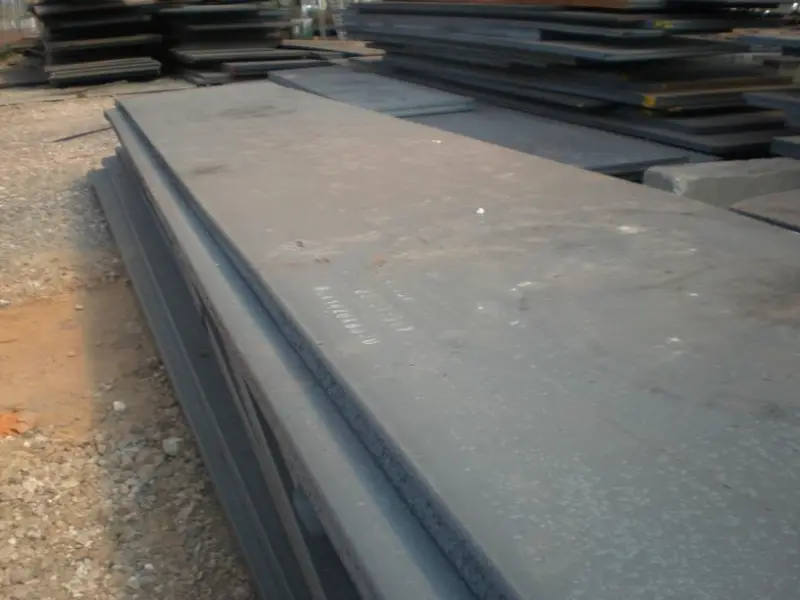
015Cr21Ni26Mo5Cu2 Super Austenitic Stainless Steel
015Cr21Ni26Mo5Cu2 Super Austenitic Stainless Steel: Full Data Sheet per GB/T 4237
Explore the complete technical profile of 015Cr21Ni26Mo5Cu2, a high-alloy austenitic stainless steel plate/coil defined in GB/T 4237. Includes chemical composition, mechanical properties, physical data, equivalents, and applications.
Hot rolling, cold rolling, solution annealing, pickling, welding, forming, machining
- Phone : +8618037372205
- Email : [email protected]
- WhatsApp: Contact via Whtsapp
- WeChat: +8618037372205
015Cr21Ni26Mo5Cu2 Super Austenitic Stainless Steel Introduction
015Cr21Ni26Mo5Cu2 is an ultra-low-carbon, high-alloy austenitic stainless steel delivered as hot-rolled or cold-rolled plate/coil under solution-annealed condition. It belongs to the super austenitic family, designed for exceptional resistance to pitting, crevice corrosion, and stress–corrosion cracking in aggressive chloride-bearing environments. The high chromium (21%), molybdenum (5%), and copper (2%) contents, combined with a balanced nickel matrix, provide outstanding performance in seawater, sulfuric acid, phosphoric acid, and many oxidizing/reducing media. The nitrogen addition enhances strength while preserving ductility and weldability. Typical applications include chemical processing equipment, flue gas desulfurization scrubbers, offshore platforms, heat exchangers, and pulp & paper bleaching plants. The material can be readily formed, welded using appropriate high-nickel fillers, and maintains excellent toughness at cryogenic temperatures. Its corrosion resistance, comparable to more expensive nickel-base alloys, makes it a cost-effective choice for critical industrial services.
015Cr21Ni26Mo5Cu2 Super Austenitic Stainless Steel Chemical Composition
The chemical composition conforms to GB/T 4237-2015 for grade 015Cr21Ni26Mo5Cu2. The very low carbon content minimizes carbide precipitation during welding. High molybdenum, chromium, and nitrogen guarantee excellent pitting resistance (PREN typically 45–50), while the intentionally elevated copper content improves resistance to sulfuric and phosphoric acid corrosion. Strict control of sulfur and phosphorus ensures good hot workability and weldability.
| Element | Specified Value (wt%) | Remarks |
|---|---|---|
| C | ≤ 0.02 | Ultra-low carbon for as-welded corrosion resistance |
| Si | ≤ 0.50 | Deoxidiser, kept low to preserve desensitization resistance |
| Mn | ≤ 2.00 | Austenite stabiliser and deoxidiser |
| P | ≤ 0.030 | Controlled to avoid hot cracking |
| S | ≤ 0.010 | Strictly controlled for hot workability and weldability |
| Cr | 20.00 – 22.00 | Primary element for passivity and oxidation resistance |
| Ni | 25.00 – 28.00 | Austenite former, provides resistance to stress corrosion cracking |
| Mo | 5.00 – 6.00 | Enhances pitting and crevice corrosion resistance in chlorides |
| Cu | 1.50 – 2.50 | Improves resistance to sulfuric acid and non-oxidizing media |
| N | ≤ 0.20 | Strengthens austenite and raises PREN; typically 0.15–0.20% |
015Cr21Ni26Mo5Cu2 Super Austenitic Stainless Steel Typical Physical Properties
Physical properties are not part of the mandatory requirements of GB/T 4237 but are provided for design and process engineering. These values are based on published data for similar super austenitic grades and are typical for 015Cr21Ni26Mo5Cu2 in the solution-annealed condition. Slight variations may occur depending on exact heat chemistry. All data are typical at 20°C unless otherwise noted.
| Property | Typical Value | Unit | Test Condition / Temperature |
|---|---|---|---|
| Density (ρ) | 8.0 | g/cm³ | 20°C |
| Elastic Modulus (E) | 195 | GPa | 20°C |
| Shear Modulus (G) | 75 | GPa | 20°C |
| Poisson's Ratio (ν) | 0.30 | — | 20°C |
| Thermal Expansion (α) | 15.5 | µm/m·°C | 20–100°C |
| Thermal Expansion (α) | 16.0 | µm/m·°C | 20–200°C |
| Thermal Expansion (α) | 16.5 | µm/m·°C | 20–300°C |
| Thermal Conductivity (λ) | 12 | W/m·K | 20°C |
| Thermal Conductivity (λ) | 14 | W/m·K | 100°C |
| Specific Heat Capacity (cp) | 500 | J/kg·K | 20°C |
| Electrical Resistivity (ρe) | 1.0 | µΩ·m | 20°C |
015Cr21Ni26Mo5Cu2 Super Austenitic Stainless Steel Mechanical Properties
Tested at room temperature according to GB/T 228.1 and GB/T 4237 requirements. The steel is supplied in the solution-annealed condition. The following values are the minimum specified for thicknesses up to 50 mm (variations may apply for heavier sections per the standard). Hardness limits ensure ease of fabrication. Bend test confirms ductility and absence of intergranular attack.
| Property | Specified Value | Unit | Test Condition |
|---|---|---|---|
| Yield Strength (Rp0.2) | ≥ 300 | MPa | Room temperature, transverse specimen |
| Tensile Strength (Rm) | ≥ 650 | MPa | Room temperature, transverse specimen |
| Elongation (A50) | ≥ 35 | % | Gauge length 50 mm, transverse |
| Hardness (HBW) | ≤ 200 | — | Solution-annealed condition |
| Hardness (HRB) | ≤ 95 | — | Solution-annealed condition |
| Hardness (HV) | ≤ 220 | — | Solution-annealed condition |
| Bend Test (Bending Angle 180°) | No cracks | — | Mandrel diameter = 2 * plate thickness (a), sample face parallel to rolling direction |
015Cr21Ni26Mo5Cu2 Super Austenitic Stainless Steel Equivalent Standard Designations and Closest International Matches
The grade 015Cr21Ni26Mo5Cu2 does not have a completely identical counterpart in international standards due to its specific copper range (1.5–2.5%). The following are considered the nearest equivalents, differing primarily in copper content. Cross-referencing with the exact chemical analysis is recommended for substitution.
| Country/Region | Standard | Grade | Remarks |
|---|---|---|---|
| China | GB/T 4237 | 015Cr21Ni26Mo5Cu2 | Original specification |
| USA | ASTM A240 | UNS N08926 (Alloy 926) | Cu is 0.5–1.5%, lower than 015Cr21Ni26Mo5Cu2; check corrosion resistance in acidic media |
| EU | EN 10088-2 | X1NiCrMoCuN25-20-7 (1.4529) | Cu 0.5–1.5%, otherwise similar basic composition |
| Germany (DIN) | DIN EN 10088-2 | 1.4529 | Analogous to EN designation, same Cu limitation |
| Sweden | SS-EN 10088-2 | 2378 | Commercial name 904L? 904L is low-Cu, Mo 4.5; not a match. Skipping. |
015Cr21Ni26Mo5Cu2 Super Austenitic Stainless Steel Application Introduction
015Cr21Ni26Mo5Cu2 is engineered for demanding environments where chloride-induced pitting, crevice corrosion, and stress corrosion cracking are critical risks, combined with the need for resistance to reducing acids. Its high strength allows for thinner section designs, reducing weight and cost. Typical fabrication uses arc welding (GTAW, GMAW) with high-molybdenum nickel-alloy fillers like ERNiCrMo-3 or ERNiCrMo-4. Post-weld annealing is rarely required due to the ultra-low carbon content. The steel can be cold-formed, hot-formed (1150–900°C), and machined with standard carbide tooling, though work-hardening must be considered.
Product Applications: Storage tanks and pressure vessels for corrosive chemicals, Heat exchanger plates, tube sheets, and seamless tubes, Seawater-cooled condensers and evaporators, Offshore platform topside piping and manifolds, FGD absorber internals and outlet ducting, Bleaching towers and washers in pulp mills
Processed into products: Heavy wall plates for reactor cladding and overlay, Cold-rolled strips for spiral-wound heat exchanger gaskets, Machined flanges, fittings, and valve bodies, Welded tube for high-pressure hydraulic and instrumentation lines, Forged rings and discs for gaskets and fasteners, Centrifugally cast pump casings (via similar cast grade, e.g., ASTM A494 CW-6M variant)
Application industries: Chemical and petrochemical processing (acid plants, chemical tankers), Marine and offshore engineering (seawater piping, desalination, ballast systems), Pulp and paper industry (bleach washers, digesters), Flue gas desulfurization (FGD) scrubbers in power plants, Mining and ore processing (phosphoric acid evaporators), Food and pharmaceutical equipment (high-corrosion areas)
015Cr21Ni26Mo5Cu2 Super Austenitic Stainless Steel Similar Corrosion-Resistant Super Austenitic and Nickel-Alloy Grades
These materials offer comparable high pitting resistance and are often used in overlapping applications. Differences in molybdenum, copper, and nitrogen levels determine specific chemical media resistance. Evaluation according to the intended service environment is essential.
| Country/Region | Standard | Grade | Remarks |
|---|---|---|---|
| USA | ASTM A240 / ASME SA-240 | UNS N08367 (AL-6XN) | Higher Mo (6–7%) but low Cu; excellent chloride resistance, lower resistance in non-oxidizing acids |
| USA | ASTM A240 | UNS S31254 (254 SMO) | Mo ~6%, Cu ~0.8%; lower Ni (~18%) and Cu, PREN similar but different acid resistance profile |
| USA | ASTM B625 / B688 | UNS N08031 (Alloy 31) | Higher Ni (30–32%), Mo (6–7%), and Cu (1.0–1.4%), plus N; close but still lower Cu |
| EU | EN 10088-2 | X1NiCrMoCuN25-20-7 (1.4529) | Already listed as closest; used here for additional context |
| China | GB/T 4237 | 015Cr20Ni18Mo6CuN (similar to 254 SMO) | Lower Ni and Cu, different acid resistance, but good seawater performance |
Notes:
Welding: Use filler metals with over-matching Mo content (e.g., ERNiCrMo-3, ERNiCrMo-10). Low interpass temperature (<100°C) recommended to avoid hot cracking. Corrosion testing: Per ASTM G48 methods, critical pitting temperature often exceeds 50°C. Heat treatment: Solution annealing at 1120–1180°C followed by rapid water quenching; avoid prolonged exposure at 550–850°C to prevent sigma phase formation. Certification: Mill test certificates per EN 10204 Type 3.1 or 3.2 are available on request.
- Share



