
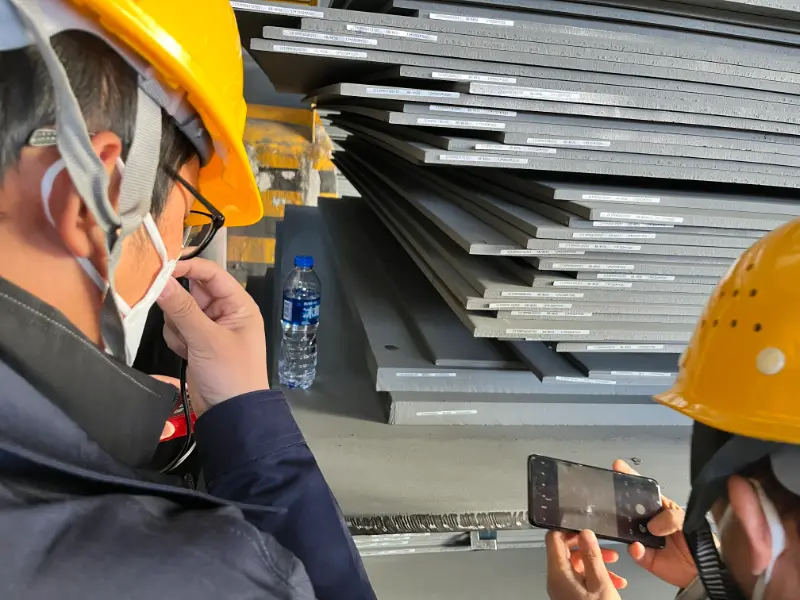
06Cr19Ni13Mo3 (0Cr19Ni13Mo3) Stainless Steel
06Cr19Ni13Mo3 (0Cr19Ni13Mo3) Stainless Steel: Ultimate Pitting Resistance for Chemical Plants & Marine Engineering
Detailed datasheet of 06Cr19Ni13Mo3 austenitic stainless steel plate/coil according to GB/T 4237. Chemical composition, mechanical properties, physical data, international equivalents and application guide for heavy corrosive environments.
Solution annealing, pickling, skin pass, cutting, slitting
- Phone : +8618037372205
- Email : [email protected]
- WhatsApp: Contact via Whtsapp
- WeChat: +8618037372205
06Cr19Ni13Mo3 Stainless Steel Introduction
06Cr19Ni13Mo3 (formerly 0Cr19Ni13Mo3) is a molybdenum-alloyed austenitic stainless steel standardized in GB/T 4237 for hot-rolled plates and coils. It is the Chinese counterpart to the international 317L (UNS S31703) grade, featuring a low carbon content (≤0.030%) to minimize intergranular carbide precipitation after welding or thermal processing. The alloy contains 18.0–20.0% chromium, 11.0–15.0% nickel, and 3.0–4.0% molybdenum, which significantly enhances resistance to pitting and crevice corrosion in chloride-containing media, as well as to sulfuric and phosphoric acids. The material is fully austenitic in the solution-annealed condition and is non-magnetic. It offers excellent formability and weldability, making it suitable for a wide range of aggressive chemical processing, pulp & paper, food, and marine applications. Delivery condition is typically solution annealed and pickled, providing a smooth, scale-free surface ready for fabrication.
06Cr19Ni13Mo3 Stainless Steel Chemical Composition
The composition of 06Cr19Ni13Mo3 is controlled to ensure stable austenitic microstructure, superior corrosion resistance, and good weldability. Low carbon content minimizes sensitization. Molybdenum is the key addition for improved pitting resistance in halide environments. All values are maximum unless a range is given, in accordance with GB/T 4237 for hot-rolled stainless steel plates and coils.
| Chemical Element | Standard Value | Remarks |
|---|---|---|
| Carbon (C) | ≤0.030 | Low carbon for welding |
| Silicon (Si) | ≤1.00 | Deoxidizer, improves oxidation resistance |
| Manganese (Mn) | ≤2.00 | Austenite stabilizer |
| Phosphorus (P) | ≤0.045 | Impurity control |
| Sulfur (S) | ≤0.030 | Impurity, machinability mildly improved |
| Chromium (Cr) | 18.00 – 20.00 | Primary ferrite former, corrosion resistance |
| Nickel (Ni) | 11.00 – 15.00 | Austenite stabilizer, toughness |
| Molybdenum (Mo) | 3.00 – 4.00 | Pitting and acid resistance enhancement |
| Nitrogen (N) | Not specified | Residual, typically <0.10% |
06Cr19Ni13Mo3 Stainless Steel Thermal & Electrical Physical Properties
Physical properties are provided as typical values at ambient temperature unless otherwise stated. These are not specification requirements but are useful for design calculations regarding heat transfer, thermal expansion, and electrical conductivity. Slight variations may occur due to exact chemistry and processing route.
| Property | Typical Value | Unit | Test Condition |
|---|---|---|---|
| Density (ρ) | 8.0 | g/cm³ | 20 °C |
| Modulus of Elasticity (E) | 200 | GPa | 20 °C |
| Shear Modulus (G) | 77 | GPa | Estimated from E and ν = 0.30 |
| Poisson's Ratio (ν) | 0.30 | — | Typical for austenitic steels |
| Coefficient of Thermal Expansion (α) | 16.5 | 10⁻⁶/K | 20–100 °C |
| Coefficient of Thermal Expansion (α) | 17.5 | 10⁻⁶/K | 20–300 °C |
| Coefficient of Thermal Expansion (α) | 18.0 | 10⁻⁶/K | 20–500 °C |
| Thermal Conductivity (λ) | 14.0 | W/(m·K) | at 100 °C |
| Thermal Conductivity (λ) | 15.0 | W/(m·K) | at 300 °C |
| Specific Heat Capacity (cp) | 500 | J/(kg·K) | at 20 °C |
| Electrical Resistivity (ρe) | 0.75 | µΩ·m | at 20 °C |
06Cr19Ni13Mo3 Stainless Steel Mechanical Properties
The following mechanical properties apply to solution-annealed plate at room temperature per GB/T 4237. The alloy exhibits excellent ductility and moderate strength, typical of molybdenum-alloyed austenitic stainless steels. Values vary slightly depending on plate thickness; the data below represent the minimum guaranteed values in the standard unless otherwise noted.
| Property | Standard Requirement | Unit | Test Condition |
|---|---|---|---|
| Yield Strength (Rp0.2) | ≥205 | MPa | Room temperature, solution annealed |
| Tensile Strength (Rm) | ≥520 | MPa | Room temperature, solution annealed |
| Elongation (A) | ≥40 | % | Gauge length 5.65√So, room temperature, solution annealed |
| Hardness (HBW) | ≤217 | HB | As per GB/T 231, solution annealed |
| Hardness (HRB) | ≤95 | HRB | As per GB/T 230, solution annealed |
| Hardness (HV) | ≤220 | HV | As per GB/T 4340, solution annealed |
| Bend Test | 180°, d = a | — | Thickness ≤12.7 mm, bend diameter equal to specimen thickness (no cracks required) |
06Cr19Ni13Mo3 Stainless Steel Perfect Match Equivalent Standards and Replaceable Grades
| Country/Region | Standard | Grade | Remarks |
|---|---|---|---|
| China | GB/T 4237 | 06Cr19Ni13Mo3 (0Cr19Ni13Mo3) | Original Chinese designation; hot-rolled plate/coil |
| USA | ASTM A240 | 317L | UNS S31703; plate, sheet, strip; same chemistry tolerance |
| Japan | JIS G4304 | SUS317L | Hot-rolled stainless steel plate and sheet; fully equivalent |
| Europe | EN 10088-2 | X2CrNiMo18-15-4 (1.4438) | Slightly higher Ni minimum (11.5 vs 11.0) but within overlap; same application |
| International | ISO 15510 | X2CrNiMo18-15-4 | Harmonized designation; matches EN composition |
06Cr19Ni13Mo3 Stainless Steel Application Introduction
Owing to its enhanced pitting resistance (PREN ≈ 24–30) and excellent formability, 06Cr19Ni13Mo3 is employed where standard 316L stainless steel reaches its corrosion limits. It withstands dilute sulfuric acid, phosphoric acid, and many chloride-bearing environments. Its low carbon content eliminates the need for post-weld heat treatment in most moderate-thickness fabrications. Typical industries and components are listed below.
Product Applications: Storage tanks for corrosive chemicals, Heat exchangers and condensers, Digesters and bleaching equipment for pulp mills, Piping systems, flanges, and fittings, Valve bodies and pump casings, Food processing vessels and conveyors
Processed into products: Welded tube sheets and baffle plates, Fasteners required for chemical vessels (bolts, nuts, washers), Eductor nozzles and injectors, Mixer blades and shafts, Column internals (trays, demisters) for distillation, Expansion joints and bellows in corrosive ducting
Application industries: Chemical & Petrochemical Processing, Pulp & Paper Manufacturing, Food, Dairy, and Beverage Processing, Marine and Offshore Equipment, Flue Gas Desulfurization (FGD) Systems, Pharmaceutical and Fine Chemicals, Coastal Architecture and Structural Fixings
06Cr19Ni13Mo3 Stainless Steel Similar / Alternative Materials Recommendation
| Country/Region | Standard | Grade | Remarks |
|---|---|---|---|
| China | GB/T 4237 | 06Cr17Ni12Mo2 (316L, 1.4404) | Lower Mo (2.0-3.0%), lower pitting resistance but more cost-effective; widely used for moderate chlorides |
| China | GB/T 4237 | 022Cr19Ni13Mo3 | Ultra-low carbon (C≤0.020) variant of 317L for maximum intergranular corrosion resistance, otherwise identical |
| USA | ASTM A240 | 904L (UNS N08904) | Higher Ni, Cr, Mo, Cu for extremely severe acid and chloride environments; more expensive substitute |
| Europe | EN 10088-2 | X3CrNiMo18-12-4 (1.4436) | Similar Mo content but slightly different Cr/Ni balance and higher N; used in valve and pump parts |
| Japan | JIS G4304 | SUS316L | Molybdenum-bearing 316L with lower Mo, suitable where full 317L resistance is not required |
Notes:
- Welding: Excellent weldability by all common methods (TIG, MIG, SAW). Filler metal matching or slightly over-alloyed: AWS ER317L or E317L for maximum corrosion resistance.
- Pickling & Passivation: Post-fabrication pickling with nitric/hydrofluoric acid restores corrosion resistance. Passivation with nitric acid is recommended for surfaces exposed to chlorides.
- Magnetic Properties: Non-magnetic in the annealed condition; may become slightly magnetic after cold working.
- Low-temperature Toughness: Suitable for cryogenic use down to -196°C; ductile-to-brittle transition is absent.
- Heating for Shaping: Hot working between 900°C and 1200°C; avoid prolonged holding at 475–860°C to prevent sigma phase embrittlement.
- Share



