
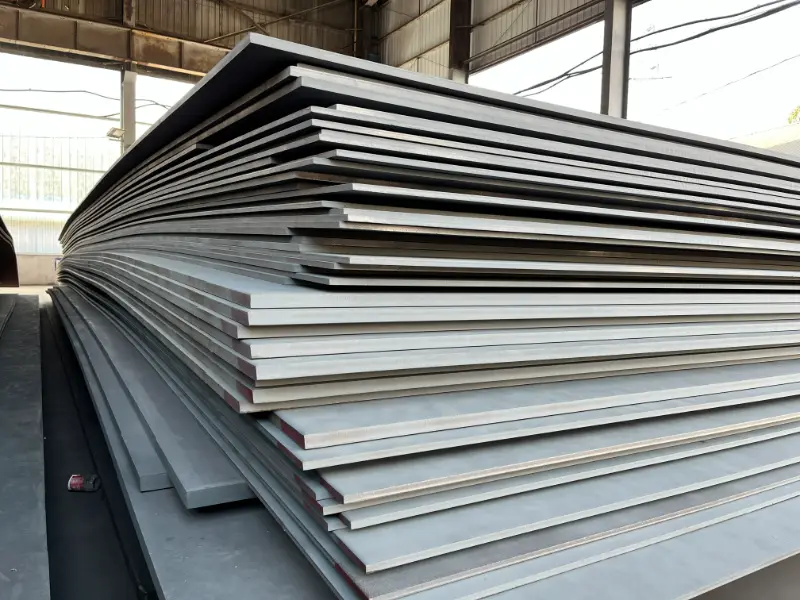
06Cr17Ni12Mo2N (S31651) Austenitic Stainless Steel
06Cr17Ni12Mo2N (S31651) Austenitic Stainless Steel - Grade Data & Performance Overview
Explore the full technical profile of 06Cr17Ni12Mo2N (0Cr17Ni12Mo2N), a high-strength austenitic stainless steel with nitrogen addition. Ideal for chemical, marine and high-load applications.
Welding, bending, cold forming, machining, deep drawing (requires higher forming forces due to nitrogen strengthening)
- Phone : +8618037372205
- Email : [email protected]
- WhatsApp: Contact via Whtsapp
- WeChat: +8618037372205
06Cr17Ni12Mo2N Austenitic Stainless Steel Introduction
06Cr17Ni12Mo2N (former designation 0Cr17Ni12Mo2N, UNS S31651) is a nitrogen-strengthened austenitic stainless steel standardized in GB/T 4237. It offers a higher yield and tensile strength compared to standard 316 types while retaining excellent corrosion resistance and toughness. The addition of 0.10%–0.16% nitrogen not only enhances mechanical properties but also improves resistance to pitting and crevice corrosion in chloride-containing environments. This grade is particularly suited for applications requiring both high strength and superior corrosion resistance, such as chemical processing equipment, marine components, and welded structures operating in aggressive media.
06Cr17Ni12Mo2N Austenitic Stainless Steel Chemical Composition
The chemical composition conforms to GB/T 4237 requirements for grade 06Cr17Ni12Mo2N. The addition of nitrogen (0.10–0.16%) significantly raises strength while maintaining austenite stability. Phosphorus and sulfur are kept low to ensure good corrosion resistance and weldability.
| Element | Standard Value | Remarks |
|---|---|---|
| Carbon (C) | ≤ 0.08 | Maximum allowed |
| Silicon (Si) | ≤ 1.00 | Maximum allowed |
| Manganese (Mn) | ≤ 2.00 | Maximum allowed |
| Phosphorus (P) | ≤ 0.045 | Maximum allowed |
| Sulfur (S) | ≤ 0.030 | Maximum allowed |
| Chromium (Cr) | 16.00 – 18.00 | Principal alloying element for corrosion resistance |
| Nickel (Ni) | 10.00 – 13.00 | Austenite stabilizer |
| Molybdenum (Mo) | 2.00 – 3.00 | Improves pitting and crevice corrosion resistance |
| Nitrogen (N) | 0.10 – 0.16 | Interstitial strengthening element; enhances strength and corrosion resistance |
| Iron (Fe) | Balance | Remainder |
06Cr17Ni12Mo2N Austenitic Stainless Steel Thermal & Electrical Physical Properties
Physical properties are typical values for 06Cr17Ni12Mo2N in the solution-annealed condition and are provided for engineering calculations. Data are derived from national standard references and material handbooks for this class of nitrogen-containing austenitic stainless steel.
| Property | Typical Value | Unit | Test Condition / Remarks |
|---|---|---|---|
| Density (ρ) | 7.93 | g/cm³ | At 20°C |
| Modulus of Elasticity (E) | 193 | GPa | At 20°C |
| Shear Modulus (G) | 77 | GPa | At 20°C |
| Poisson's Ratio (ν) | 0.30 | — | In elastic range |
| Thermal Expansion Coefficient (α) | 16.0 | 10⁻⁶/K | 20°C to 100°C |
| Thermal Expansion Coefficient (α) | 16.5 | 10⁻⁶/K | 20°C to 300°C |
| Thermal Expansion Coefficient (α) | 17.5 | 10⁻⁶/K | 20°C to 500°C |
| Thermal Conductivity (λ) | 16.3 | W/(m·K) | At 100°C |
| Thermal Conductivity (λ) | 21.5 | W/(m·K) | At 500°C |
| Specific Heat Capacity | 500 | J/(kg·K) | At 20°C |
| Electrical Resistivity (ρₑ) | 0.75 | μΩ·m | At 20°C |
06Cr17Ni12Mo2N Austenitic Stainless Steel Mechanical Properties
Minimum mechanical property requirements at room temperature per GB/T 4237 for solution-annealed condition. Elongation is measured on a gauge length of 50 mm (2 in) for thickness up to 8 mm. For thicker plates, elongation requirements may be separately agreed. No impact testing is specified for this austenitic grade in the standard.
| Property | Standard Required Value | Unit | Test Condition |
|---|---|---|---|
| 0.2% Proof Strength (Rp0.2, Yield Strength) | ≥ 240 | MPa | Room temperature, transverse specimen |
| Tensile Strength (Rm) | ≥ 530 | MPa | Room temperature, transverse specimen |
| Elongation after fracture (A) | ≥ 40 | % | Gauge length 50 mm, thickness ≤ 8 mm (for plate) |
06Cr17Ni12Mo2N Austenitic Stainless Steel Fully Equivalent Material Standards & Substitute Grades
| Country/Region | Standard | Designation | Remarks |
|---|---|---|---|
| China | GB/T 4237 | 06Cr17Ni12Mo2N (0Cr17Ni12Mo2N, S31651) | Original grade; precise match. |
| USA | ASTM A240/A240M | UNS S31651 (occasionally written 316N with Mo) | UNS S31651 is mostly aligned; verify N and C limits per actual standard revision. |
06Cr17Ni12Mo2N Austenitic Stainless Steel Application Introduction
06Cr17Ni12Mo2N is chosen where higher mechanical strength is required in addition to the typical corrosion resistance of 316 stainless steel. The nitrogen strengthening allows for material savings (thinner sections) and improved fatigue resistance. It is widely used in the fabrication of welded equipment for aggressive chemical media and seawater service.
Product Applications: Pressure vessels and storage tanks, Heat exchangers and condensers, Reactors and columns for chemical plants, Seawater piping systems, Hygienic equipment (tanks, mixers, pasteurizers), Welded structural components in corrosive atmospheres
Processed into products: Flanges, gaskets, and bolting sets, Pump shafts and impellers, Valve bodies and trim, Fasteners for high-load applications, Welded fabrications (beams, brackets) for offshore platforms, Instrumentation tubing and fittings, Metal housings for electronic equipment in marine environments
Application industries: Chemical and petrochemical processing, Marine engineering and offshore structures, Food and beverage processing equipment, Pharmaceutical and biotechnology plants, Pulp and paper industry, Environmental engineering (flue gas desulfurization, water treatment), Power generation (nuclear and conventional)
06Cr17Ni12Mo2N Austenitic Stainless Steel Similar / Substitute Materials
| Country/Region | Standard | Designation | Remarks |
|---|---|---|---|
| International / USA | ASTM A240 | 316LN (UNS S31653) | Low-carbon variant (C ≤ 0.030) with N 0.10–0.16; similar strength and corrosion resistance, improved intergranular corrosion. Slightly lower strength when C is lower. |
| Europe | EN 10088-2 | X2CrNiMoN17-11-2 (1.4406) | C ≤ 0.030, N 0.12–0.22, higher Ni min 11.5%; mechanical properties comparable but lower carbon gives better welding behavior. |
| Japan | JIS G4304 | SUS316LN | Similar to 316LN (C ≤ 0.030), widely used for high-temperature/high-strength applications. |
| China | GB/T 4237 | 06Cr17Ni12Mo2 (S31608, 0Cr17Ni12Mo2) | Standard 316 without intentional nitrogen addition; lower strength but similar corrosion resistance. |
| China | GB/T 4237 | 022Cr17Ni12Mo2N (S31653) | Low-carbon version with N addition; improved intergranular corrosion resistance, slightly lower strength than 06Cr17Ni12Mo2N. |
Notes:
- The nitrogen content of this grade must be carefully controlled during welding to avoid porosity; filler metals matching ER316LN or equivalent are recommended.
- Post-weld heat treatment is generally not required, but solution annealing followed by water quenching restores full corrosion resistance after heavy fabrication.
- This grade is susceptible to sigma phase embrittlement after prolonged exposure at 650–900°C; therefore its continuous service temperature should generally not exceed 450°C for structural applications.
- Data provided in this sheet represent standard minimum or typical values; actual properties may vary with product thickness and processing conditions. For critical applications, consult the latest edition of GB/T 4237 or supplier certifications.
- Share



