
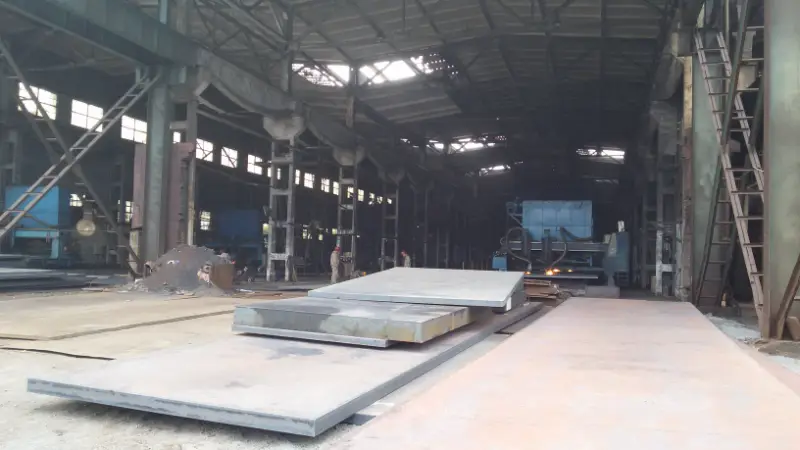
06Cr17Ni12Mo2 (0Cr17Ni12Mo2) Stainless Steel
06Cr17Ni12Mo2 (0Cr17Ni12Mo2) Stainless Steel: GB/T 4237 Austenitic Plate & Coil Properties Guide
Complete material data for 06Cr17Ni12Mo2 (equivalent to AISI 316) austenitic stainless steel plate and coil under GB/T 4237, including chemical composition, mechanical and physical properties.
Hot rolling, cold rolling, solution annealing, pickling, cutting, forming, welding
- Phone : +8618037372205
- Email : [email protected]
- WhatsApp: Contact via Whtsapp
- WeChat: +8618037372205
06Cr17Ni12Mo2 Stainless Steel Introduction
06Cr17Ni12Mo2 (former designation 0Cr17Ni12Mo2) is a molybdenum-bearing austenitic stainless steel defined in GB/T 4237 for hot-rolled stainless steel plates, sheets, and strips. This grade is the Chinese counterpart to the globally recognized AISI 316 and EN 1.4401 alloys. The addition of 2.0–3.0% molybdenum significantly enhances resistance to pitting and crevice corrosion in chloride environments compared to standard 18/8 chromium-nickel grades such as 06Cr19Ni10 (304). The alloy exhibits excellent toughness, ductility, and weldability across a wide temperature range, making it suitable for demanding applications in medical, chemical, food processing, and marine engineering industries.
- Excellent corrosion resistance in acidic and halide environments
- Non-magnetic in the solution-annealed condition
- Good high-temperature strength up to 870 °C intermittent service
- Supplied in solution-annealed and pickled condition for optimal corrosion performance
06Cr17Ni12Mo2 Stainless Steel Chemical Composition as per GB/T 4237
The chemical composition of 06Cr17Ni12Mo2 is designed to provide a stable austenitic microstructure with enhanced pitting resistance. Chromium (16.0–18.0%) ensures passivity, while nickel (10.0–14.0%) stabilizes the austenite phase. The critical addition of molybdenum (2.0–3.0%) dramatically improves resistance to localized corrosion in chloride-containing media. Carbon is restricted to a maximum of 0.06% to mitigate sensitization during welding, though the standard grade does not require the ultra-low carbon levels found in 316L (022Cr17Ni12Mo2).
| Element | Standard Value (wt%) | Remarks |
|---|---|---|
| Carbon (C) | ≤ 0.06 | Max limit to control sensitization |
| Silicon (Si) | ≤ 1.00 | Deoxidizer and strength enhancer |
| Manganese (Mn) | ≤ 2.00 | Austenite stabilizer, aids hot working |
| Phosphorus (P) | ≤ 0.045 | Max limit to avoid grain boundary weakness |
| Sulfur (S) | ≤ 0.030 | Max limit to preserve ductility and weldability |
| Chromium (Cr) | 16.00 – 18.00 | Primary element for passivity and corrosion resistance |
| Nickel (Ni) | 10.00 – 14.00 | Austenite former, enhances toughness and formability |
| Molybdenum (Mo) | 2.00 – 3.00 | Key element for pitting and crevice corrosion resistance in chloride environments |
| Nitrogen (N) | ≤ 0.10 (reference) | Not explicitly listed in GB/T 4237, often controlled to ≤0.10 in practice |
06Cr17Ni12Mo2 Stainless Steel Thermal and Electrical Physical Properties
Physical properties for 06Cr17Ni12Mo2 are characteristic of molybdenum-bearing austenitic stainless steels. Density is slightly higher than standard 304 due to the molybdenum content. The coefficient of thermal expansion is moderate, while thermal conductivity is lower than that of carbon steels, which must be considered in heat exchanger design. Electrical resistivity reflects the alloying concentration in the austenitic matrix. These values are typical for the fully annealed, wrought product form.
| Property | Standard Value | Unit | Test Condition |
|---|---|---|---|
| Density (ρ) | 8.0 | g/cm³ | At 20 °C |
| Elastic Modulus (E) | 193 | GPa | At 20 °C |
| Elastic Modulus (E) | 185 | GPa | At 100 °C |
| Elastic Modulus (E) | 170 | GPa | At 300 °C |
| Elastic Modulus (E) | 155 | GPa | At 500 °C |
| Shear Modulus (G) | 86 | GPa | At 20 °C (typical) |
| Poisson's Ratio (ν) | 0.30 | — | At 20 °C |
| Thermal Expansion Coefficient (α) | 16.5 × 10⁻⁶ | K⁻¹ | Range 20 – 100 °C |
| Thermal Expansion Coefficient (α) | 17.5 × 10⁻⁶ | K⁻¹ | Range 20 – 300 °C |
| Thermal Expansion Coefficient (α) | 18.5 × 10⁻⁶ | K⁻¹ | Range 20 – 500 °C |
| Thermal Conductivity (λ) | 16.2 | W/(m·K) | At 100 °C |
| Thermal Conductivity (λ) | 21.5 | W/(m·K) | At 500 °C |
| Specific Heat Capacity (cp) | 500 | J/(kg·K) | At 20 °C |
| Electrical Resistivity (ρe) | 0.74 | μΩ·m | At 20 °C |
06Cr17Ni12Mo2 Stainless Steel Mechanical Properties per GB/T 4237
Mechanical properties are measured on test samples taken from hot-rolled plates in the solution-annealed condition. The values represent the minimum guaranteed performance. Yield strength (Rp0.2) is the stress at 0.2% plastic strain, while tensile strength (Rm) is the ultimate load-bearing capacity. Elongation (A) reflects the ductility of the material, with slight variations depending on the plate thickness. Hardness values provide an indication of wear resistance and formability.
- All values are valid for room temperature testing.
- Actual mill-supplied properties often exceed the standard minimums.
| Property | Standard Requirement | Unit | Test Condition / Remarks |
|---|---|---|---|
| Yield Strength (Rp0.2) | ≥ 205 | MPa | Room temperature, solution annealed |
| Tensile Strength (Rm) | ≥ 515 | MPa | Room temperature, solution annealed |
| Elongation (A) | ≥ 40 | % | Gauge length 50 mm, thickness >3 mm |
| Elongation (A) | ≥ 35 | % | Gauge length 50 mm, thickness ≤3 mm |
| Brinell Hardness (HBW) | ≤ 217 | HBW | Solution annealed condition |
| Rockwell Hardness (HRB) | ≤ 95 | HRB | Solution annealed condition |
| Vickers Hardness (HV) | ≤ 220 | HV | Solution annealed condition |
06Cr17Ni12Mo2 Stainless Steel Completely Equivalent International Grades and Standards
| Country / Region | Standard | Grade / Designation | Remarks |
|---|---|---|---|
| China | GB/T 4237 | 06Cr17Ni12Mo2 (0Cr17Ni12Mo2) | Original hot-rolled plate/coil standard; austenitic stainless steel |
| China | GB/T 3280 | 06Cr17Ni12Mo2 | Cold-rolled stainless steel sheet and strip |
| United States | ASTM A240/A240M | 316 (UNS S31600) | Chromium-nickel-molybdenum stainless steel plate/sheet |
| European Union | EN 10088-2 / EN 10028-7 | X5CrNiMo17-12-2 (1.4401) | Standard 316 grade for general purposes |
| Japan | JIS G4304 / G4305 | SUS316 | Hot-rolled / Cold-rolled stainless steel plate and strip |
| International | ISO 15510 | X5CrNiMo17-12-2 | International standard for stainless steel compositions |
06Cr17Ni12Mo2 Stainless Steel Application Introduction
06Cr17Ni12Mo2 (AISI 316 equivalent) is widely used in aggressive environments where standard 304 grade may fail due to pitting or crevice corrosion. Its superior resistance to chlorides, sulfates, and many organic and inorganic chemicals makes it a preferred choice in medical, marine, and chemical processing fields. The material exhibits excellent formability and weldability, enabling fabrication into complex shapes and structures.
- Chemical processing: Reactors, heat exchangers, and storage tanks for corrosive media
- Medical applications: Surgical instruments, orthopedic and dental implants, pharmaceutical equipment
- Food industry: Brewing tanks, dairy processing equipment, and conveyors
Product Applications: Pressure vessels and reactors, Shell-and-tube heat exchangers, Storage tanks for acidic chemicals, Hygienic piping and tubing systems, Surgical and dental instruments, Orthopedic implants and bone fixation plates, Pharmaceutical clean-room equipment, Marine hardware and propeller shafts, Brewery fermentation vessels, Dairy processing and pasteurization equipment
Processed into products: Weld neck and slip-on flanges (ASME B16.5 / EN 1092-1), Butt-weld pipe fittings (elbows, tees, reducers), Ball and gate valve bodies, Centrifugal pump casings and impellers, Agitator shafts and mixing blades, High-strength bolting and fasteners (when solution annealed and strain hardened), Column trays and packings for distillation towers, Tube sheets for heat exchangers, Surgical hemostats, scissors, and forceps, Custom machined instrumentation parts
Application industries: Medical and healthcare device manufacturing, Chemical and petrochemical processing plants, Pharmaceutical production facilities, Food and beverage processing industry, Marine and offshore engineering, Pulp and paper production, Textile dyeing equipment, Power generation (condenser tubing, nuclear applications)
06Cr17Ni12Mo2 Stainless Steel Similar / Alternative Materials with Close Performance
| Country / Region | Standard | Grade / Designation | Remarks |
|---|---|---|---|
| China / EU / US | GB/T 4237 / EN 10088 / ASTM A240 | 022Cr17Ni12Mo2 (316L) / X2CrNiMo17-12-2 (1.4404) / UNS S31603 | Low-carbon variant (<0.030% C) for improved welding performance and minimized sensitization risk |
| China / EU / US | GB/T 4237 / EN 10088 / ASTM A240 | 06Cr19Ni13Mo3 (317) / X5CrNiMo17-13-3 (1.4449) / UNS S31700 | Higher molybdenum content (3.0–4.0%) for superior corrosion resistance in chemical media |
| European Union | EN 10088-2 | X3CrNiMo17-13-3 (1.4436) | Slightly higher Mo and Ni than 1.4401, enabling better pitting resistance and formability |
| China / EU / US | GB/T 4237 / EN 10088 / ASTM A240 | 06Cr17Ni12Mo2Ti (316Ti) / X6CrNiMoTi17-12-2 (1.4571) / UNS S31635 | Titanium-stabilized grade for enhanced high-temperature strength and intergranular corrosion resistance |
Notes:
Welding considerations: This grade is readily weldable by TIG, MIG, MMA, and submerged arc processes. Use filler metal ER316 or E316 to match the parent metal properties. Post-weld annealing is not typically required for thicknesses under 3 mm, but in heavy sections or critical corrosion applications, solution annealing at 1010–1120 °C followed by rapid quenching is recommended to restore full corrosion resistance. Machining: Austenitic stainless steels work-harden; use sharp tools, rigid setups, and adequate coolant. Pickling and passivation: To achieve optimum corrosion resistance, remove surface oxides and iron contamination after fabrication using nitric-hydrofluoric acid pickling followed by passivation in nitric acid. Intergranular corrosion: Continuous service above 425 °C or slow cooling through 850–450 °C may cause sensitization; for such conditions, consider the low-carbon variant 022Cr17Ni12Mo2 (316L) or stabilized 316Ti. Magnetic properties: The material is essentially non-magnetic in the solution-annealed condition, but cold working can induce a slight martensitic transformation and weak magnetic response. This data reflects typical properties and standard requirements; for critical applications, specific mill certificates should be requested.
- Share



