
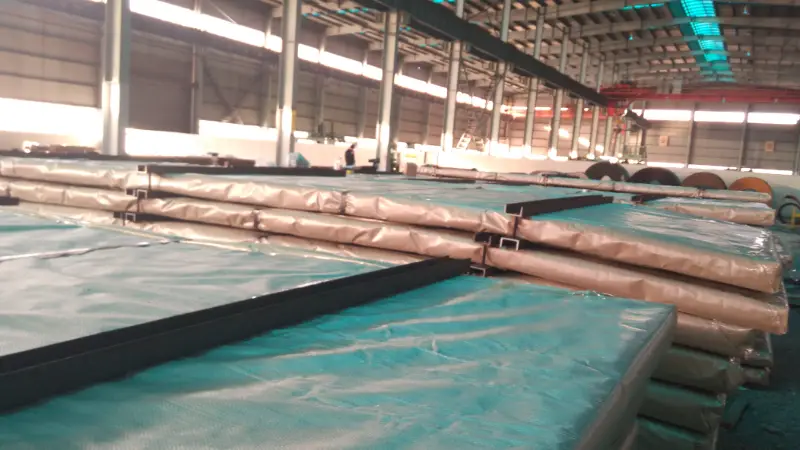
022Cr17Ni12Mo2 (00Cr17Ni14Mo2) Stainless Steel
022Cr17Ni12Mo2 (00Cr17Ni14Mo2) Stainless Steel - GB/T 4237 Austenitic Plate/Coil Data
Comprehensive data sheet for 022Cr17Ni12Mo2 (formerly 00Cr17Ni14Mo2) austenitic stainless steel per GB/T 4237. Covers chemical composition, mechanical and physical properties, international equivalents, and application guidance.
Forging, rolling, welding, cutting, bending, deep drawing, stamping
- Phone : +8618037372205
- Email : [email protected]
- WhatsApp: Contact via Whtsapp
- WeChat: +8618037372205
022Cr17Ni12Mo2 Stainless Steel Introduction
022Cr17Ni12Mo2 (formerly 00Cr17Ni14Mo2) is an ultra-low carbon, molybdenum-bearing austenitic stainless steel widely recognized as the Chinese counterpart to AISI 316L. The addition of 2–3% molybdenum significantly improves resistance to pitting and crevice corrosion in chloride environments, while the very low carbon content (<0.03%) virtually eliminates the risk of intergranular corrosion after welding or stress relieving. The material offers excellent general corrosion resistance, good formability, and weldability, making it suitable for a wide range of aggressive media.
- Ultra-low carbon content (C ≤ 0.030%) prevents sensitization during welding
- Molybdenum addition enhances resistance to chlorides, organic acids, and reducing acids
- Excellent toughness at cryogenic temperatures
- Readily formed, bent, deep drawn, and welded
022Cr17Ni12Mo2 Stainless Steel Chemical Composition
The chemical composition of 022Cr17Ni12Mo2 conforms to GB/T 4237. The low carbon content is critical to prevent carbide precipitation during welding. Molybdenum is added to improve pitting resistance, while nickel stabilizes the austenitic structure. All values are ladle analysis limits.
| Element | Standard Value (wt.%) | Remarks |
|---|---|---|
| C | ≤0.030 | Ultra-low carbon to avoid sensitization |
| Si | ≤1.00 | Deoxidizer; promotes pitting resistance if too high |
| Mn | ≤2.00 | Improves hot workability |
| P | ≤0.045 | Impurity; controlled for corrosion resistance |
| S | ≤0.030 | Impurity; detrimental to weldability and surface quality |
| Cr | 16.00–18.00 | Primary element for passivation and corrosion resistance |
| Ni | 10.00–14.00 | Austenite stabilizer; ensures ductility and toughness |
| Mo | 2.00–3.00 | Enhances resistance to pitting, crevice corrosion, and reducing acids |
| N | ≤0.10 | Residual; can increase strength but may reduce pitting resistance |
022Cr17Ni12Mo2 Stainless Steel Thermal and Electrical Physical Properties
Physical properties for austenitic stainless steel 022Cr17Ni12Mo2 in the annealed condition. The data represent typical values at room temperature unless otherwise specified. Thermal expansion and conductivity vary with temperature; values at common reference temperatures are provided.
| Property | Typical Value | Unit | Test Condition |
|---|---|---|---|
| Density (ρ) | 8.0 | g/cm³ | 20°C |
| Modulus of Elasticity (E) | 193 | GPa | Room temperature |
| Shear Modulus (G) | 77 | GPa | Room temperature |
| Poisson's Ratio (ν) | 0.30 | - | Room temperature (elastic range) |
| Thermal Expansion Coefficient (α) | 16.0 | 10⁻⁶/K | 20–100°C |
| Thermal Expansion Coefficient (α) | 16.5 | 10⁻⁶/K | 20–300°C |
| Thermal Expansion Coefficient (α) | 17.5 | 10⁻⁶/K | 20–500°C |
| Thermal Conductivity (λ) | 15.0 | W/(m·K) | At 100°C |
| Thermal Conductivity (λ) | 21.5 | W/(m·K) | At 500°C |
| Specific Heat Capacity (c) | 500 | J/(kg·K) | 0–100°C |
| Electrical Resistivity (ρ_e) | 0.74 | μΩ·m | 20°C |
022Cr17Ni12Mo2 Stainless Steel Mechanical Properties
Mechanical properties for 022Cr17Ni12Mo2 steel plate in the solution-annealed condition as per GB/T 4237. Values represent minimum requirements for thickness up to 8 mm unless noted. Hardness values are maximum limits. The material exhibits excellent ductility and deep drawability.
| Property | Minimum Value | Unit | Test Condition |
|---|---|---|---|
| Yield Strength (Rp0.2) | 175 | MPa | Room temperature, transverse direction |
| Tensile Strength (Rm) | 480 | MPa | Room temperature, transverse direction |
| Elongation (A) | 40 | % | Gauge length 5.65√S₀ (or 50 mm); thickness ≤8 mm |
| Hardness (HBW) | ≤187 | - | Room temperature |
| Hardness (HRB) | ≤90 | - | Room temperature |
| Hardness (HV) | ≤200 | - | Room temperature |
022Cr17Ni12Mo2 Stainless Steel Full Equivalent Material Standards and Replaceable Grades
| Country/Region | Standard | Grade | Remarks |
|---|---|---|---|
| USA | ASTM A240/A240M | 316L (UNS S31603) | Low carbon, Mo-alloyed austenitic stainless steel plate |
| EU | EN 10028-7 / EN 10088-2 | 1.4404 (X2CrNiMo17-12-2) | Identical composition target |
| Japan | JIS G4304 | SUS316L | Hot rolled stainless steel plate |
| International | ISO 15510 | X2CrNiMo17-12-2 | Direct international designation |
| China | GB/T 4237 | 022Cr17Ni12Mo2 | Also known as 00Cr17Ni14Mo2 (old designation) |
022Cr17Ni12Mo2 Stainless Steel Application Introduction
022Cr17Ni12Mo2 is a versatile stainless steel suitable for environments containing chloride ions, organic acids, and many process chemicals. Its low carbon content makes it the preferred choice for welded fabrications where post-weld heat treatment is not feasible. It finds widespread use across industries requiring both corrosion resistance and cleanliness.
Product Applications: Pressure Vessels and Storage Tanks, Shell-and-Tube Heat Exchangers, Piping Systems and Manifolds, Process Columns and Reactors, Tubular Heaters and Condensers, Sanitary Tubing and Fittings (food/pharma grade), Structural Components in Corrosive Atmospheres
Processed into products: Flanges (weld neck, slip-on, blind), Butt-weld Fittings (elbows, tees, reducers), Valves and Pump Housings, Fasteners (bolts, nuts – when solution annealed), Reactor Vessels and Agitators, Distillation Columns Trays and Packing Supports, Welded Tubes for Heat Exchangers
Application industries: Chemical Processing, Pharmaceutical Manufacturing, Food & Beverage Processing, Marine & Offshore Equipment, Oil & Gas Production, Pulp & Paper Machinery, Water Treatment
022Cr17Ni12Mo2 Stainless Steel Materials with Similar Properties and Alternative Substitutes
| Country/Region | Standard | Grade | Remarks |
|---|---|---|---|
| China | GB/T 4237 | 06Cr17Ni12Mo2 (316) | Higher carbon (≤0.08%) – may sensitize in welding; similar corrosion resistance in non-welded condition |
| China | GB/T 4237 | 022Cr19Ni13Mo3 (317L) | Higher Mo (3.0–4.0%) for superior pitting resistance; slightly higher strength |
| EU | EN 10088-2 | 1.4436 (X3CrNiMo17-13-3) | Higher Ni and Mo for improved corrosion resistance |
| USA | ASTM A240 | 316 (UNS S31600) | Higher carbon version of 316L |
| USA | ASTM A240 | 317L (UNS S31703) | Higher Mo and Ni for superior pitting resistance |
Notes:
Delivery and Processing Notes:
- Supplied in solution annealed and descaled condition per GB/T 4237; pickling or bright annealing may be specified.
- For thicknesses >75 mm, the minimum mechanical properties may be slightly reduced; consult the specification or supplementary agreement.
- Low carbon content assures resistance to intergranular corrosion in the as-welded state (typically no PWHT required).
- Austenitic structure renders it non-magnetic in the annealed condition; slight magnetism may develop after cold working.
- For optimum corrosion resistance, post-fabrication pickling and passivation is recommended.
- Available surface finishes: No.1, 2B, 2D, BA (per customer requirements).
- Share



