
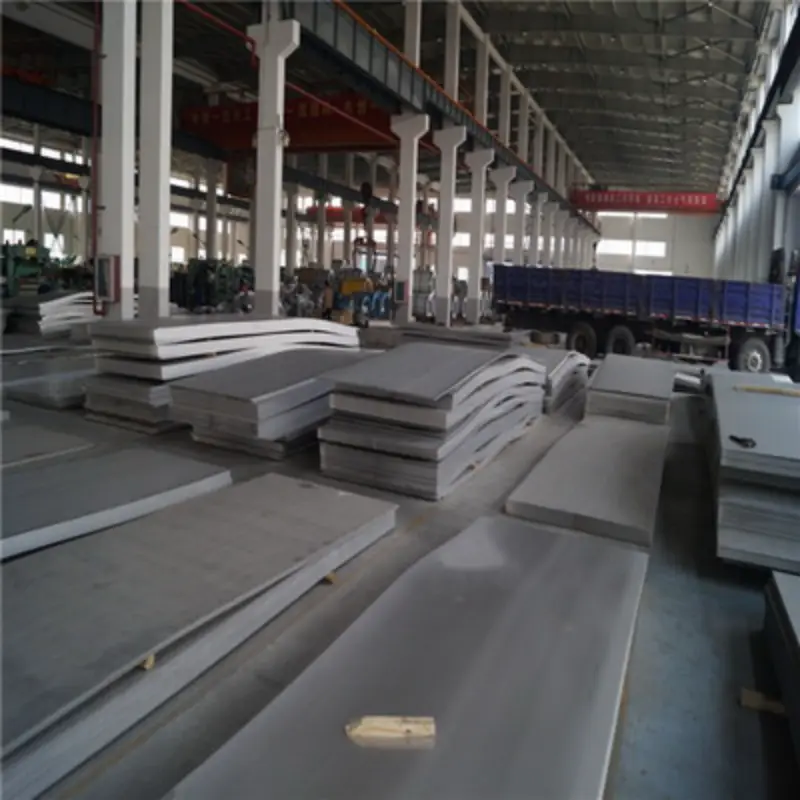
022Cr25Ni22Mo2N Super Austenitic Stainless Steel Plate/Coil
022Cr25Ni22Mo2N Super Austenitic Stainless Steel Plate/Coil - GB/T 4237
Comprehensive technical data for 022Cr25Ni22Mo2N super austenitic stainless steel (equivalent to UNS S31050/1.4466) per GB/T 4237 – chemistry, mechanics, physics, applications.
Hot rolling, cold rolling, solution annealing, pickling, shearing
- Phone : +8618037372205
- Email : [email protected]
- WhatsApp: Contact via Whtsapp
- WeChat: +8618037372205
022Cr25Ni22Mo2N Super Austenitic Stainless Steel Plate/Coil Introduction
022Cr25Ni22Mo2N is a nitrogen-alloyed super austenitic stainless steel standardized under GB/T 4237 for hot-rolled and cold-rolled plates and coils. It combines high chromium (25%), nickel (22%), molybdenum (2–3%), and controlled nitrogen (0.10–0.20%) to deliver exceptional resistance to pitting, crevice corrosion, and stress corrosion cracking in chloride-bearing environments. The deliberate nitrogen addition boosts mechanical strength without compromising ductility, enabling lighter design. This grade bridges the gap between conventional austenitic grades (e.g., 316L) and high-nickel alloys.
- Excellent pitting resistance equivalent number (PREN) typically above 40
- High yield strength (>270 MPa) combined with good elongation (>30%)
- Superior intergranular corrosion resistance after welding
- Readily formable and weldable using common practices
022Cr25Ni22Mo2N Super Austenitic Stainless Steel Plate/Coil Chemical Composition
The composition is defined by GB/T 4237 and corresponds to a high-alloy austenitic stainless steel. The balanced combination of chromium, nickel, molybdenum, and nitrogen ensures excellent localized corrosion resistance and mechanical strength, while low carbon minimizes intergranular precipitation during welding.
| Element | Content (%) | Remarks |
|---|---|---|
| C | ≤0.030 | |
| Si | ≤1.00 | |
| Mn | ≤2.00 | |
| P | ≤0.035 | |
| S | ≤0.030 | |
| Cr | 24.00–26.00 | |
| Ni | 21.00–23.00 | |
| Mo | 2.00–3.00 | |
| N | 0.10–0.20 | |
| Fe | Balance |
022Cr25Ni22Mo2N Super Austenitic Stainless Steel Plate/Coil Thermal and Electrical Physical Properties
Physical properties of 022Cr25Ni22Mo2N in solution-annealed condition. These typical values assist in engineering calculations. The austenitic microstructure leads to a low thermal conductivity and high thermal expansion relative to ferritic steels, which must be considered in design of components subjected to thermal cycling.
| Property | Value | Unit | Test Condition |
|---|---|---|---|
| Density (ρ) | 8.0 | g/cm³ | 20 °C |
| Elastic modulus (E) | 200 | GPa | 20 °C |
| Elastic modulus (E) | 190 | GPa | 100 °C |
| Elastic modulus (E) | 180 | GPa | 200 °C |
| Shear modulus (G) | 77 | GPa | 20 °C |
| Poisson's ratio (ν) | 0.30 | — | 20 °C |
| Thermal expansion (α) | 16.0 | 10⁻⁶/K | 20–100 °C |
| Thermal expansion (α) | 16.5 | 10⁻⁶/K | 20–200 °C |
| Thermal expansion (α) | 17.0 | 10⁻⁶/K | 20–300 °C |
| Thermal expansion (α) | 17.5 | 10⁻⁶/K | 20–400 °C |
| Thermal conductivity (λ) | 15 | W/(m·K) | 20 °C |
| Thermal conductivity (λ) | 16 | W/(m·K) | 100 °C |
| Thermal conductivity (λ) | 18 | W/(m·K) | 200 °C |
| Thermal conductivity (λ) | 20 | W/(m·K) | 300 °C |
| Thermal conductivity (λ) | 22 | W/(m·K) | 400 °C |
| Thermal conductivity (λ) | 24 | W/(m·K) | 500 °C |
| Specific heat (cp) | 500 | J/(kg·K) | 20 °C |
| Electrical resistivity (ρe) | 0.85 | µΩ·m | 20 °C |
022Cr25Ni22Mo2N Super Austenitic Stainless Steel Plate/Coil Mechanical Properties
Tensile properties are measured on transversely oriented specimens from solution-annealed plates in accordance with GB/T 4237. The nitrogen alloying raises the minimum yield strength to about 270 MPa while maintaining excellent ductility. Hardness values are informative for quality control.
| Property | Value | Unit | Test Condition |
|---|---|---|---|
| Yield strength (Rp0.2) | ≥270 | MPa | Solution annealed, room temperature |
| Tensile strength (Rm) | 580–800 | MPa | Solution annealed, room temperature |
| Elongation after fracture (A) | ≥30 | % | 50 mm gauge length, solution annealed |
| Brinell hardness (HBW) | ≤217 | — | Solution annealed |
022Cr25Ni22Mo2N Super Austenitic Stainless Steel Plate/Coil Full Equivalent Material Standards and Substitutable Grades
| Region/Country | Standard | Grade | Remarks |
|---|---|---|---|
| China | GB/T 4237 | 022Cr25Ni22Mo2N | Original specification |
| European Union | EN 10028-7 | 1.4466 (X2CrNiMoN25-22-2) | Chemically and mechanically identical |
| USA | ASTM A240 | UNS S31050 | Fully equivalent super austenitic grade |
| International | ISO 15510 | X2CrNiMoN25-22-2 | ISO designation, matches all properties |
022Cr25Ni22Mo2N Super Austenitic Stainless Steel Plate/Coil Application Introduction
With its optimized CR-Ni-Mo-N balance, 022Cr25Ni22Mo2N offers outstanding resistance to chloride-induced stress corrosion cracking, pitting, and crevice corrosion. Its elevated nitrogen content provides higher yield and tensile strengths compared to standard 300-series stainless steels, often allowing a reduction in wall thickness and weight. The alloy is fully austenitic and non-magnetic in the solution-annealed condition.
Product Applications: Pressure vessels and storage tanks, Shell-and-tube and plate heat exchangers, Welded and seamless piping systems, Distillation columns, internals, and trays, Offshore platform process equipment, Desalination evaporators and flash chambers
Processed into products: Reactor vessels and linings, Digester and bleach tower components, Flue gas ducts and scrubber shells, Seawater piping and pump casings, Valve bodies and trim, Impellers and agitators
Application industries: Chemical processing (acids, caustic), Petrochemical and refining, Pulp & paper (bleaching, chemical recovery boilers), Seawater and brine handling, Flue gas desulfurization (FGD) and pollution control, Food processing (high-chloride, salty media), Pharmaceutical and sterile equipment
022Cr25Ni22Mo2N Super Austenitic Stainless Steel Plate/Coil Similar/Alternative Materials for Comparative Selection
| Region/Country | Standard | Grade | Remarks |
|---|---|---|---|
| USA | ASTM A240 | UNS S31254 (254SMO) | Higher Mo (6%), better pitting resistance but more expensive |
| USA | ASTM A240 | UNS N08926 (1.4529) | Higher Ni and Mo; used in more severe chloride environments |
| China | GB/T 4237 | 022Cr20Ni18Mo6CuN | Super austenitic, enhanced resistance but different composition |
| EU | EN 10028-7 | 1.4539 (X1NiCrMoCuN25-20-7) / UNS N08904 | Lower Mo (4–5%), good general corrosion resistance, lower cost |
Notes:
Welding: Use matching filler metals such as AWS A5.9 ER310Mo or equivalent to preserve corrosion resistance. Low heat input and interpass temperature control are recommended. Post-weld solution annealing may be required for maximum corrosion performance in highly critical services.
Strength advantage: The nitrogen addition raises yield strength by approximately 30–40% above S30400/S31600, enabling weight savings.
Available dimensions: Typical plate thickness range 3–100 mm, coils up to 2000 mm width per GB/T 4237. For exact stock availability inquire with the supplier.
- Share



