
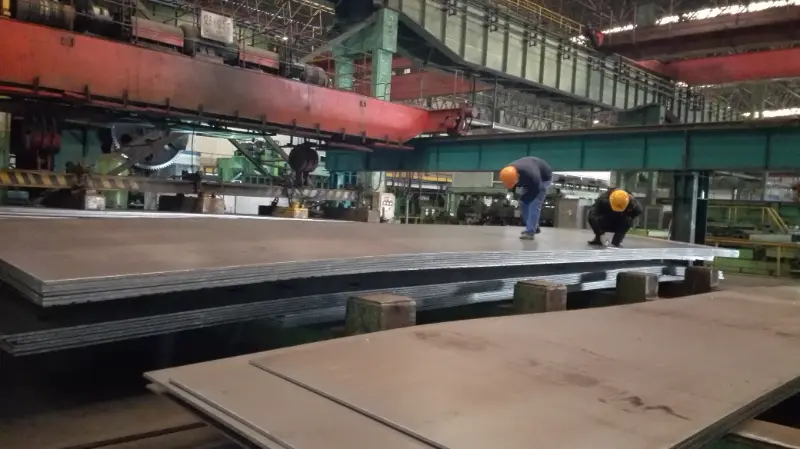
06Cr13 (0Cr13) Martensitic Stainless Steel Plate/Coil per GB/T 4237
06Cr13 (0Cr13) Martensitic Stainless Steel Plate/Coil per GB/T 4237: Chemical & Performance Data
Detailed technical data for 06Cr13 (formerly 0Cr13) martensitic stainless steel plate and coil according to Chinese standard GB/T 4237, including chemical composition, mechanical and physical properties, international equivalents, and application guidance.
Hot rolling, cold forming (after annealing), welding, heat treatment (quenching and tempering for higher strength), machining
- Phone : +8618037372205
- Email : [email protected]
- WhatsApp: Contact via Whtsapp
- WeChat: +8618037372205
06Cr13 Martensitic Stainless Steel Plate/Coil per GB/T 4237 Introduction
06Cr13 (S11306), formerly designated 0Cr13, is a low-carbon martensitic stainless steel specified in GB/T 4237 for hot-rolled plates and coils. It is an iron-chromium alloy containing approximately 12% Cr with very low carbon content (≤0.08%), which improves weldability and toughness compared to higher-carbon martensitic grades. The material exhibits a martensitic microstructure after heat treatment, but in the annealed condition it offers a good combination of moderate strength, ductility, and corrosion resistance in mildly aggressive environments. Key features include:
- Good resistance to atmospheric corrosion, water, and some chemicals
- Excellent formability in the annealed state
- Improved weldability due to low carbon, minimizing hardening in the heat-affected zone
- Can be hardened by heat treatment if needed, but typically supplied in annealed condition
- Used where 12% Cr stainless steel is required with better ductility than 1Cr13
06Cr13 Martensitic Stainless Steel Plate/Coil per GB/T 4237 Chemical Composition
The chemical composition of 06Cr13 according to GB/T 4237-2015 for hot-rolled stainless steel plates and coils. The low carbon content ensures good weldability and toughness, while the chromium content provides the necessary corrosion resistance. Residual elements are tightly controlled.
| Element | Standard Value (%) | Remarks |
|---|---|---|
| Carbon (C) | ≤ 0.08 | Low carbon improves weldability |
| Silicon (Si) | ≤ 1.00 | Deoxidizer; typical range 0.30–0.60 |
| Manganese (Mn) | ≤ 1.00 | Austenite stabilizer; residual from steelmaking |
| Phosphorus (P) | ≤ 0.040 | Impurity; limited to avoid embrittlement |
| Sulfur (S) | ≤ 0.030 | Impurity; limited for ductility |
| Chromium (Cr) | 11.50 – 13.50 | Key alloying element for corrosion resistance |
| Nickel (Ni) | ≤ 0.60 | May be present as residual or intentional addition up to 0.60% |
| Iron (Fe) | Balance | Remainder |
06Cr13 Martensitic Stainless Steel Plate/Coil per GB/T 4237 Thermal and Electrical Physical Properties
Physical properties of 06Cr13 (12% Cr martensitic stainless steel) at room temperature and elevated temperatures. These values are typical for the annealed condition and are provided for design and engineering calculations. Data are based on well-established reference sources for similar grades.
| Property | Standard Requirement Value | Unit | Test Condition |
|---|---|---|---|
| Density (ρ) | 7.75 | g/cm³ | 20°C |
| Modulus of Elasticity (E) | 200 | GPa | 20°C, tension |
| Shear Modulus (G) | 77 | GPa | 20°C, calculated from E and ν |
| Poisson's Ratio (ν) | 0.27 – 0.30 | — | Elastic range |
| Thermal Expansion Coefficient (α) | 10.6 | 10⁻⁶/K | 20–100°C |
| Thermal Expansion Coefficient (α) | 11.2 | 10⁻⁶/K | 20–200°C |
| Thermal Expansion Coefficient (α) | 11.8 | 10⁻⁶/K | 20–400°C |
| Thermal Conductivity (λ) | 24.9 | W/(m·K) | at 100°C |
| Thermal Conductivity (λ) | 26.0 | W/(m·K) | at 500°C |
| Specific Heat Capacity (cp) | 460 | J/(kg·K) | 20°C |
| Electrical Resistivity (ρ_e) | 0.57 | μΩ·m | 20°C |
06Cr13 Martensitic Stainless Steel Plate/Coil per GB/T 4237 Mechanical Properties
Mechanical properties of 06Cr13 in the solution annealed condition as per GB/T 4237-2015. The values are minimum requirements unless specified as maximum (e.g., hardness). Properties are valid for plate thickness up to specified limits in the standard.
| Property | Standard Requirement Value | Unit | Test Condition |
|---|---|---|---|
| Tensile Strength (Rm) | ≥ 415 | MPa | Room temperature, annealed state |
| Yield Strength (Rp0.2) | ≥ 205 | MPa | Room temperature, 0.2% offset |
| Elongation (A) | ≥ 20 | % | Gauge length 50mm (or proportional) |
| Bend Test (Bend Diameter) | d = 2a (no cracks) | — | 180° bend; a = specimen thickness |
| Hardness | ≤ 183 HBW | HBW | Annealed condition |
| Hardness (Rockwell B) | ≤ 89 HRB | HRB | Alternative measurement |
| Hardness (Vickers) | ≤ 200 HV | HV | Alternative measurement |
06Cr13 Martensitic Stainless Steel Plate/Coil per GB/T 4237 Completely Equivalent Material Standards and Substitutable Grades
| Country/Region | Standard | Grade | Remarks |
|---|---|---|---|
| China | GB/T 4237 | 06Cr13 (S11306) | Original designation 0Cr13 |
| China | GB/T 3280 | 06Cr13 | Cold-rolled stainless steel strip |
| USA | ASTM A240/A240M | UNS S41008 (Type 410S) | Low-carbon martensitic, similar chemistry |
| European Union | EN 10088-2 | X6Cr13 (1.4000) | Chemical and mechanical equivalence |
| Japan | JIS G4304 | SUS410S | Commonly used in Japan for similar applications |
| International | ISO 15510 | X6Cr13 | Corresponds to 06Cr13 |
06Cr13 Martensitic Stainless Steel Plate/Coil per GB/T 4237 Application Introduction
06Cr13 (0Cr13) is used in a variety of applications where moderate corrosion resistance, good ductility, and ease of fabrication are required. The low carbon content makes it weldable without preheating under most conditions, and it can be cold formed in the annealed state. Typical industries and products include:
Product Applications: Storage tanks and pressure vessels (for non-aggressive media), Heat exchanger plates and tubes, Baffles and linings, Boiler parts (economizers, air preheaters), Automotive catalytic converter shells, Kitchen sinks and cutlery (lower-cost alternative to 304)
Processed into products: Valve bodies and trim (low-pressure), Pump shafts and sleeves, Flanges and fittings, Welded structures in petrochemical plants, Steam turbine blades (when higher strength not required), Nut and bolt assemblies for moderately corrosive environments
Application industries: Petrochemical and chemical processing, Power generation (boilers, steam turbines), Automotive exhaust systems, Food processing equipment, Architectural and construction components, General engineering and machinery
06Cr13 Martensitic Stainless Steel Plate/Coil per GB/T 4237 Similar or Analogous Substitute Material Recommendations
| Country/Region | Standard | Grade | Remarks |
|---|---|---|---|
| China | GB/T 1220 | 12Cr13 (1Cr13) | Higher carbon (0.08–0.15%), higher strength, lower weldability |
| USA | ASTM A240 | 410 (UNS S41000) | Higher carbon than 410S, requires preheat for welding |
| EU | EN 10088-2 | X12Cr13 (1.4006) | 12% Cr with higher carbon |
| Global | — | CA6NM (martensitic stainless cast) | Cast equivalent of 12Cr-4Ni for larger components |
| Global | — | 409 (S40900) | 11% Cr ferritic stainless, often used in automotive exhaust |
Notes:
Heat treatment: Annealing at 800–900°C followed by slow cooling (furnace or air) to achieve maximum softness. For hardening, austenitize at 950–1000°C and oil or air quench; tempering between 200–700°C depending on desired properties. Welding: Use filler of similar composition (e.g., AWS E410-16 or ER410). Post-weld heat treatment may be necessary to relieve stress and restore ductility. Corrosion resistance: Best in environments that are mildly corrosive, such as rural atmosphere, freshwater, and some dilute acids. Not recommended for chloride-rich environments or strong reducing acids. Surface condition: Supplied as hot-rolled (No.1) or pickled/heat-treated; can be polished or ground for improved aesthetics.
- Share



