
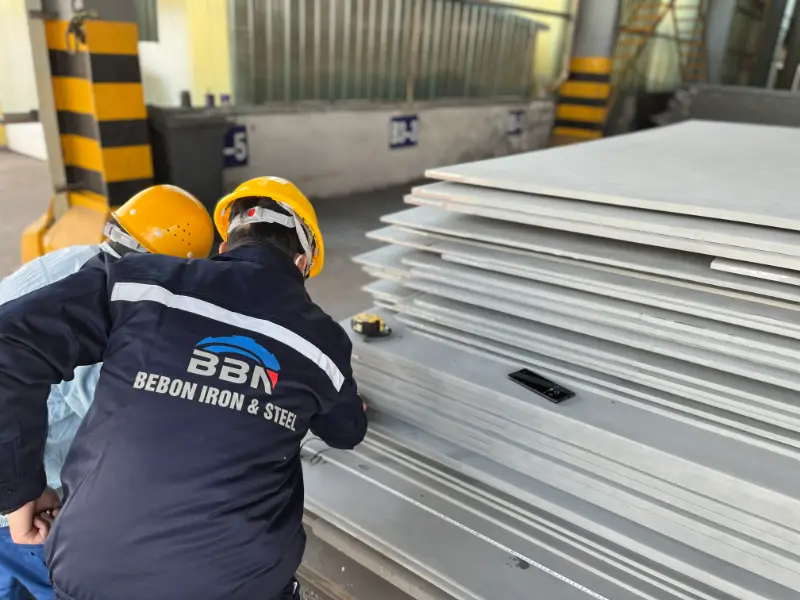
12Cr12 (1Cr12) Martensitic Stainless Steel Plate/Coil
12Cr12 (1Cr12) Martensitic Stainless Steel Plate/Coil - GB/T 4237
Get complete data for 12Cr12 (1Cr12) martensitic stainless steel plate and coil according to GB/T 4237. Chemical composition, mechanical properties, physical and thermal properties, international equivalents and application guide.
Hot rolling, annealing, quenching & tempering, cold working (machining)
- Phone : +8618037372205
- Email : [email protected]
- WhatsApp: Contact via Whtsapp
- WeChat: +8618037372205
12Cr12 Martensitic Stainless Steel Plate/Coil Introduction
12Cr12 (formerly 1Cr12) is a martensitic stainless steel defined in GB/T 4237 for hot-rolled stainless steel plates, sheets and strips. It combines moderate corrosion resistance with high strength and excellent toughness after heat treatment. The alloy features a minimum chromium content of 11.5%, which provides basic oxidation and corrosion resistance in mild environments (fresh water, steam, many organic chemicals).
- Heat treatable – can be hardened and tempered to a wide range of strengths.
- Good ductility and impact toughness in the quenched & tempered condition.
- Good weldability with proper preheating and post-weld heat treatment.
- Magnetic in all conditions.
- Used primarily for components requiring high mechanical loads and moderate corrosion resistance, such as turbine blades, valves and fasteners.
The steel is delivered in annealed condition and is typically further hardened by the end user.
12Cr12 Martensitic Stainless Steel Plate/Coil Chemical Composition
Chemical requirements according to GB/T 4237-2015 for martensitic stainless steel 12Cr12. The alloy is a low-carbon, chromium martensitic grade with controlled sulphur and phosphorus levels to ensure good hot workability and toughness. Nickel is not intentionally added but may be present as a residual element up to 0.60%.
| Element | Standard Value (%) | Remarks |
|---|---|---|
| Carbon (C) | ≤ 0.15 | – |
| Silicon (Si) | ≤ 1.00 | – |
| Manganese (Mn) | ≤ 1.00 | – |
| Phosphorus (P) | ≤ 0.040 | – |
| Sulphur (S) | ≤ 0.030 | – |
| Chromium (Cr) | 11.50 – 13.50 | Minimum 11.50 ensures martensitic structure |
| Nickel (Ni) | ≤ 0.60 | Residual element, not intentionally added |
12Cr12 Martensitic Stainless Steel Plate/Coil Thermal and Electrical Physical Properties
The following values are typical for martensitic stainless steel similar to AISI 410, representing the 12Cr12 grade in annealed condition. Data are compiled from published technical sources for 12% Cr martensitic stainless steels. Actual values may vary slightly with heat treatment and exact composition within the standard range.
| Property | Typical Value | Unit | Test Condition / Remarks |
|---|---|---|---|
| Density (ρ) | 7.70 | kg/dm³ (g/cm³) | At 20°C |
| Modulus of Elasticity (E) | 200 | GPa | At 20°C |
| Shear Modulus (G) | 78 | GPa | At 20°C |
| Poisson's Ratio (ν) | 0.28 | – | At 20°C |
| Thermal expansion coefficient (α, 20–100°C) | 10.5 ×10⁻⁶ | K⁻¹ | Mean coefficient between 20°C and 100°C |
| Thermal expansion coefficient (α, 20–300°C) | 11.5 ×10⁻⁶ | K⁻¹ | Mean coefficient between 20°C and 300°C |
| Thermal expansion coefficient (α, 20–500°C) | 12.2 ×10⁻⁶ | K⁻¹ | Mean coefficient between 20°C and 500°C |
| Thermal conductivity (λ) | 25.0 (at 100°C) | W/(m·K) | Typical; decreases with rising temperature |
| Specific heat capacity (c) | 460 | J/(kg·K) | At 20–100°C |
| Electrical resistivity (ρₑ) | 0.57 | µΩ·m | At 20°C |
12Cr12 Martensitic Stainless Steel Plate/Coil Mechanical Properties
Mechanical properties as specified in GB/T 4237-2015 for 12Cr12 in annealed condition (heat treatment: slow cooling from 800–900°C or rapid cooling from approximately 750°C). These values apply to hot-rolled plates and strips. The tensile test is carried out at room temperature. Hardness is measured as Brinell (HBW), but conversion to Rockwell B (HRB) or Vickers (HV) is possible.
| Property | Minimum / Typical Value | Unit | Test Condition |
|---|---|---|---|
| Yield Strength (Rp0.2) | ≥ 205 | MPa | Room temperature, annealed |
| Tensile Strength (Rm) | ≥ 450 | MPa | Room temperature, annealed |
| Elongation (A, gauge length 50 mm) | ≥ 20 | % | Room temperature, annealed |
| Brinell Hardness (HBW) | ≤ 217 | HBW | Annealed; approximate conversion: ≤ 96 HRB, ≤ 230 HV |
| Bend Test (bending angle 180°, bend diameter) | d=2a (a=plate thickness) | – | Transverse specimens, no cracks |
12Cr12 Martensitic Stainless Steel Plate/Coil Exact International Equivalent Designations for 12Cr12
| Country / Region | Standard | Grade / Designation | Remarks |
|---|---|---|---|
| China | GB/T 4237 | 12Cr12 (1Cr12) | Original definition, martensitic stainless steel |
| United States | ASTM A240/A240M | 410 (UNS S41000) | Widely used martensitic grade, similar carbon and chromium content |
| European Union | EN 10088-2 | 1.4006 (X12Cr13) | Similar composition; minor differences in allowed impurity limits |
| Japan | JIS G4304 | SUS410 | Equivalent for hot-rolled plates and sheets |
| International | ISO 15510 | X12Cr13 | Basic international grade matching the 12% Cr martensitic type |
12Cr12 Martensitic Stainless Steel Plate/Coil Application Introduction
12Cr12 offers an excellent combination of mechanical properties and moderate corrosion resistance at a relatively low cost. It is easy to machine in the annealed condition and can be hardened to a wide range of strengths.
- Ideal for parts where high tensile and fatigue strength are needed along with some resistance to atmospheric corrosion, steam and water.
- Not recommended for strong acids or chloride-rich environments that can cause pitting.
- Typical final heat treatment: quenching from 950-1050°C and tempering at 600-750°C for optimum toughness and strength.
Product Applications: Hot-rolled plates and coils for further fabrication, Forged bars and rings, Wire and drawn products, Turbine blades and buckets, Valve trim parts (stems, seats, discs), Fasteners (bolts, nuts, screws), Surgical and dental instruments
Processed into products: Steam turbine blade profiles, Pump shafts and impellers, Valve seats and stems, High-strength bolts and studs, Cutting blades and knives, Wear-resistant bushings and sleeves
Application industries: Power generation (steam turbines, gas turbines), Pumps & valves manufacturing, General engineering (bolting, shafts, gears), Cutlery and kitchen tools, Automotive (exhaust components, trim), Food processing equipment (non-corrosive applications)
12Cr12 Martensitic Stainless Steel Plate/Coil Similar / Comparable Materials for Property Reference
| Country / Region | Standard | Grade | Remarks |
|---|---|---|---|
| China | GB/T 1220 | 12Cr13 (1Cr13) | Slightly lower carbon (≤0.15), similar Cr; better ductility but lower hardenability |
| China | GB/T 1220 | 20Cr13 (2Cr13) | Higher carbon (0.16-0.25); higher strength after hardening, but lower toughness and corrosion resistance |
| United States | ASTM A240 | 410S (S41008) | Low-carbon version of 410; non-hardening, used where weldability is required |
| European Union | EN 10088-3 | 1.4021 (X20Cr13) | Higher carbon version of X12Cr13; used for higher hardness requirements |
Notes:
The data in the mechanical properties table refer to the annealed condition as per the standard. When the steel is subsequently quenched and tempered by the fabricator, strength levels can be significantly increased (e.g., Rm up to 700-850 MPa) with corresponding reduction in elongation. For welded structures, preheat (200-300°C) and post-weld heat treatment (680-750°C) are strongly recommended to avoid cracking. The alloy is magnetic in all conditions.
- Share



