
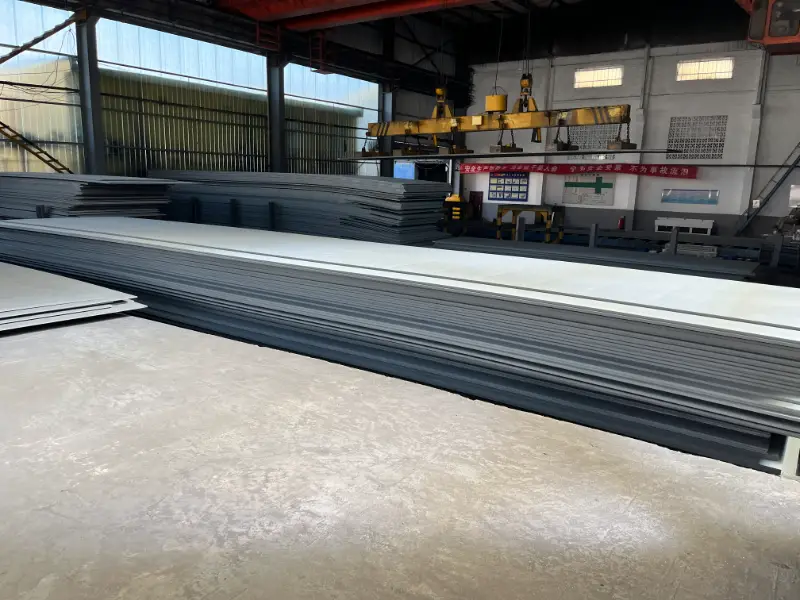
022Cr23Ni4MoCuN Duplex Stainless Steel Plate/Coil
022Cr23Ni4MoCuN Duplex Stainless Steel Plate/Coil - GB/T 4237 S23043 Data
Comprehensive technical data for 022Cr23Ni4MoCuN (S23043) austenitic-ferritic duplex stainless steel according to GB/T 4237, including chemical composition, mechanical properties, thermal and electrical physical properties, international equivalents, and application guidance.
Welding, forming, machining, grinding, heat treatment (solution annealing)
- Phone : +8618037372205
- Email : [email protected]
- WhatsApp: Contact via Whtsapp
- WeChat: +8618037372205
022Cr23Ni4MoCuN Duplex Stainless Steel Plate/Coil Introduction
022Cr23Ni4MoCuN (digital grade S23043) under the Chinese standard GB/T 4237 is an austenitic-ferritic (duplex) stainless steel with a carefully balanced microstructure of approximately equal parts austenite and ferrite. It contains low carbon (≤0.030%), chromium (22-24%), nickel (3.5-5.5%), and deliberate additions of molybdenum, copper, and nitrogen to enhance corrosion resistance and strength. This grade offers a compelling combination of high mechanical strength (yield strength ≥400 MPa, tensile strength ≥600 MPa), good toughness, excellent resistance to stress corrosion cracking, and improved pitting corrosion resistance compared to standard 304L austenitic stainless steel. It is typically supplied in the solution-annealed condition (980–1040°C, rapid cooling) as plate, coil, or strip. Its balanced properties make it a cost-effective alternative for many applications in chemical processing, architecture, marine environments, and pressure vessel construction where both high strength and corrosion resistance are required.
022Cr23Ni4MoCuN Duplex Stainless Steel Plate/Coil Chemical Composition
The chemical composition of 022Cr23Ni4MoCuN is defined by GB/T 4237, ensuring a balanced duplex microstructure. The low carbon content maximizes intergranular corrosion resistance, while chromium, molybdenum, and nitrogen contribute to pitting and crevice corrosion resistance. Copper is added to enhance resistance to reducing acids and improve general corrosion performance. Nickel balances the austenite-ferrite phase ratio. All values are in weight percent (mass fraction).
| Element | Standard Value (wt%) | Remarks |
|---|---|---|
| Carbon (C) | ≤0.030 | Low carbon for improved weldability and corrosion resistance |
| Silicon (Si) | ≤1.00 | Deoxidizer, contributes to strength |
| Manganese (Mn) | ≤2.50 | Austenite stabilizer, improves hot workability |
| Phosphorus (P) | ≤0.035 | Impurity, controlled for toughness |
| Sulfur (S) | ≤0.030 | Impurity, kept low for ductility |
| Chromium (Cr) | 22.00 – 24.00 | Key element for corrosion and oxidation resistance |
| Nickel (Ni) | 3.50 – 5.50 | Austenite stabilizer, balances microstructure |
| Molybdenum (Mo) | 0.10 – 0.60 | Improves pitting and crevice corrosion resistance |
| Copper (Cu) | 0.10 – 0.60 | Enhances resistance to reducing acids |
| Nitrogen (N) | 0.05 – 0.20 | Increases strength and pitting resistance |
022Cr23Ni4MoCuN Duplex Stainless Steel Plate/Coil Thermal and Electrical Physical Properties
Typical physical properties for 022Cr23Ni4MoCuN / S32304 are provided for design and engineering guidance. These values are representative for the duplex structure at ambient and moderately elevated temperatures. Thermal expansion is intermediate between austenitic and ferritic stainless steels, and thermal conductivity is higher than that of common austenitic grades, which benefits heat exchanger applications.
| Property | Typical Value | Unit | Test Condition |
|---|---|---|---|
| Density (ρ) | 7.8 | g/cm³ | 20°C |
| Elastic Modulus (E) | 200 | GPa | 20°C |
| Shear Modulus (G) | 77 | GPa | 20°C, calculated from E and ν |
| Poisson's Ratio (ν) | 0.3 | — | 20°C |
| Thermal Expansion Coefficient (α) | 13.0 | µm/m·°C | 20–100°C |
| Thermal Conductivity (λ) | 15 | W/m·K | 20°C |
| Specific Heat Capacity (c) | 500 | J/kg·K | 20°C |
| Electrical Resistivity (ρ_e) | 0.80 | µΩ·m | 20°C |
022Cr23Ni4MoCuN Duplex Stainless Steel Plate/Coil Mechanical Properties
Mechanical properties are obtained after solution annealing at 980–1040°C and rapid cooling. The duplex structure provides significantly higher yield strength than standard austenitic grades. Data apply to plate/coil products per GB/T 4237. For bend test, a tighter bend radius (d=a) applies to thickness less than 3 mm. Hardness values are maximum limits in the annealed condition.
| Property | Standard Requirement | Unit | Test Condition |
|---|---|---|---|
| Yield Strength (Rp0.2) | ≥400 | MPa | Solution annealed, room temperature, tensile test |
| Tensile Strength (Rm) | ≥600 | MPa | Solution annealed, room temperature, tensile test |
| Elongation (A) | ≥25 | % | Gauge length 50 mm, thickness >3 mm |
| Bend Test (180°) | d=2a (thickness ≥3 mm); d=a (thickness <3 mm) | — | According to GB/T 4237, room temperature |
| Hardness, Brinell (HBW) | ≤290 | — | After solution annealing |
| Hardness, Rockwell B (HRB) | ≤31 | — | After solution annealing |
| Hardness, Rockwell C (HRC) | ≤32 | — | After solution annealing |
| Hardness, Vickers (HV) | ≤300 | — | After solution annealing |
022Cr23Ni4MoCuN Duplex Stainless Steel Plate/Coil Exact Equivalent Material Standards and Substitution Grades
| Country/Region | Standard | Designation/Grade | Remarks |
|---|---|---|---|
| China | GB/T 4237 | 022Cr23Ni4MoCuN (S23043) | Original grade specified in GB/T 4237 |
| European Union | EN 10088-2 | X2CrNiN23-4 (1.4362) | Fully equivalent; chemical and mechanical properties align |
| USA | ASTM A240/A240M | UNS S32304 | Equivalent duplex stainless steel; also in ASME II A SA-240 |
| International | ISO 15510 | X2CrNiN23-4 | Internationally recognized equivalent |
022Cr23Ni4MoCuN Duplex Stainless Steel Plate/Coil Application Introduction
022Cr23Ni4MoCuN duplex stainless steel is selected for applications requiring a superior combination of strength, toughness, and resistance to stress corrosion cracking compared to standard austenitic grades. Its good weldability and formability allow fabrication into a wide range of components. The balanced duplex structure makes it particularly suitable for service in chloride-containing environments and moderately acidic media.
Product Applications: Storage tanks and pressure vessels, Plate-type heat exchangers, Piping systems and fittings, Structural sections and bridges, Architectural cladding and facades, Desalination evaporators, Reaction vessels and columns
Processed into products: Heat exchanger plates and shells, Pump shafts and impellers, Valves and valve bodies, Flanges and gaskets, Welded pipe and tube assemblies, Fasteners (bolts, nuts), Structural support beams, Column internals and trays
Application industries: Chemical and petrochemical processing, Oil and gas (offshore platforms, piping), Pulp and paper (digesters, bleaching equipment), Desalination and water treatment, Architecture and construction (structural components, bridges), Marine engineering (boat shafts, propeller shafts), Heat exchanger and pressure vessel manufacturing, Food and beverage processing (tanks)
022Cr23Ni4MoCuN Duplex Stainless Steel Plate/Coil Similar / Alternative Materials Recommendation
| Country/Region | Standard | Designation/Grade | Remarks |
|---|---|---|---|
| China / EU / USA | GB/T 4237 / EN 10088-2 / ASTM A240 | 022Cr22Ni5Mo3N (S31803) / 1.4462 / UNS S32205 | Higher strength and corrosion resistance but also higher alloy cost; suitable for more aggressive environments. |
| China / EU / USA | GB/T 4237 / EN 10088-2 / ASTM A240 | 022Cr19Ni5Mo3Si2N (S21953) / 1.4418 / UNS S31500 | Lower nickel, similar corrosion resistance; can be a cost-saving alternative in less severe conditions. |
| China / EU | GB/T 4237 / EN 10088-2 | 06Cr19Ni10 (304) / 1.4301 / UNS S30400 | Austenitic grade with lower strength but excellent ductility; used when high strength is not critical and lower cost is needed. |
| International | Various | UNS S32101 (LDX 2101®) | Lean duplex with lower Ni and Mo; comparable strength but lower corrosion resistance; economical alternative. |
Notes:
Duplex stainless steel 022Cr23Ni4MoCuN requires careful control of welding parameters and interpass temperature to maintain a balanced austenite-ferrite ratio and avoid precipitation of detrimental intermetallic phases. Post-weld heat treatment is generally not required for thin sections, but solution annealing may be applied for thick sections or critical service. The steel is magnetic due to the ferrite phase. For hot forming, temperature should be kept in the range of 1150–950°C followed by final solution annealing. Cold forming is possible but requires higher forces than austenitic grades; springback must be considered. The grade can be supplied with various surface finishes, including No.1, 2B, BA, and No.4. Typical available thickness range for plate is 3–60 mm, and for coil/strip 0.5–6.0 mm. Always refer to the full standard for detailed tolerances and testing requirements.
- Share



