
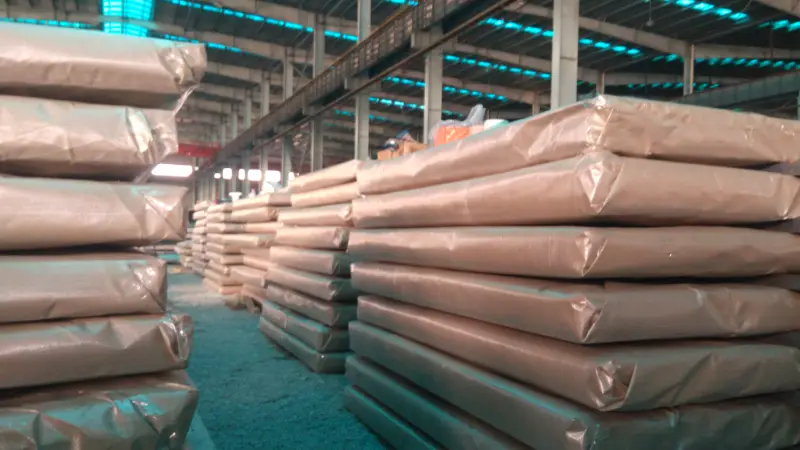
022Cr25Ni6Mo2N Duplex Stainless Steel Plate/Coil
022Cr25Ni6Mo2N Duplex Stainless Steel Plate/Coil - High Strength & Corrosion Resistant
Comprehensive data for 022Cr25Ni6Mo2N austenitic-ferritic stainless steel per GB/T 4237, including chemistry, mechanical and physical properties, international equivalents, and applications.
Hot rolling, cold rolling, forming, welding, machining, solution annealing
- Phone : +8618037372205
- Email : [email protected]
- WhatsApp: Contact via Whtsapp
- WeChat: +8618037372205
022Cr25Ni6Mo2N Duplex Stainless Steel Plate/Coil Introduction
022Cr25Ni6Mo2N is a low-carbon duplex (austenitic-ferritic) stainless steel standardized in GB/T 4237 for hot-rolled plates and coils. With approximately 25% chromium, 6% nickel, 2% molybdenum and nitrogen addition, it offers a balanced microstructure of roughly equal parts austenite and ferrite. This gives the material:
- High yield strength (typically twice that of standard austenitic grades)
- Excellent resistance to pitting, crevice corrosion and stress corrosion cracking in chloride-containing environments
- Good weldability and toughness
- Low carbon content minimizes carbide precipitation during welding
It is widely used in aggressive environments where both mechanical strength and corrosion resistance are critical.
022Cr25Ni6Mo2N Duplex Stainless Steel Plate/Coil Chemical Composition
Chemical composition limits according to GB/T 4237 and GB/T 20878 for grade 022Cr25Ni6Mo2N (UNS S22553). Iron is balance.
| Element | Standard Value | Remark |
|---|---|---|
| C | ≤0.03 | Max |
| Si | ≤1.00 | Max |
| Mn | ≤2.00 | Max |
| P | ≤0.035 | Max |
| S | ≤0.030 | Max |
| Cr | 24.0–26.0 | Range |
| Ni | 5.5–7.5 | Range |
| Mo | 1.5–2.5 | Range |
| N | 0.08–0.20 | Range |
| Fe | Balance |
022Cr25Ni6Mo2N Duplex Stainless Steel Plate/Coil Thermal and Electrical Physical Properties
Typical physical properties for duplex stainless steel 022Cr25Ni6Mo2N in the solution annealed condition. These values are representative and may vary slightly with processing.
| Property | Typical Value | Unit | Test Condition |
|---|---|---|---|
| Density (ρ) | 7.8 | g/cm³ | 20°C |
| Elastic Modulus (E) | 200 | GPa | 20°C |
| Shear Modulus (G) | 77 | GPa | 20°C (calculated) |
| Poisson's Ratio (ν) | 0.3 | — | 20°C |
| Thermal Expansion Coefficient (α) | 13.5 | 10-6/K | 20–100°C |
| Thermal Expansion Coefficient (α) | 14.0 | 10-6/K | 20–300°C |
| Thermal Conductivity (λ) | 15 | W/(m·K) | 20°C |
| Thermal Conductivity (λ) | 17 | W/(m·K) | 100°C |
| Specific Heat Capacity | 500 | J/(kg·K) | 20°C |
| Electrical Resistivity (ρe) | 0.80 | Ω·mm²/m | 20°C |
022Cr25Ni6Mo2N Duplex Stainless Steel Plate/Coil Mechanical Properties
Minimum tensile properties at room temperature for solution annealed plates as per GB/T 4237. Values apply to the specified thickness ranges. Hardness is for reference.
| Property | Standard Requirement | Unit | Test Condition |
|---|---|---|---|
| Tensile Strength (Rm) | ≥620 | MPa | Solution annealed, plate thickness ≤75 mm |
| Yield Strength (Rp0.2) | ≥450 | MPa | Solution annealed, plate thickness ≤75 mm |
| Elongation (A) | ≥25 | % | Solution annealed, plate thickness ≤75 mm, gauge length 50 mm |
| Hardness | ≤290 | HBW | Solution annealed, all thicknesses |
| Tensile Strength (Rm) | ≥590 | MPa | Solution annealed, plate thickness >75 mm |
| Yield Strength (Rp0.2) | ≥390 | MPa | Solution annealed, plate thickness >75 mm |
| Elongation (A) | ≥20 | % | Solution annealed, plate thickness >75 mm, gauge length 50 mm |
022Cr25Ni6Mo2N Duplex Stainless Steel Plate/Coil Fully Equivalent Material Standards and Substitutable Grades
| Country/Region | Standard | Grade | Remark |
|---|---|---|---|
| China | GB/T 4237 | 022Cr25Ni6Mo2N | Original designation, plate and coil |
| USA | ASTM A240/A240M | UNS S31200 | Identical chemical composition and equivalent mechanical properties; widely used duplex stainless steel |
022Cr25Ni6Mo2N Duplex Stainless Steel Plate/Coil Application Introduction
022Cr25Ni6Mo2N is engineered for service in aggressive chloride-containing environments where high strength, good weldability and excellent resistance to pitting and stress corrosion cracking are required. Its duplex microstructure allows for thinner wall thicknesses compared to austenitic grades, saving weight and cost. It is suitable for moderately high temperatures (up to ~300°C) but not for prolonged use above this range due to potential embrittlement.
Product Applications: Hot-rolled plates and coils, Welded and seamless pipes (fabricated from plate), Heat exchangers, Storage tanks, Pressure vessels, Structural profiles (e.g., angles, beams), Flanges and fittings
Processed into products: Pump shafts and impellers, Valve bodies and internals, Fasteners (bolts, studs, nuts), Flanges and gaskets, Welded assemblies and support structures, Desalination system components (brine heaters, evaporator shells), Chemical process equipment internals
Application industries: Oil & Gas (offshore platforms, subsea equipment, piping systems), Chemical and petrochemical processing (pressure vessels, reactors, heat exchangers), Marine engineering (shafts, propeller, structural components), Pulp and paper (digesters, bleaching equipment, liquor tanks), Desalination (multistage flash and reverse osmosis plants), Power generation (flue gas desulfurization, cooling water systems), Water treatment
022Cr25Ni6Mo2N Duplex Stainless Steel Plate/Coil Similar or Alternative Stainless Steels
| Country/Region | Standard | Grade | Remark |
|---|---|---|---|
| USA | ASTM A240 | UNS S32550 (Ferralium 255) | Higher Mo (~3%) and Cu addition, providing greater pitting resistance but not a direct substitute due to cost; can be considered where extra corrosion resistance is needed. |
| USA | ASTM A240 | UNS S32750 (2507) | Super duplex with ~7% Ni, 4% Mo, higher N; significantly higher strength and corrosion resistance; overqualified for many 022Cr25Ni6Mo2N applications. |
| China/EU | GB/T 4237 / EN 10088-2 | 022Cr22Ni5Mo3N / 1.4462 (2205) | Lower chromium (22%) but similar molybdenum; most common duplex grade; lower strength and corrosion resistance, but widely available; can be an economic alternative in less demanding environments. |
| Japan | JIS G4304 | SUS 329J4L | Similar duplex with 25Cr-6Ni-3Mo-N; may be considered if locally available, but Mo content is slightly higher. |
Notes:
Welding: Requires filler metals with matching or slightly higher alloy content (e.g., ER2594 or ER2209); interpass temperature should be limited to prevent excessive ferrite; post-weld heat treatment is normally not required. Magnetism: Duplex stainless steels are ferromagnetic due to the ferrite phase. Heat treatment: Solution annealing at 1020–1100°C followed by rapid water quenching is essential to restore phase balance and corrosion resistance after hot forming or welding. This material is not recommended for use at temperatures above 300°C due to risk of 475°C embrittlement and sigma phase formation. For detailed fabrication guidelines, refer to published manufacturer data and relevant codes.
- Share



