
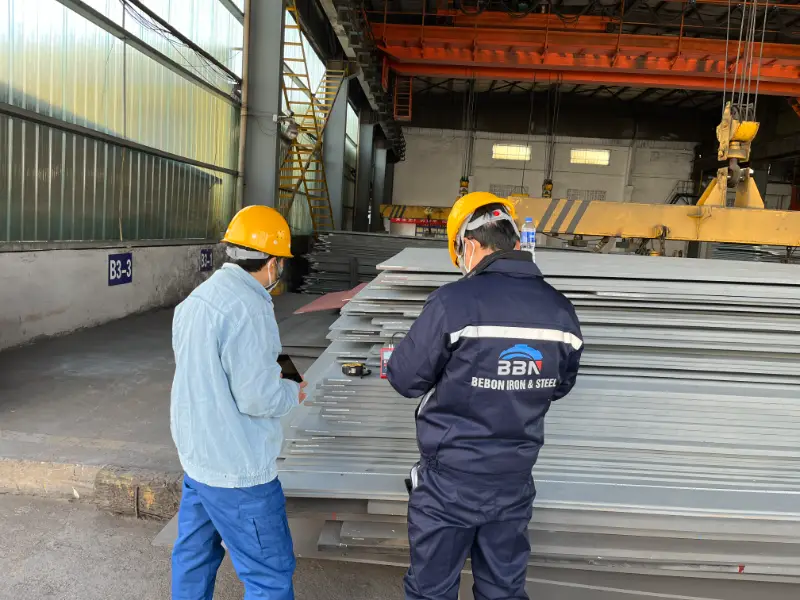
022Cr23Ni5Mo3N Duplex Stainless Steel
022Cr23Ni5Mo3N Duplex Stainless Steel: Superior Strength & Corrosion Resistance for Harsh Environments
Explore the properties of 022Cr23Ni5Mo3N duplex stainless steel under GB/T 4237 standard. Equivalent to UNS S32205, this austenitic-ferritic grade offers exceptional mechanical strength and chloride stress corrosion cracking resistance, ideal for marine, chemical, and offshore applications.
Hot rolling, cold rolling, welding, forging, machining (with appropriate tooling), forming
- Phone : +8618037372205
- Email : [email protected]
- WhatsApp: Contact via Whtsapp
- WeChat: +8618037372205
022Cr23Ni5Mo3N Duplex Stainless Steel Introduction
022Cr23Ni5Mo3N is an austenitic-ferritic duplex stainless steel defined in GB/T 4237 (China), commonly supplied as hot-rolled plate and coil. Combining approximately equal parts austenite and ferrite, this grade delivers a unique blend of high strength, excellent pitting and crevice corrosion resistance, and resistance to stress corrosion cracking in chloride-containing environments. Its low carbon content and nitrogen addition enhance weldability and intergranular corrosion resistance. Widely regarded as the counterpart to the internationally known UNS S32205 (also S31803) and EN 1.4462, it is a cost-effective solution for demanding applications where both mechanical integrity and corrosion performance are critical.
022Cr23Ni5Mo3N Duplex Stainless Steel Chemical Composition
The following chemical composition conforms to GB/T 4237-2015 for grade 022Cr23Ni5Mo3N (designated as S22053 in the unified numbering system). All values are maximum unless a range is indicated. The balanced addition of Cr, Mo, and N ensures a stable duplex structure and superior pitting resistance equivalent number (PREN).
| Element | Standard Value | Remarks |
|---|---|---|
| C | ≤ 0.030 | Low carbon for improved weldability and intergranular corrosion resistance |
| Si | ≤ 1.00 | Silicon content |
| Mn | ≤ 2.00 | Manganese content |
| P | ≤ 0.030 | Phosphorus is a controlled impurity |
| S | ≤ 0.020 | Sulfur is a controlled impurity |
| Cr | 22.0 - 23.0 | Chromium provides passivity and corrosion resistance |
| Ni | 4.50 - 6.50 | Nickel promotes austenite formation and toughness |
| Mo | 3.00 - 3.50 | Molybdenum enhances pitting and crevice corrosion resistance |
| N | 0.14 - 0.20 | Nitrogen strengthens, enhances pitting resistance, and stabilizes austenite |
022Cr23Ni5Mo3N Duplex Stainless Steel Thermal and Electrical Physical Properties
These physical properties are representative for 022Cr23Ni5Mo3N (UNS S32205) in the solution-annealed condition. Values may vary slightly depending on exact composition and temperature. Data are sourced from recognized duplex stainless steel technical literature and align with typical S32205/1.4462 publications.
| Property | Typical Value | Unit | Test Condition / Temperature |
|---|---|---|---|
| Density (ρ) | 7.8 | g/cm³ | At 20°C |
| Elastic modulus (E) | 200 | GPa | At 20°C; vary slightly with temperature |
| Shear modulus (G) | 77 | GPa | At 20°C, calculated from E and Poisson's ratio |
| Poisson's ratio (ν) | 0.3 | - | At 20°C, elastic region |
| Thermal expansion coefficient (α) | 13.0 | 10⁻⁶/K | 20 - 100°C |
| Thermal expansion coefficient (α) | 13.5 | 10⁻⁶/K | 20 - 200°C |
| Thermal expansion coefficient (α) | 14.0 | 10⁻⁶/K | 20 - 300°C |
| Thermal conductivity (λ) | 15 | W/(m·K) | At 20°C |
| Thermal conductivity (λ) | 17 | W/(m·K) | At 100°C |
| Thermal conductivity (λ) | 19 | W/(m·K) | At 200°C |
| Specific heat capacity | 500 | J/(kg·K) | At 20°C |
| Electrical resistivity (ρ_e) | 0.80 | Ω·mm²/m (or μΩ·m) | At 20°C |
022Cr23Ni5Mo3N Duplex Stainless Steel Mechanical Properties
Mechanical properties are tested at room temperature on specimens machined from plate/coil in the solution-annealed and quenched delivery condition. The values comply with GB/T 4237-2015 for plate thickness up to 75 mm. Impact toughness is measured using Charpy V-notch specimens. The duplex structure ensures a favorable combination of strength and ductility.
| Property | Standard Requirement | Unit | Test Condition |
|---|---|---|---|
| Tensile Strength (Rm) | ≥ 620 | MPa | Room temperature, transverse specimen |
| Yield Strength (ReH) (0.2% offset) | ≥ 450 | MPa | Room temperature, transverse specimen |
| Elongation after fracture (A) | ≥ 25 | % | Gauge length 50 mm (or 5.65√So) |
| Bend test (bend diameter) | No cracking | - | 180° bend, bend diameter = 3t (t = plate thickness) |
| Impact toughness (KV2) | ≥ 60 (mean), ≥ 40 (single) | J | Charpy V-notch, -40°C (commonly specified for offshore applications, though standard may use 20°C; this is a common supplementary requirement) |
| Hardness (HBW) | ≤ 293 | HBW | Brinell hardness, typical maximum for duplex |
022Cr23Ni5Mo3N Duplex Stainless Steel Fully Equivalent Material Standards and Substitutable Grades
| Country / Region | Standard | Grade | Remarks |
|---|---|---|---|
| China | GB/T 4237, GB/T 20878 | 022Cr23Ni5Mo3N (S22053) | Original designation |
| USA | ASTM A240/A240M | UNS S32205 | Identical chemical and mechanical requirements; also S31803 with narrower chemistry |
| Europe | EN 10088-2, EN 10028-7 | 1.4462 (X2CrNiMoN22-5-3) | Fully equivalent; widely used in pressure vessel construction |
| Japan | JIS G 4304,JIS G 4305 | SUS329J3L | Equivalent duplex grade; check individual standard for minor variations |
| International (ISO) | ISO 9444-2 | X2CrNiMoN22-5-3 | Chemically identical to EN 1.4462 |
| International (NACE) | NACE MR0175/ISO 15156 | UNS S32205 (as material class) | Approved for sour service under specific hardness and environmental limits |
022Cr23Ni5Mo3N Duplex Stainless Steel Application Introduction
022Cr23Ni5Mo3N duplex stainless steel excels in environments requiring high strength combined with excellent resistance to chloride stress corrosion cracking (SCC). Its dual-phase microstructure allows for weight reduction and extended service life in aggressive media. The material is readily weldable and formable, making it suitable for a wide array of industrial applications.
Product Applications: Hot-rolled plates and sheets for pressure vessels and structural fabrication, Cold-rolled coils for precise thin-gauge components, Seamless and welded tubes for heat exchangers and umbilicals, Forged bars and rings for flanges and valves, Pre-fabricated modules and skids for offshore topsides, Clad plate (duplex as cladding layer on carbon steel)
Processed into products: Heat exchanger tube sheets and baffles, Pressure vessel shells and heads, Piping spools and flanges, Centrifuge and pump components (impellers, casings), Subsea manifolds and connectors, Desalination brine ducting and evaporator bodies, Bridge expansion joints and bearing plates
Application industries: Oil & Gas (offshore platforms, subsea pipelines, flowlines, heat exchangers), Chemical Processing (reactors, storage tanks, piping systems handling chlorides and acids), Desalination (evaporators, brine heaters, high-pressure piping), Pulp & Paper (digesters, bleach washers, equipment exposed to corrosive bleaching chemicals), Marine Engineering (propeller shafts, fasteners, structural components), Power Generation (flue gas desulfurization units, cooling water systems), Architecture and Construction (bridge components, swimming pool structures, coastal handrails)
022Cr23Ni5Mo3N Duplex Stainless Steel Similar / Alternative Material Recommendations
| Country / Region | Standard | Grade | Remarks |
|---|---|---|---|
| China | GB/T 4237 | 022Cr25Ni7Mo4N (S25073) | Super duplex with higher Cr, Mo, N content; superior corrosion resistance but higher alloy cost |
| USA | ASTM A240 | UNS S31803 | Similar to S32205 but with slightly lower minimum N and Cr; may not satisfy all S32205 requirements |
| Europe | EN 10088-2 | 1.4410 (X2CrNiMoN25-7-4) | Super duplex grade with better pitting resistance; typically used for more aggressive chloride environments |
| Japan | JIS G4304 | SUS329J4L | Duplex grade with comparable corrosion resistance; often interchangeable with S32205 |
| Various | Common austenitic stainless | 316L (UNS S31603) | Lower strength but good general corrosion resistance; may be substituted where duplex strength is not required |
Notes:
Welding: 022Cr23Ni5Mo3N can be welded by most common processes (GTAW, GMAW, SMAW, SAW). Minimum heat input and interpass temperature control (<150°C) are critical to avoid excessive ferrite and intermetallic precipitation. Filler metals matching or over-alloyed (e.g., ER2209, ER2594 for super duplex) are recommended. Heat treatment: Solution annealing at 1020-1100°C followed by rapid water quenching is mandatory to restore phase balance and corrosion resistance after hot forming or welding. Corrosion testing: For sour service (H2S), strict compliance with NACE MR0175/ISO 15156 hardness limits (HRC 28 max) and corrosion testing (ASTM G48) is often required. Surface condition: Pickled and passivated surfaces offer the best corrosion performance. This grade is included in the Pressure Equipment Directive (PED) harmonized material standards.
- Share



