
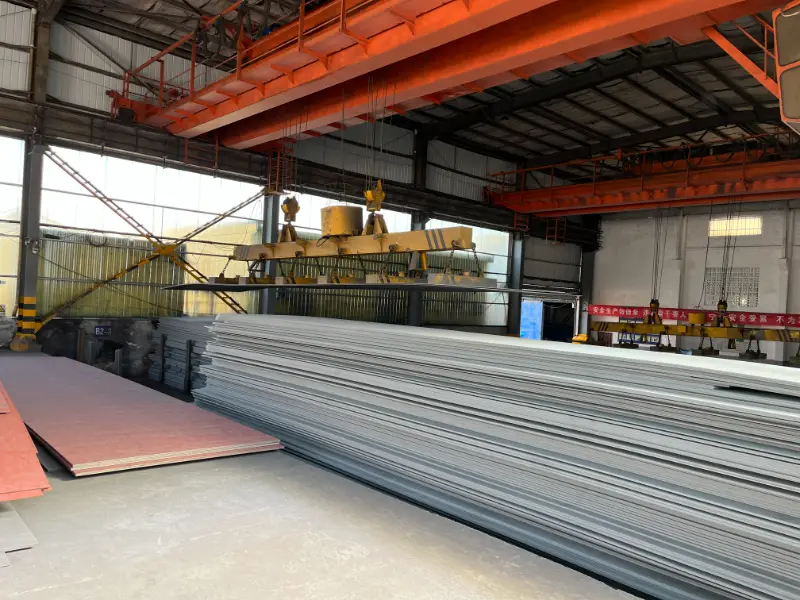
022Cr17Ni7N Stainless Steel
022Cr17Ni7N Stainless Steel: High-Strength Austenitic Grade for Structural Applications
Explore the properties of 022Cr17Ni7N, a low-carbon, nitrogen-strengthened austenitic stainless steel conforming to GB/T 4237, ideal for cold-rolled plates and coils requiring high strength and good corrosion resistance.
Cold Forming, Hot Forming, Laser Cutting, Plasma Cutting, Machining, Welding (TIG, MIG, Resistance).
- Phone : +8618037372205
- Email : [email protected]
- WhatsApp: Contact via Whtsapp
- WeChat: +8618037372205
022Cr17Ni7N Stainless Steel Introduction
022Cr17Ni7N is a nitrogen-alloyed austenitic stainless steel specified in the GB/T 4237 standard for hot-rolled and cold-rolled stainless steel plate, sheet, and strip. This grade is characterized by a low carbon content for enhanced intergranular corrosion resistance after welding, and the addition of nitrogen to significantly increase strength while maintaining good ductility. It exhibits a high work-hardening rate, allowing for substantial strength gains through cold forming. The material offers a favorable combination of high yield and tensile strength, excellent toughness, and good general corrosion resistance in moderately aggressive environments. It is non-magnetic in the annealed condition but may become slightly magnetic after heavy cold working. Typical applications are in the structural, automotive, and railway industries where lightweight, high-strength, and corrosion-resistant solutions are required.
022Cr17Ni7N Stainless Steel Chemical Composition
The chemical composition for grade 022Cr17Ni7N is as specified in GB/T 4237. It features a low carbon content (≤0.03%) to improve welding performance, and a controlled addition of nitrogen to replace some nickel, providing solid-solution strengthening. Chromium is the primary element for corrosion resistance, while nickel stabilizes the austenitic structure. Manganese aids in nitrogen solubility and further stabilizes the austenite.
- Values represent maximum limits unless a range is specified.
- Residual elements are controlled to standard melting practices.
| Element | Standard Value (wt%) | Remarks |
|---|---|---|
| Carbon (C) | ≤0.030 | Max |
| Silicon (Si) | ≤1.00 | Max |
| Manganese (Mn) | 6.50–9.00 | Range |
| Phosphorus (P) | ≤0.045 | Max |
| Sulfur (S) | ≤0.015 | Max |
| Chromium (Cr) | 16.00–18.00 | Range |
| Nickel (Ni) | 3.50–5.50 | Range |
| Nitrogen (N) | 0.15–0.30 | Range |
| Iron (Fe) | Balance | Remainder |
022Cr17Ni7N Stainless Steel Physical and Thermal Properties
These physical properties are typical reference values for 022Cr17Ni7N austenitic stainless steel and are not mandatory standard requirements. Properties can vary with heat treatment and cold working condition. Thermal expansion and conductivity are critical for welding and thermal cycling applications. The grade is non-magnetic in the annealed state.
- Density is slightly lower than standard 304.
- Electrical and thermal conductivity are lower than carbon steels.
| Property | Typical Value | Unit | Test Condition |
|---|---|---|---|
| Density (ρ) | 7.8 | g/cm³ | At 20°C |
| Modulus of Elasticity (E) | 196 | GPa | At 20°C |
| Shear Modulus (G) | 76 | GPa | At 20°C |
| Poisson's Ratio (ν) | 0.3 | —— | At 20°C |
| Mean Thermal Expansion Coefficient (α) | 16.5 | 10⁻⁶/K | 20°C to 100°C |
| Mean Thermal Expansion Coefficient (α) | 17.5 | 10⁻⁶/K | 20°C to 300°C |
| Mean Thermal Expansion Coefficient (α) | 18.5 | 10⁻⁶/K | 20°C to 500°C |
| Thermal Conductivity (λ) | 15 | W/(m·K) | At 20°C |
| Thermal Conductivity (λ) | 17 | W/(m·K) | At 200°C |
| Thermal Conductivity (λ) | 19 | W/(m·K) | At 400°C |
| Specific Heat Capacity (c) | 500 | J/(kg·K) | At 20°C |
| Electrical Resistivity (ρe) | 0.75 | μΩ·m | At 20°C |
022Cr17Ni7N Stainless Steel Mechanical Properties at Room Temperature
Mechanical properties for GB/T 4237 plate/coil in the solution-annealed condition (1D/2D/2B surface). Yield and tensile strength requirements depend on product thickness and delivery condition. The values below are typical for solution-annealed plate. Cold-worked tempers (e.g., 1/4 Hard, 1/2 Hard) exhibit significantly higher strength but lower elongation. Test pieces are typically oriented transversely.
- ReH: Upper Yield Strength (Yield Point) or Rp0.2: 0.2% Proof Strength.
- Rm: Tensile Strength.
- A: Percentage Elongation after Fracture.
| Property | Required Value | Unit | Test Condition |
|---|---|---|---|
| Yield Strength (Rp0.2) | ≥310 | MPa | Room Temp., Annealed, t≤75mm |
| Tensile Strength (Rm) | ≥700 | MPa | Room Temp., Annealed, t≤75mm |
| Elongation (A)50mm | ≥40 | % | Room Temp., Annealed, t≤75mm gauge 50mm |
| Hardness | ≤260 | HBW | Solution Annealed, t≤75mm |
| Hardness | ≤104 | HRB | Solution Annealed, t≤75mm |
| Hardness | ≤265 | HV | Solution Annealed, t≤75mm |
022Cr17Ni7N Stainless Steel Full Equivalent International Standards and Recommended Substitute Grades
| Country/Region | Standard | Grade Designation | Remarks |
|---|---|---|---|
| China | GB/T 4237 | 022Cr17Ni7N | Original grade, for plate, sheet, and strip. |
| International | ISO 15510 | X2CrNiN17-7 | Chemically and mechanically equivalent. |
| Europe | EN 10088-2 / EN 10088-4 | 1.4371 (X2CrNiN17-7-5) | Direct counterpart for stainless steel strip and plate. |
| USA | ASTM A240 / ASTM A666 | UNS S20430 (Type 204*Cu) | Broadly equivalent. A240 for general plate, A666 for cold-rolled strip. |
| Japan | JIS G 4304 / JIS G 4305 | SUS204 | Equivalent in JIS standard for hot/cold-rolled stainless steel plate. |
022Cr17Ni7N Stainless Steel Application Introduction
022Cr17Ni7N is a cost-effective, high-strength austenitic stainless steel where superior strength-to-weight ratio is a primary design requirement. Its high work-hardening capability allows achieving high mechanical properties through cold rolling or forming.
- Transportation: Excellent for structural components subject to impact and fatigue loads.
- Chemical and Process: Suitable for tanks and vessels where strength allows for thinner walls, reducing weight and cost.
- Affordability: Provides a high-strength alternative to traditional Cr-Ni grades with better economic efficiency.
Product Applications: Railway wagon and passenger coach bodies, Ready-mix concrete truck drums and chassis, Stainless steel tank containers for chemical transport, Architectural cladding and structural mullions, Industrial pipe and tube systems for moderate pressures, Water treatment filtration press plates
Processed into products: Cold-bent structural profiles and channels, Stamped and deep-drawn automotive brackets and mounts, Welded pressure vessel shells and heads, Laser-cut flanges and machinery frames, Conveyor chain links and bucket elevators, Heat exchanger tube sheets
Application industries: Railway and Mass Transit, Automotive (Lightweight Chassis and Frames), Chemical Processing Equipment, Food and Beverage Industry, Architecture and Construction, Industrial Machinery
022Cr17Ni7N Stainless Steel Similar or Alternative Materials for Consideration
| Country/Region | Standard | Grade Designation | Remarks |
|---|---|---|---|
| China | GB/T 4237 | 12Cr17Mn6Ni5N | Higher C version with similar mechanical strength, slightly lower corrosion resistance. |
| China/EU | GB/T 4237 / EN 10088-2 | 06Cr19Ni10 / 1.4301 (S30400) | Higher Ni content, better formability and corrosion resistance, but lower base strength without alloying cost. |
| Europe | EN 10088-2 | 1.4318 (X2CrNiN18-7) | Higher Cr and N content for significantly higher strength, often a direct upgrade path. |
| USA | ASTM A240 | S30100 (Type 301) | Classic high work-hardening grade. Higher Ni than 022Cr17Ni7N, used for similar high-strength structural applications. |
Notes:
For optimal corrosion resistance in welded conditions, post-weld annealing is recommended, though the low carbon grade (<0.03%) generally allows welding without sensitization issues in light gauge sections. The material is susceptible to galling under high-speed metal-to-metal contact. Cold-working operations induce a martensitic phase transformation, which increases the material's magnetic permeability and strength.
- Share



