
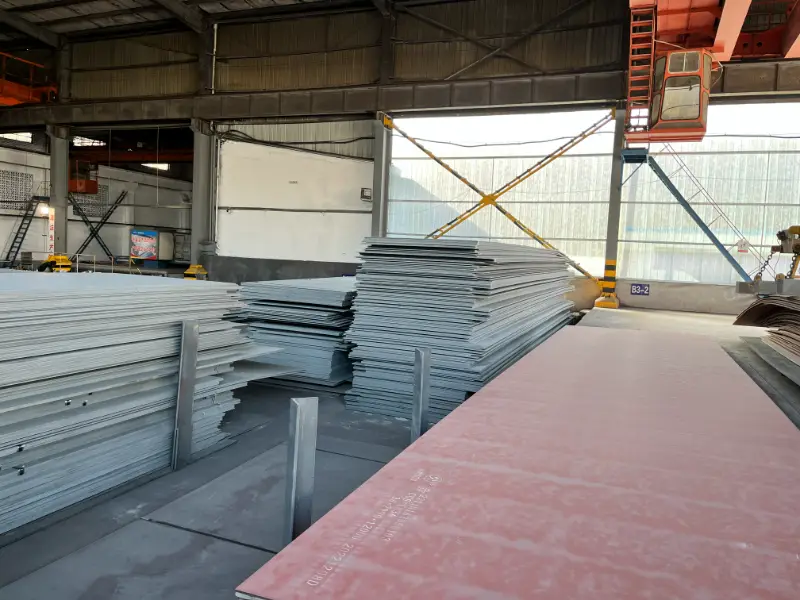
022Cr17Ni7 Stainless Steel to GB/T 4237
022Cr17Ni7 Stainless Steel to GB/T 4237 | Austenitic Plate & Coil | 301L Equivalent
Explore 022Cr17Ni7 stainless steel per GB/T 4237: an austenitic Cr-Ni grade with low carbon and controlled nitrogen, offering high strength, excellent formability, and good corrosion resistance for structural and transportation applications.
Hot rolling, cold rolling (subsequent), solution annealing, pickling, cutting, forming, welding, cold working for strength enhancement
- Phone : +8618037372205
- Email : [email protected]
- WhatsApp: Contact via Whtsapp
- WeChat: +8618037372205
022Cr17Ni7 Stainless Steel to GB/T 4237 Introduction
022Cr17Ni7 is an austenitic stainless steel specified in GB/T 4237 for hot-rolled plates and coils. It belongs to the Cr-Ni series with a chemical composition featuring low carbon (≤0.030%), moderate chromium (16-18%), nickel (6-8%), and intentional nitrogen addition (≤0.20%). This grade is the Chinese counterpart to the international 301L type, combining high work-hardening rate with improved weldability and intergranular corrosion resistance compared to standard 301. It is primarily supplied in solution-annealed condition, exhibiting a balanced set of mechanical properties: minimum tensile strength of 520 MPa, yield strength (Rp0.2) ≥205 MPa, and elongation ≥40%. The material is not intended for hardening by heat treatment but can be significantly strengthened by cold working. Its non-magnetic nature in the annealed state makes it suitable for applications requiring both strength and formability, such as railway vehicle bodies, structural components, conveyor belts, and springs. The grade is also noted for good cryogenic toughness and moderate resistance to atmospheric and chemical environments.
022Cr17Ni7 Stainless Steel to GB/T 4237 Chemical Composition
The chemical composition is in accordance with GB/T 4237-2015 for grade 022Cr17Ni7. This analysis represents the heat (ladle) analysis; product analysis may have slight permissible variations. The low carbon content enhances resistance to intergranular corrosion after welding, while nitrogen is intentionally added to stabilize the austenitic structure and increase strength.
| Element | Standard Value (wt%) | Remarks |
|---|---|---|
| Carbon (C) | ≤0.030 | Low carbon for improved welding and corrosion resistance |
| Silicon (Si) | ≤1.00 | Deoxidizer; excessive amounts may promote sigma phase |
| Manganese (Mn) | ≤2.00 | Austenite stabilizer, aids hot workability |
| Phosphorus (P) | ≤0.045 | Residual element; kept low to maintain toughness |
| Sulfur (S) | ≤0.030 | Residual element; controlled for machinability and weldability |
| Chromium (Cr) | 16.00 – 18.00 | Primary element for corrosion resistance |
| Nickel (Ni) | 6.00 – 8.00 | Austenite former, enhances ductility and toughness |
| Nitrogen (N) | ≤0.20 | Intentional addition to replace some nickel and increase strength |
022Cr17Ni7 Stainless Steel to GB/T 4237 Physical Properties
The physical properties presented are typical reference values for 301L-type austenitic stainless steel supplied according to GB/T 4237. Variations may occur due to processing history and exact composition. These data are not specified by the standard but are widely accepted for design and engineering calculations. Thermal and electrical properties are influenced by temperature; values at elevated temperatures are indicated where applicable.
| Property | Typical Value | Unit | Test Condition / Temperature |
|---|---|---|---|
| Density (ρ) | 7.93 | g/cm³ | 20°C |
| Modulus of Elasticity (E) | 193 | GPa | 20°C, tension |
| Shear Modulus (G) | 78 | GPa | 20°C, calculated |
| Poisson's Ratio (ν) | 0.30 | - | 20°C |
| Thermal Expansion Coefficient (α) | 16.6 | 10⁻⁶/K | 20–100°C |
| Thermal Expansion Coefficient (α) | 17.0 | 10⁻⁶/K | 20–200°C |
| Thermal Expansion Coefficient (α) | 17.5 | 10⁻⁶/K | 20–300°C |
| Thermal Conductivity (λ) | 15.0 | W/(m·K) | at 100°C |
| Thermal Conductivity (λ) | 21.5 | W/(m·K) | at 500°C |
| Specific Heat Capacity (cp) | 500 | J/(kg·K) | 20°C |
| Electrical Resistivity (ρe) | 0.72 | µΩ·m | 20°C |
| Melting Range | 1400–1455 | °C | - |
022Cr17Ni7 Stainless Steel to GB/T 4237 Mechanical Properties
The mechanical properties specified are minimum values for hot-rolled plates and coils in the solution-annealed state as delivered per GB/T 4237-2015, Table 18. Testing is performed at room temperature on samples taken transverse to the rolling direction. The elongation requirement applies to thicknesses ≥0.5 mm. Hardness values are optional and are measured only when agreed upon by the purchaser. These values reflect the material's balanced combination of strength and ductility.
| Property | Standard Requirement (min/max) | Unit | Test Condition |
|---|---|---|---|
| Tensile strength (Rm) | ≥520 | MPa | Room temperature, transverse specimen |
| Yield strength (Rp0.2) | ≥205 | MPa | Room temperature, 0.2% proof stress |
| Elongation (A) | ≥40 | % | Gauge length 50 mm (or 80 mm), thickness ≥0.5 mm |
| Brinell hardness (HBW) | ≤187 | - | Optional, for reference only |
| Rockwell hardness (HRB) | ≤90 | - | Optional, for reference only |
| Vickers hardness (HV) | ≤200 | - | Optional, for reference only |
022Cr17Ni7 Stainless Steel to GB/T 4237 Completely Equivalent Material Standards and Substitutable Grades
| Country/Region | Standard | Designation/Grade | Remarks |
|---|---|---|---|
| China | GB/T 4237 | 022Cr17Ni7 | Hot-rolled plate and coil; identical chemical and mechanical requirements |
| USA | ASTM A240/A240M | UNS S30103 (Type 301L) | Low-carbon variant of 301; similar composition but may have slight differences in allowed ranges |
| European Union | EN 10088-2 | 1.4318 (X2CrNiN18-7) | Closely matches C, Cr, Ni, and intentional N addition; considered a functional equivalent |
| Japan | JIS G4304 | SUS301L | Low-carbon 301 with controlled N; mechanical properties may vary with thickness but equivalent in overall grade intention |
022Cr17Ni7 Stainless Steel to GB/T 4237 Application Introduction
022Cr17Ni7 is engineered for applications where a combination of high strength, good ductility, and moderate corrosion resistance is required. Its controlled nitrogen content and low carbon make it especially suitable for welded structures that undergo forming operations. It cannot be hardened by heat treatment but can be significantly strengthened by cold working, similar to 301. Typical uses span transportation, industrial equipment, and consumer products.
Product Applications: Railway passenger car bodies, underframes, and corrugated panels, Automotive wheel covers, trim, and structural reinforcements, Conveyor belts and chains for food and chemical industries, Spring washers, flat springs, and hose clamps, Architectural cladding panels and curtain walls, Pressure vessel shells requiring moderate corrosion protection
Processed into products: Rolled and welded structural frames, Formed brackets and stiffeners, Deep-drawn kitchen sinks and bowls, Stamped safety diaphragms, Flexible metal hoses and bellows, Cold-headed bolts, screws, and rivets
Application industries: Railway and mass transit, Automotive and transportation, Food processing and kitchen equipment, Architecture and construction, General engineering and manufacturing, Medical orthopedics (when biocompatibility is acceptable)
022Cr17Ni7 Stainless Steel to GB/T 4237 Similar/Comparable Substitute Materials
| Country/Region | Standard | Designation/Grade | Remarks |
|---|---|---|---|
| China | GB/T 4237 | 12Cr17Ni7 (old 1Cr17Ni7) | Standard 301 grade with higher carbon (≤0.15%), lower weldability; suitable when higher strength after cold working is needed |
| China | GB/T 4237 | 022Cr19Ni10 (304L) | Higher chromium and nickel (18-20%, 8-12%), lower strength but superior corrosion resistance; easily formable |
| USA | ASTM A240/A240M | S30100 (Type 301) | Higher carbon (≤0.15%); used for springs and high-strength parts but susceptible to intergranular attack after welding |
| European Union | EN 10088-2 | 1.4310 (X10CrNi18-8) | Standard 301 with higher carbon; work-hardens rapidly; used for springs and fasteners |
Notes:
- Heat treatment for solution annealing is typically performed at 1010–1120°C with rapid air or water quenching to ensure full carbide dissolution and optimal corrosion resistance.
- Cold working can raise tensile strength to over 1000 MPa (e.g., 1/4 hard, 1/2 hard, full hard tempers are achievable but are covered by other standards such as GB/T 3280 for cold-rolled strip).
- Welding methods: All common fusion welding processes are applicable (TIG, MIG, resistance welding); pre-heat and post-weld heat treatment are not required for this low-carbon grade, but pickling and passivation after welding are recommended.
- Magnetic properties: The material is non-magnetic in the solution-annealed condition; cold deformation can induce slight magnetism.
- Corrosion resistance: Performs well in atmospheric, fresh water, and mild chemical environments; not recommended for chloride-rich environments where pitting corrosion may occur.
- The data provided are based on GB/T 4237-2015 and typical physical properties; always verify requirements with the supplier for critical applications.
- Share



