
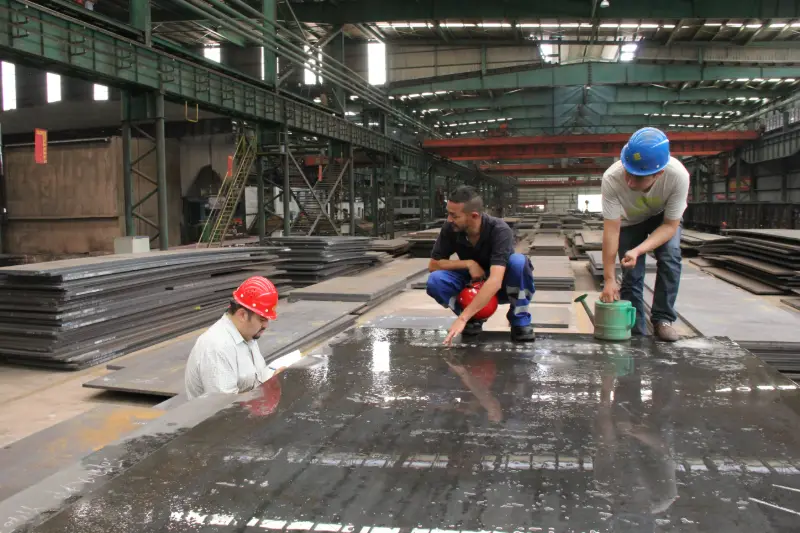
019Cr19Mo2NbTi (00Cr18Mo2) Ferritic Stainless Steel
019Cr19Mo2NbTi (00Cr18Mo2) Ferritic Stainless Steel - GB/T 4237 Properties and Equivalents
Comprehensive material data for 019Cr19Mo2NbTi (formerly 00Cr18Mo2) ferritic stainless steel plate/coil according to GB/T 4237. Includes chemical composition, mechanical and physical properties, international equivalents, and application guidance.
Cutting, bending, stamping, deep drawing, welding, cold forming
- Phone : +8618037372205
- Email : [email protected]
- WhatsApp: Contact via Whtsapp
- WeChat: +8618037372205
019Cr19Mo2NbTi Ferritic Stainless Steel Introduction
019Cr19Mo2NbTi (formerly designated 00Cr18Mo2) is a low-carbon ferritic stainless steel stabilized with titanium and niobium. It is specified in GB/T 4237 for hot-rolled stainless steel plates and coils. The alloy delivers a combination of good corrosion resistance, particularly to pitting and stress corrosion cracking, and excellent formability/weldability.
- Ultra-low carbon content prevents sensitization and intergranular corrosion.
- Molybdenum addition improves resistance to chloride-induced pitting.
- Ti+Nb stabilization enhances weld zone properties and high-temperature strength.
- Comparable to UNS S44400 and EN 1.4521.
Applications include hot water tanks, solar water heaters, heat exchangers, and water treatment equipment.
019Cr19Mo2NbTi Ferritic Stainless Steel Chemical Composition
The chemical composition of 019Cr19Mo2NbTi as specified in GB/T 4237-2015 (referencing GB/T 20878). The steel is characterized by very low carbon (≤0.025%) to resist intergranular corrosion. Molybdenum provides pitting resistance. Titanium and niobium are added in combination to stabilize the structure and prevent chromium carbide precipitation during welding. Nitrogen is kept low to avoid embrittlement.
- Single values are maxima unless a range is given.
- Ti+Nb content is calculated from the formula 0.20+4(C+N) as a minimum, up to 0.80%.
| Element | Value (%) | Remarks |
|---|---|---|
| Carbon (C) | ≤0.025 | Max |
| Silicon (Si) | ≤1.00 | Max |
| Manganese (Mn) | ≤1.00 | Max |
| Phosphorus (P) | ≤0.040 | Max |
| Sulfur (S) | ≤0.030 | Max |
| Chromium (Cr) | 17.50 – 19.50 | |
| Molybdenum (Mo) | 1.75 – 2.50 | |
| Nickel (Ni) | ≤0.60 | Max, specified in GB/T 20878 |
| Nitrogen (N) | ≤0.035 | Max |
| Titanium + Niobium (Ti+Nb) | 0.20+4(C+N) to 0.80 | Stabilization addition |
019Cr19Mo2NbTi Ferritic Stainless Steel Thermal and Electrical Physical Properties
The following data are typical values for 019Cr19Mo2NbTi ferritic stainless steel in the annealed condition, compiled from stainless steel handbooks and engineering databases. They are not mandatory requirements of GB/T 4237 but are widely used for design calculations.
- Density, elastic modulus, and thermal expansion are at room temperature unless noted.
- Thermal conductivity and specific heat capacity vary with temperature; multiple points are given.
- Electrical resistivity is typical for this alloy class.
| Property | Typical Value | Unit | Test Condition / Temperature |
|---|---|---|---|
| Density (ρ) | 7.75 | g/cm³ | 20 °C |
| Modulus of Elasticity (E) | 200 | GPa | 20 °C |
| Shear Modulus (G) | 77 | GPa | 20 °C |
| Poisson's Ratio (ν) | 0.28 | 20 °C | |
| Thermal Expansion Coeff. (α) | 10.5 | 10⁻⁶/K | 20–100 °C |
| Thermal Expansion Coeff. (α) | 11.0 | 10⁻⁶/K | 20–300 °C |
| Thermal Expansion Coeff. (α) | 11.5 | 10⁻⁶/K | 20–500 °C |
| Thermal Conductivity (λ) | 25 | W/(m·K) | 20 °C |
| Thermal Conductivity (λ) | 26 | W/(m·K) | 100 °C |
| Thermal Conductivity (λ) | 28 | W/(m·K) | 500 °C |
| Specific Heat Capacity (c) | 460 | J/(kg·K) | 20 °C |
| Electrical Resistivity (ρ_e) | 0.60 | µΩ·m | 20 °C |
019Cr19Mo2NbTi Ferritic Stainless Steel Mechanical Properties
Mechanical properties apply to the solution-annealed condition as per GB/T 4237-2015. Tests are performed on longitudinal or transverse specimens at room temperature.
- Thickness ≤ 8 mm: tensile test with gauge length of 50 mm (A50).
- Thickness > 8 mm: elongation values may be agreed between supplier and purchaser.
- Bending test uses a mandrel diameter of 2a for thickness ≤ 8 mm (180° bend).
- Hardness values are for reference; HBW or HRB/HV can be specified by agreement.
Impact toughness is not normally required for ferritic stainless steel plates, but can be tested if specified.
| Property | Required Value | Unit | Test Condition / Remarks |
|---|---|---|---|
| Yield Strength (Rp0.2) | ≥245 | MPa | Transverse, room temperature |
| Tensile Strength (Rm) | ≥410 | MPa | Transverse, room temperature |
| Elongation (A) | ≥20 | % | Thickness ≤ 8 mm, GL = 50 mm |
| Bending Test | Bend angle 180°, d=2a | Thickness ≤ 8 mm; no cracks after bending | |
| Hardness (HBW) | ≤230 | HBW | For reference; alternative scale by agreement |
019Cr19Mo2NbTi Ferritic Stainless Steel Completely Equivalent Material Standards and Substitute Grades
| Country / Region | Standard | Grade | Remarks |
|---|---|---|---|
| USA | ASTM A240/A240M | UNS S44400 | Identical chemistry concept; dual-stabilized (Ti+Nb) ferritic with 18%Cr–2%Mo. Typical thicknesses included. |
| EU | EN 10088-2 | 1.4521 (X2CrMoTi18-2) | Closest European equivalent; minor Ni limit difference (≤0.5%) |
| Japan | JIS G4304 | SUS444 | JIS version of 18Cr–2Mo–Ti/Nb ferritic stainless; mechanical properties comparable. |
019Cr19Mo2NbTi Ferritic Stainless Steel Application Introduction
019Cr19Mo2NbTi is selected for its superior resistance to pitting and stress corrosion cracking in chloride-containing environments, combined with good formability and weldability. It is a cost-effective alternative to 304/316 austenitic grades in many non-magnetic applications.
- Typical operating temperature range: -40 °C to 400 °C.
- Excellent for welded structures without post-weld heat treatment when proper shielding gas is used.
- Not suitable for highly reducing acids or high-temperature scaling service above 500 °C.
Product Applications: Hot water storage tanks, Solar collector panels and absorber plates, Heat exchanger tube sheets and baffles, Condenser shells, Water treatment vessels and piping, Food-grade processing equipment
Processed into products: Tank heads and cylindrical shells (press-formed or rolled), Flanges and bolted connections, Bends, tees, and reducers (welded fabrication), Impellers and pump casings (for fresh water), Support brackets and structural parts in corrosive atmospheres, Deep-drawn sink bowls and catering trays
Application industries: Solar thermal and water heating, Potable water treatment and distribution, Food and beverage processing, Chemical processing (moderate corrosive environments), Heat exchanger manufacturing, Automotive exhaust components (rear sections)
019Cr19Mo2NbTi Ferritic Stainless Steel Similar / Near-Equivalent Alternative Materials
| Country / Region | Standard | Grade | Remarks |
|---|---|---|---|
| China | GB/T 4237 | 019Cr18MoTi (S11863) | Similar 18Cr–Mo ferritic grade with Ti only; lower cost but less high-temperature stability. |
| China | GB/T 3280 | 019Cr19Mo2NbTi (S11972) | Cold-rolled sheet/strip version; same composition, used for thinner gauges. |
| USA | ASTM A240 | Type 444 (S44400) variant | Earlier versions with only Ti or only Nb also exist, but Ti+Nb dual stabilization is preferred for welding. |
| EU | EN 10088-2 | 1.4509 (X2CrTiNb18) | Ti+Nb stabilized 18%Cr ferritic without Mo; lower corrosion resistance but similar weldability. |
Notes:
Welding: Use low heat input and filler metals of matching composition (e.g., ER444 wire) or over-alloyed austenitic fillers (ER309L) for dissimilar joints. Post-weld cleaning: Pickle and passivate to restore corrosion resistance. Magnetic properties: Ferritic, high magnetic permeability – useful for induction-compatible equipment. Dual certification: Often supplied meeting both GB/T 4237 and equivalent foreign standards (ASTM/EN) to facilitate global trade.
- Share



