
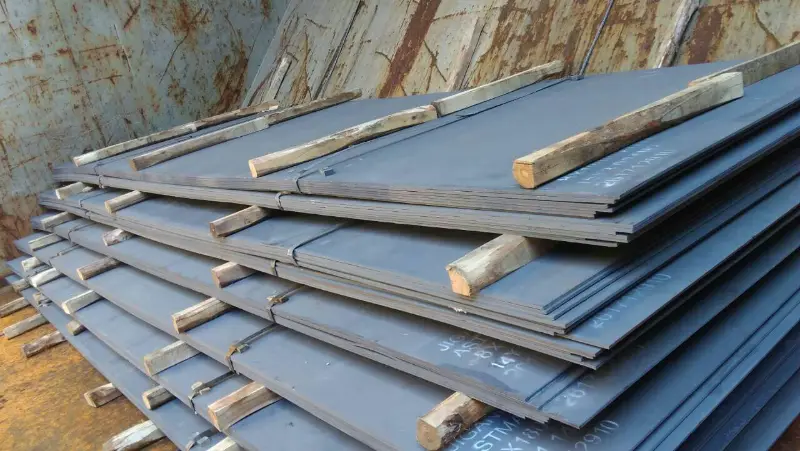
008Cr27Mo (00Cr27Mo) Ferritic Stainless Steel
008Cr27Mo (00Cr27Mo) Ferritic Stainless Steel: Ultra-Low Interstitial High-Chromium Alloy with Superior Corrosion Resistance
Explore the properties and applications of 008Cr27Mo (00Cr27Mo) ferritic stainless steel, a high-chromium grade with excellent resistance to chloride stress corrosion cracking, pitting, and crevice corrosion in aggressive environments.
Hot rolling, cold rolling, welding, forming, machining
- Phone : +8618037372205
- Email : [email protected]
- WhatsApp: Contact via Whtsapp
- WeChat: +8618037372205
008Cr27Mo Ferritic Stainless Steel Introduction
008Cr27Mo, formerly designated 00Cr27Mo, is an ultra-low interstitial (ULI) ferritic stainless steel specified in GB/T 4237 for hot-rolled plates and coils. It combines 26-28% chromium and 0.75-1.50% molybdenum with extremely low carbon and nitrogen levels, resulting in exceptional resistance to pitting, crevice corrosion, and stress corrosion cracking in chloride-containing media. The alloy remains ferritic at all temperatures, offering high thermal conductivity, low thermal expansion, and good resistance to oxidation. Its fabrication is facilitated by the absence of nickel, providing a cost-effective alternative to duplex and super-austenitic stainless steels in many chemical processing, marine, and heat transfer applications. Typical delivery condition is solution annealed.
008Cr27Mo Ferritic Stainless Steel Chemical Composition
Chemical composition limits according to GB/T 4237 for 008Cr27Mo. Ultra-low carbon and nitrogen contents ensure maximum intergranular corrosion resistance and ductility without the need for stabilization by titanium or niobium.
| Element | Standard Value | Remarks |
|---|---|---|
| Carbon (C) | ≤0.010 | Ultra-low carbon for improved corrosion resistance and toughness |
| Silicon (Si) | ≤1.00 | - |
| Manganese (Mn) | ≤1.00 | - |
| Phosphorus (P) | ≤0.030 | - |
| Sulfur (S) | ≤0.020 | - |
| Chromium (Cr) | 25.00 - 27.50 | Key element for corrosion and oxidation resistance |
| Molybdenum (Mo) | 0.75 - 1.50 | Enhances pitting and crevice corrosion resistance |
| Nickel (Ni) | ≤0.50 | Low nickel content ensures ferritic structure |
| Copper (Cu) | ≤0.20 | - |
| Nitrogen (N) | ≤0.015 | Extremely low nitrogen to prevent sensitization |
| Iron (Fe) | Balance | - |
008Cr27Mo Ferritic Stainless Steel Thermal and Electrical Physical Properties
Typical physical property data for 008Cr27Mo ferritic stainless steel in the annealed condition. These values aid in design and engineering calculations involving heat transfer and thermal loading. Thermal conductivity is higher than that of austenitic stainless steels, while thermal expansion is lower.
| Property | Standard Requirement Value | Unit | Test Condition |
|---|---|---|---|
| Density (ρ) | 7.67 | g/cm³ | 20°C |
| Modulus of Elasticity (E) | 200 | GPa | 20°C |
| Shear Modulus (G) | 76 | GPa | 20°C (calculated) |
| Poisson's Ratio (ν) | 0.28 | - | 20°C (typical for ferritic steels) |
| Coefficient of Thermal Expansion (α) | 10.5 | 10⁻⁶/K | 20 - 100°C |
| Coefficient of Thermal Expansion (α) | 11.0 | 10⁻⁶/K | 20 - 200°C |
| Coefficient of Thermal Expansion (α) | 11.5 | 10⁻⁶/K | 20 - 400°C |
| Thermal Conductivity (λ) | 24.0 | W/m·K | 100°C |
| Thermal Conductivity (λ) | 25.5 | W/m·K | 200°C |
| Thermal Conductivity (λ) | 27.0 | W/m·K | 400°C |
| Specific Heat Capacity | 460 | J/kg·K | 20°C |
| Electrical Resistivity (ρ_e) | 0.76 | µΩ·m | 20°C |
008Cr27Mo Ferritic Stainless Steel Mechanical Properties
Mechanical properties for annealed plate/coil according to GB/T 4237. Both transverse and longitudinal specimens may be used; values are minimum unless otherwise noted. Dimensional thickness affects elongation requirements. Tensile testing is performed according to GB/T 228.1.
| Property | Standard Requirement Value | Unit | Test Condition |
|---|---|---|---|
| Yield Strength (Rp0.2) | ≥245 | MPa | Room temperature, annealed |
| Tensile Strength (Rm) | 450 - 650 | MPa | Room temperature, annealed |
| Elongation after Fracture (A) | ≥20 | % | Gauge length 50 mm, thickness ≤ 3 mm |
| Elongation after Fracture (A) | ≥18 | % | Gauge length 50 mm, thickness > 3 mm |
| Hardness | ≤219 | HBW | Brinell hardness, annealed |
| Hardness | ≤95 | HRB | Rockwell B hardness, annealed |
| Bend Test (Bend Radius / Thickness) | ≤1×t | - | 180° bend test, annealed strip/plate |
008Cr27Mo Ferritic Stainless Steel Fully Equivalent Material Standards and Substitutable Grades
| Country/Region | Standard | Grade | Remarks |
|---|---|---|---|
| USA | ASTM A240/A240M | UNS S44627 | Composition and typical mechanical properties match; plate, sheet, strip. |
| Japan | JIS G4304 | SUS XM27 | Hot-rolled stainless steel plate, equivalent chemistry and similar mechanicals. |
| International | ISO 15510 | X1CrMo26-1 | Chemical composition closely aligned; may be ordered to ISO standards. |
| China (alternative) | GB/T 3280 | 008Cr27Mo | Cold-rolled stainless steel plate, sheet and strip; same chemistry, slightly different thickness range. |
008Cr27Mo Ferritic Stainless Steel Application Introduction
Due to its exceptional resistance to chloride-induced stress corrosion cracking, pitting, and crevice corrosion, 008Cr27Mo is extensively used in aggressive environments where conventional austenitic stainless steels (e.g., 304/316) fail. Its high thermal conductivity and low thermal expansion make it ideal for heat transfer applications. The alloy is cost-effective as it contains little to no nickel. Typical applications include:
Product Applications: Hot-rolled plates and coils for pressure vessels and structural components, Cold-rolled sheets and strips for fabricated parts, Welded and seamless tubing for heat exchangers and condensers, Clad plates and explosive-bonded composite panels
Processed into products: Shell-and-tube heat exchanger tubes and tube sheets, Seawater cooling water pipes and bends, Desalination plant flash chambers, Chemical storage tank shells and bottoms, Sea-water cooled condensers in power plants, Scrubber components in Flue Gas Desulfurization (FGD) systems, Architectural panels and roofing in marine atmospheres
Application industries: Chemical and petrochemical processing (acid coolers, piping, and heat exchangers), Desalination and water treatment (evaporator shells, brine heaters), Marine engineering and offshore platforms (seawater piping, fasteners, and structural components), Power generation (condenser tubing, feedwater heaters), Food and beverage industry (sanitary tubing, storage tanks for aggressive products), Architecture (aggressive coastal environments)
008Cr27Mo Ferritic Stainless Steel Recommendations for Similar or Alternative Materials
| Country/Region | Standard | Grade | Remarks |
|---|---|---|---|
| USA | ASTM A240 | UNS S44600 | 26Cr-1Mo ferritic grade; slightly lower Mo content, similar corrosion resistance but may be less resistant in some aggressive chloride environments. |
| Europe | EN 10088-2 | 1.4521 (X2CrMoTi18-2) | 18Cr-2Mo stabilized ferritic; lower Cr, but widely used as a cost-effective substitute in less severe conditions. |
| USA | ASTM A240 | UNS S44400 | 18Cr-2Mo-Ti ferritic; excellent chloride SCC resistance, but lower general corrosion resistance compared to 008Cr27Mo. |
| Japan | JIS G4304 | SUS 447J1 | 30Cr-2Mo ferritic; higher chromium for enhanced corrosion resistance but less common in plate form. |
| International | ISO 15510 | X1CrNiMoN25-22-2 | Austenitic with similar PRE; can be used as a substitute where toughness or formability is critical, but more expensive. |
Notes:
Welding of 008Cr27Mo requires low heat input and thorough shielding to preserve corrosion resistance; matching filler metals (e.g., ER44627) are recommended. Because the alloy is fully ferritic, it may exhibit 475°C embrittlement after prolonged exposure in the range 300-550°C; thus, service temperatures above 300°C should be carefully evaluated. Post-weld heat treatment is not typically required, but a solution anneal may restore properties if needed. For demanding forming operations, consider that ductility is lower than in austenitic grades, and cold forming should be followed by a re-anneal if critical corrosion resistance is desired.
- Share



