
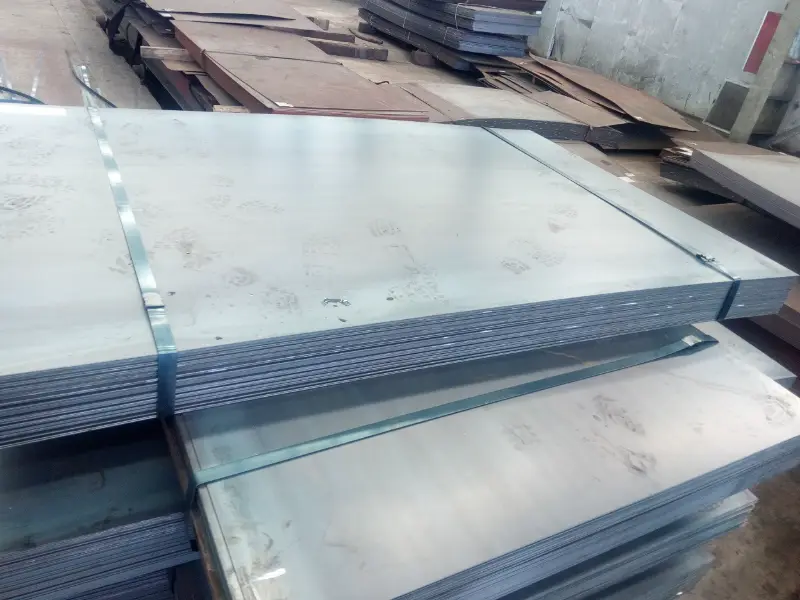
XM-27 (S44627) Ferritic Stainless Steel
XM-27 (S44627) Ferritic Stainless Steel: High Purity E-Brite 26‑1 for Superior Corrosion Resistance
Explore XM‑27 (UNS S44627) ferritic stainless steel: chemical composition per ASTM A240, mechanical properties, thermal and electrical physical data, equivalent grades, and applications in chemical processing, food industry, and heat exchangers.
Hot rolling, cold rolling, annealing, pickling, forming, welding
- Phone : +8618037372205
- Email : [email protected]
- WhatsApp: Contact via Whtsapp
- WeChat: +8618037372205
XM-27 Ferritic Stainless Steel Introduction
XM‑27, designated as UNS S44627 and commonly known as E‑Brite 26‑1, is a high‑purity, low‑interstitial ferritic stainless steel. It contains approximately 26% chromium and 1% molybdenum, offering excellent resistance to chloride stress‑corrosion cracking, pitting, and crevice corrosion in oxidizing environments. The extremely low carbon and nitrogen levels combined with niobium and titanium stabilization prevent intergranular corrosion after welding. This grade exhibits good ductility and toughness in thin sections, and its thermal expansion coefficient is lower than that of austenitic grades, making it suitable for heat exchanger applications. It is supplied as plate, sheet, and coil under ASTM A240 / A240M.
XM-27 Ferritic Stainless Steel Chemical Composition per ASTM A240/A240M for S44627
The composition of XM‑27 is tightly controlled to maintain ferritic structure and corrosion resistance. Carbon and nitrogen are held to extremely low levels (<0.015 %) to avoid sensitization and to ensure ductility. Niobium and titanium serve as stabilizers, tying up remaining carbon and nitrogen.
- Cr (25.0–27.5 %) provides excellent oxidation and corrosion resistance.
- Mo (0.75–1.50 %) enhances pitting and crevice corrosion resistance in chloride environments.
- Low Ni (max 0.50 %) maintains ferritic structure and helps resistance to stress‑corrosion cracking.
| Chemical Element | Standard Value (wt.%) | Remarks |
|---|---|---|
| Carbon (C) | 0.010 max | Low carbon to prevent sensitization |
| Manganese (Mn) | 0.40 max | Deoxidizer, residual control |
| Phosphorus (P) | 0.020 max | Residual impurity |
| Sulfur (S) | 0.020 max | Residual impurity, improves machinability minimally |
| Silicon (Si) | 0.40 max | Deoxidizer, residual control |
| Chromium (Cr) | 25.0 – 27.5 | Primary corrosion resistance element |
| Nickel (Ni) | 0.50 max | Low Ni for ferritic structure |
| Molybdenum (Mo) | 0.75 – 1.50 | Improves pitting resistance (PREN) |
| Nitrogen (N) | 0.015 max | Strictly limited to avoid embrittlement |
| Copper (Cu) | 0.20 max | Residual from scrap |
| Niobium (Cb) + Titanium (Ti) | 0.20 – 1.00 | Stabilization elements; Ti+Cb ≥ 0.20 % |
XM-27 Ferritic Stainless Steel Thermal and Electrical Physical Properties
These physical properties are typical for XM-27 (S44627) ferritic stainless steel in the annealed condition. They are representative and may vary slightly depending on exact processing. Thermal expansion coefficient is lower than that of austenitic grades, beneficial for thermal cycling applications. Density is about 7.6 g/cm³. Electrical resistivity is moderate due to high chromium content.
| Property | Typical Value | Unit | Test Condition / Remarks |
|---|---|---|---|
| Density (ρ) | 7.6 | g/cm³ | At 20 °C |
| Elastic Modulus (E) | 200 | GPa | Room temperature |
| Shear Modulus (G) | 77 | GPa | Calculated from E and ν |
| Poisson's Ratio (ν) | 0.28 | – | Room temperature |
| Thermal Expansion Coefficient (α) | 10.4 | µm/m·°C | 20–100 °C |
| Thermal Expansion Coefficient (α) | 10.8 | µm/m·°C | 20–200 °C |
| Thermal Expansion Coefficient (α) | 11.2 | µm/m·°C | 20–300 °C |
| Thermal Conductivity (λ) | 21.0 | W/m·K | At 20 °C |
| Thermal Conductivity (λ) | 22.0 | W/m·K | At 100 °C |
| Specific Heat Capacity | 460 | J/kg·K | At 20 °C |
| Electrical Resistivity (ρ_e) | 0.69 | µΩ·m | At 20 °C |
XM-27 Ferritic Stainless Steel Mechanical Properties
Tensile properties are specified per ASTM A240 for annealed plate, sheet, and strip. The values apply to transverse or longitudinal test specimens as per product standard. Elongation is measured in 2 in. (50 mm) gauge length. Hardness is typically Rockwell B scale. Impact properties are not usually specified for this ferritic grade, but it exhibits good toughness in thin sections due to low interstitial content.
| Property | Standard Required Value | Unit | Test Condition / Remarks |
|---|---|---|---|
| Tensile Strength (Rm) | 450 min (65 min) | MPa (ksi) | Room temperature, transverse specimen |
| Yield Strength (ReH, 0.2 % offset) | 275 min (40 min) | MPa (ksi) | Room temperature, transverse specimen |
| Elongation (A) | 20 min | % | In 2 in. (50 mm) gauge length |
| Hardness | 90 max | HRB | Rockwell B scale, typical for annealed condition |
| Hardness | 200 max | HBW | Brinell hardness for information |
XM-27 Ferritic Stainless Steel Exact Equivalent Material Standards and Designations
XM-27 (UNS S44627) is a specific grade within ASTM A240. There is no identical EN or JIS grade, but the following international references point to the same alloy.
| Country/Region | Standard | Designation | Remarks |
|---|---|---|---|
| USA | ASTM A240/A240M | UNS S44627 (XM-27) | Primary designation |
| USA | ASME SA240 | UNS S44627 | Identical for pressure vessel applications |
| USA | ANSI/AWS A5.9 | ER44627 (filler metal) | Equivalent welding consumable |
| International | UNS | S44627 | Unified Numbering System |
XM-27 Ferritic Stainless Steel Application Introduction
XM-27 is selected for environments where chloride stress-corrosion cracking is a concern and where austenitic stainless steels (like 304/316) fail. Its low thermal expansion and high thermal conductivity make it ideal for heat exchanger tubing. The stabilized composition ensures good weldability without post-weld heat treatment in many cases.
Product Applications: Welded and seamless heat exchanger tubes, Condenser tubes for power plants, Plate heat exchangers, Storage tanks for corrosive chemicals, Brewery and dairy processing equipment, Thin-gauge strip for flexible connectors
Processed into products: Tube sheets and baffles, Expansion bellows, Filter housings, Spiral heat exchanger plates, Custom fabricated vessels, Sanitary tubing and fittings
Application industries: Chemical processing (tanks, reactors, piping), Food and beverage processing (evaporators, storage), Water treatment and desalination (reverse osmosis plants), Power generation (condenser tubes, air preheaters), Marine engineering (offshore platforms, seawater piping), Pharmaceutical and biotechnology (clean steam systems), Flue gas desulfurization (scrubber components)
XM-27 Ferritic Stainless Steel Similar / Alternative Materials for Consideration
The following grades offer similar corrosion resistance or are used in comparable applications, but may differ in composition or mechanical properties. They are not direct equivalents but can be considered as alternatives in certain environments.
| Country/Region | Standard | Designation | Remarks |
|---|---|---|---|
| USA | ASTM A240 | UNS S44600 (26-1Ti) | Higher carbon, lower purity; inferior toughness and weldability compared to S44627 |
| USA | ASTM A240 | UNS S44660 (Sea-Cure) | Higher Mo and Ni; better pitting resistance, used in seawater applications |
| Europe | EN 10088-2 | 1.4521 (X2CrMoTi18-2) | Lower Cr (18 %), leaner duplex-like; less corrosion resistance but lower cost |
| Japan | JIS G4304 | SUS447J1 | High Cr-Mo ferritic; excellent seawater corrosion resistance, similar to S44660 |
| USA | ASTM A240 | UNS S44700 (29-4) | Higher Cr and Mo; superior localized corrosion resistance, often used in desalination |
Notes:
- Welding should be performed with matching filler metal (ER44627) and low heat input to maintain toughness.
- Susceptible to 475 °C embrittlement after long-time exposure to temperatures 400–540 °C; avoid prolonged use in this range.
- Not recommended for service above ~350 °C due to potential sigma phase formation and loss of ductility.
- Surface preparation and passivation improve corrosion resistance in chloride environments.
- Share



